
By Christabel DANSO ABEAM
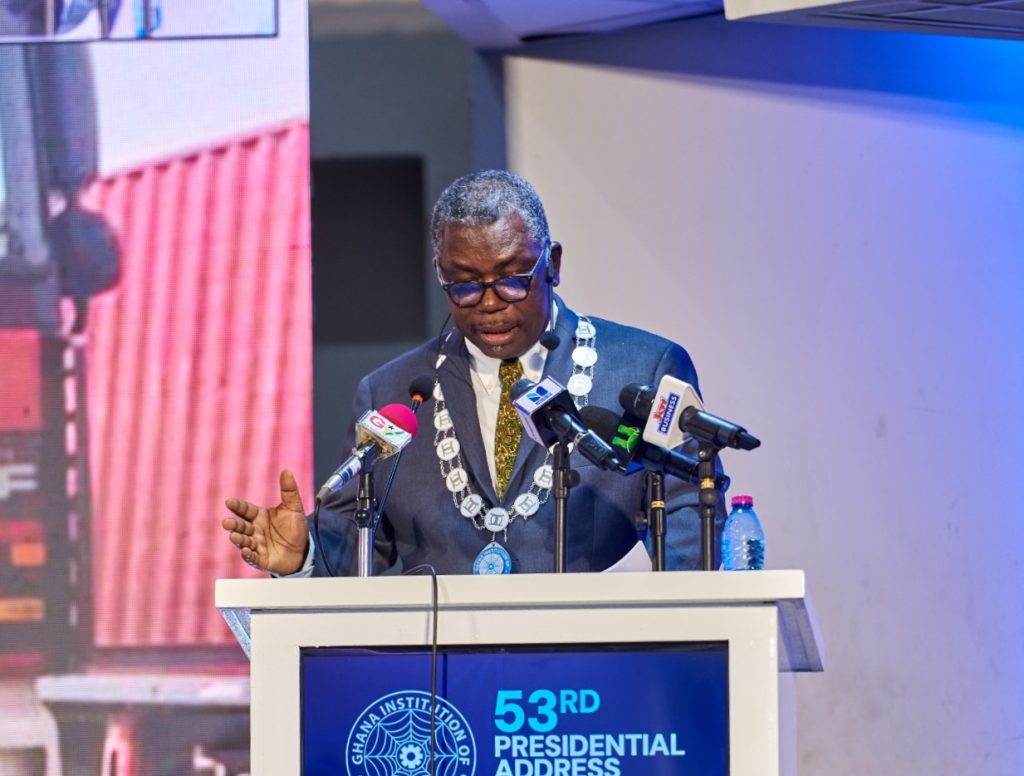
Ghana’s road sector is facing mounting scrutiny over procurement practices, as the President of the Ghana Institution of Engineering (GhIE), Ing. Ludwig Annang Hesse, in a speech at the institution’s 53rd Presidential Address in Accra, warned that excessive single-source and selective tendering is inflating costs, weakening transparency and deepening the sector’s financial crisis.
Instead of the usual open competitive tendering — a standard method under the Public Procurement Act, Ing. Hesse stressed that authorities are increasingly relying on special procurement methods that are meant only for emergencies or specialized projects.
“A practice which is supposed to be an exception is gradually becoming a common practice lately,” he lamented.
Bulk approvals raise red flags
Procurement in the country’s road construction sector is governed by the Public Procurement Act (Act 633 of 2003). It applies to all public institutions such as the Ministries, Departments and Agencies (MDAs) and Metropolitan, Municipal, District Assemblies (MMDAs), and all publicly funded projects.
However, the President says that large batches of road contracts are being submitted for selective tendering approval — a situation to him, undermines the spirit of competition.
With this concern, Ing. Hesse is requesting that at least 90 percent of all MDA and MMDA procurement should be done through an open competitive tendering.
He also suggested a monthly public disclosure of all single-source approvals, and publication of project names, values and justifications.
Again, he proposed that every single-source contract should go through the same financial review thresholds as competitive tenders — while urging that transparency in procurement is no longer optional since it plays a major role in fiscal stability.
Financial exposure unsustainable
The procurement debate comes amid severe financial stress in the road subsector. The President disclosed that as at December 2024, total road sector workload stood at approximately GH¢141 billion, outstanding payments amounted to GH¢31.1 billion and combined annual allocation was at about GH¢8.4 billion
At current funding levels, he estimated it could take over a decade to clear arrears and nearly two decades to complete already signed contracts.
Ing. Hesse is calling for a comprehensive review of all ongoing projects; reduction of project portfolio to match available resources; a structured settlement of outstanding contractor payments by the Ministry of Finance, and refocusing the Road Maintenance Trust Fund exclusively on maintenance.
“Continuing to award projects without sustainable financing strategies is fiscally dangerous,” he highlighted.
Beyond procurement, the President raised alarm over weak enforcement of axle load regulations.
He stressed that although engineers design roads based on a 13-ton axle load assumption, the legal limit remains 11.5 tons — and studies show between 19 percent and 54 percent of axles exceed legal limits on some roads.
The National Roads Authority (NRA) has been urged to modernise axle load enforcement; deploy weigh-in-motion systems; implement automated data collection platforms, and introduce compliance certification for heavy trucks leaving ports and industrial premises
“We cannot build strong roads while permitting systematic destruction,” he noted.
The event themed “Do it well, do it right – A focus on roads in Ghana” focused on strategies to enhance infrastructure quality, reinforce professional accountability, and promote value – for – money delivery across the road sector.
Increasing deaths on roads
On measures to reduce deaths on roads, Ign. Hesse suggested regular maintenance of road signs and markings on highways and safety measures for commercial motorcycle ‘Okada’ operations – while calling for the review of the NRA Act 2024 (Act 1118) to assist in the implementation of a system that separates policy from asset management and full devotion of the responsibility of Department of Feeder Roads, and the Department of Urban Roads.
Post Views: 26
Discover more from The Business & Financial Times
Subscribe to get the latest posts sent to your email.