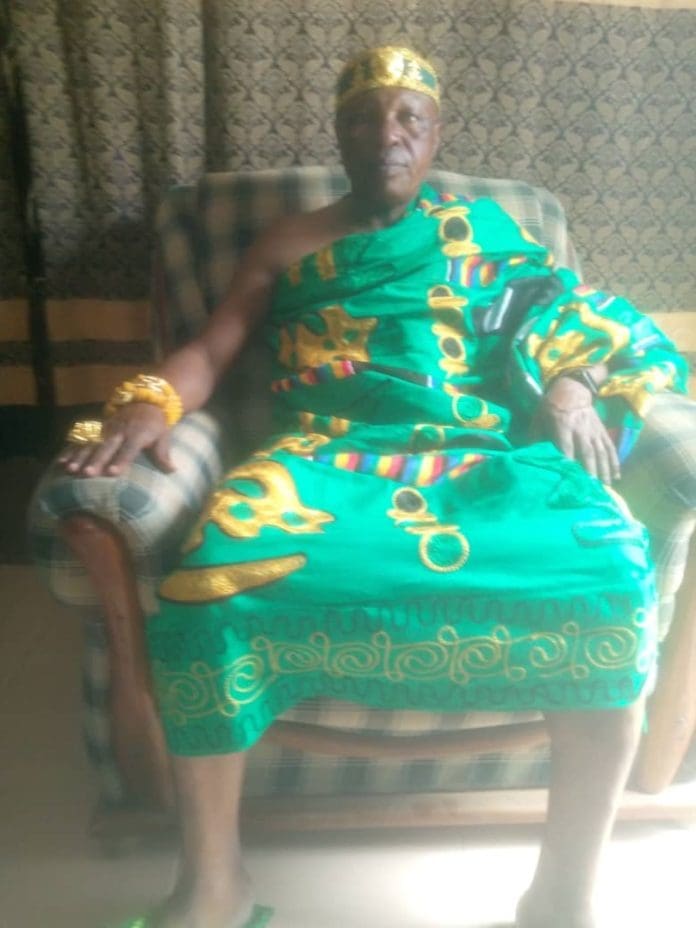

The Bankumhen of Agona Asafo in the Central Region, Nana Motto Katakyi Ababio Pemsan IX, and the head of the Royal Asona no. 1 Clan, Ebusuapanyin Yaw Fred Appiah, who is also the Chairman of the Akwambo Planning Committee, have appealed to Clan members, both home and abroad, to contribute to the expansion and renovation of the palace to befit the status that it deserves.
They appealed during the fortification of the royal Asona Stool as part of rituals to celebrate this year’s annual Akwambo festival of the town.
According to them, the construction of an ultra-modern storey palace has become necessary to accommodate the ever-increasing number of members of the Clan during such occasions.
The two leaders have therefore called for support from the members of the Clan, either in cash or in kind, to execute the project.
The Chief, Nana Motto Katakyi Ababio Pemsan, further advocated for the reintroduction of cultural practices and norms into the school curriculum, enabling the younger generation to appreciate their identity.
In a related development, the Guantuahen of the town, Nana Kwesi Tenkorang II, has also urged Ghanaians to demystify the perception created about cultural practices and norms that it is a fetish, and advised people to participate in their various festivals.
He said culture identifies every particular group of people, and therefore refusing to participate in it means the loss of one’s identity. He made the admonition during the performance of traditional rituals to fortify the royal Aboradze Clan Stool as part of this year’s annual Akwambo festival celebration of the town.
Nana Kwesi Tenkorang II pointed out that the ritual is not only meant to remember their ancestors, but also to connect with them for their continuous protection.
According to him, culture is historic, and therefore must be protected and sustained for generations unborn.
About cultural practices in Ghana
Ghana is rich with vibrant cultural practices that reflect its diverse ethnic heritage. One widely recognized tradition is the naming ceremony, known locally as Outdooring.
Outdooring Ceremony: This is a special event held eight days after a child is born. The baby is formally introduced to the community and the ancestors. Elders give the child a name, often reflecting family lineage, day of birth, or aspirations. Water and alcohol may be placed on the baby’s tongue to symbolize truth and discernment. It is a festive occasion with drumming, dancing, and sharing of food—strengthening social ties.
Other notable practices include traditional festivals like Homowo, a Ga harvest festival; Aboakyer, an Effutu antelope hunt; Bakatue, a Fanti fishing festival; Akwasidae, an Ashanti ancestor veneration; and Kundum, an Ahanta harvest festival, with each region and ethnic group observing unique rituals and traditions to mark harvests, historical events, or religious customs.
On such occasions, Ghanaians exhibit unique greeting styles such as the Ghanaian handshake with a finger snap, and food-sharing etiquette, where saying, “You are invited,” is a polite gesture even if not meant literally.