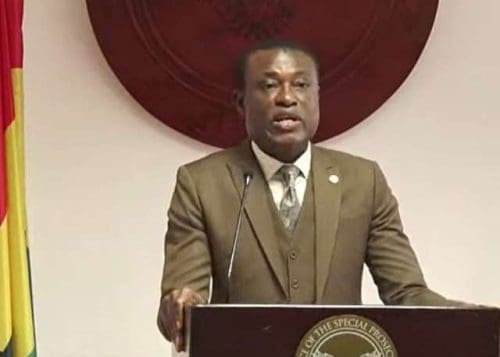

Ghana’s Office of the Special Prosecutor confronts mounting pressure as ten separate petitions seek the removal of Special Prosecutor Kissi Agyebeng, while critics including the International Monetary Fund question whether taxpayers receive adequate value for resources allocated to the anti corruption agency.
The presidency has forwarded all ten petitions to Chief Justice Paul Baffoe Bonnie for review, government spokesperson Felix Kwakye Ofosu confirmed last week. Under the Office of the Special Prosecutor Act of 2017, removal petitions must follow formal procedures involving independent investigation before action can be taken.
Parliament approved 146.75 million cedis for the Office of the Special Prosecutor (OSP) in the 2025 budget, with 71.75 million cedis designated for employee compensation covering 249 staff members. This translates to an average monthly cost of approximately 23,075 cedis per employee, an amount that in some cases exceeds the annual salary of certain public sector workers.
Despite substantial investment, governance analysts argue the office’s output fails to match its resource allocation, deepening concerns over taxpayer value. The agency received over 95 percent of its 149 million cedi approved budget in 2024, yet critics contend it has not achieved a major high profile corruption conviction since its 2018 establishment.
A coalition led by Apostle Abraham Lincoln Larbi and private legal practitioner Martin Kpebu staged a protest in Accra on November 25, calling for Agyebeng’s removal over perceived failure to deliver on his mandate. The demonstration, themed “Agro Ne Fom,” culminated in a petition delivered to President John Mahama at the Jubilee House.
Kpebu revealed that fifteen separate petitions have been filed seeking the Special Prosecutor’s removal, suggesting deepening public dissatisfaction. He criticized claims made by Agyebeng regarding attempts to secure assistance from state institutions to arrest former finance minister Ken Ofori Atta, arguing they have been proven false.
“He claimed that before Ofori Atta travelled, he saw a letter the former minister wrote to both the outgoing chief of staff and the incoming chief of staff. How do you see such a letter?” Kpebu asked. He added that Agyebeng’s assertions about Immigration and National Security refusing help to arrest Ofori Atta turned out to be false.
The protest reflects growing impatience and skepticism over OSP effectiveness, coming alongside broader institutional critiques from bodies including the IMF, which highlighted structural weaknesses such as absence of formal charging policy and overlapping mandates with other anti corruption institutions.
An IMF Technical Assistance Report released in March 2024 raised serious concerns about Ghana’s anti corruption framework, warning that fragmentation, overlapping mandates, political interference, and chronic underfunding undermine effectiveness of key agencies, especially the OSP. The report described the system as “fragmented, overlapping and exposed to political influence.”
The Fund noted that lack of formal charging policy creates inconsistencies in prosecutorial decisions and weakens corruption case quality. Without clear systems to determine case readiness, decisions risk appearing arbitrary, with some cases potentially filed on incomplete evidence, contributing to weak court outcomes and undermining conviction rates.
The IMF report highlighted significant mandate overlap between the OSP and other anti corruption bodies, particularly the Commission on Human Rights and Administrative Justice (CHRAJ) and the Economic and Organised Crime Office (EOCO). This duplication creates confusion and legal uncertainty, blurring which institution should lead on particular corruption matters.
Parallel investigations result from the overlap, causing unnecessary expenditure and fragmented administrative processes that stretch limited public resources. The IMF called for clearly defined jurisdictions among CHRAJ, OSP, EOCO, and the Attorney General’s Department to improve efficiency.
The report emphasized that the Office of the President wields significant control over appointment and removal of anti corruption institution heads, including the OSP, which could compromise independence. Although the Special Prosecutor and Deputy require parliamentary approval, the IMF observed this safeguard remains weak since presidents historically enjoy majority parliamentary control.
Between 2016 and 2023, anti corruption institutions received only about 51 percent of approved budget allocations on average, the IMF found. Despite legal provisions stating these agencies should be independent, the Ministry of Finance retains significant control over their budgets and recruitment. Agencies cannot hire staff or make payments without ministry clearance.
The IMF recommended introducing a Charging Code for OSP prosecutors, a structured decision making guide used in countries like the United Kingdom to ensure consistency and improve conviction rates in corruption cases. The report recalled that the first Special Prosecutor’s 2020 resignation citing “executive interference” reflected deeper structural vulnerabilities.
Several legal experts have criticized Agyebeng’s performance. Lawyer Kweku Paintsil questioned the OSP’s frequent media briefings, saying they amount to conducting trials in public rather than in court. In 2023, an Accra High Court judge criticized the OSP for acting “as if it had appellate jurisdiction” over the court, describing the action as abuse of power.
Former Special Prosecutor Martin Amidu has called Agyebeng “unfit” for office, especially regarding comments on the Strategic Mobilisation Ghana Limited (SML) case. Amidu reportedly filed one petition in April 2024 alleging procurement breaches in vehicle purchases and misconduct involving judges, though Amidu later disputed reports about his petition’s authorship.
Chief Justice Gertrude Sackey Torkornoo previously dismissed a petition seeking Agyebeng’s removal in May 2024, citing insufficient grounds and evidence. That petition allegedly from Amidu lacked substantial factual and legal basis to warrant further investigation, sources revealed.
The OSP has expanded operations significantly since Agyebeng took office in 2021, growing from operating without permanent staff to employing 249 personnel by September 2023. The office retrofitted structures and extended facilities from a three bedroom house to a ten storey building.
Agyebeng has initiated several high profile investigations including cases involving the Electricity Company of Ghana, illegal mining, National Sports Authority, Ghana Water Company, Ghana Revenue Authority’s Customs Division, Airbus SE, Bank of Ghana, Ghana Police Service, and the estate of Kwadwo Owusu Afriyie.
In July 2025, the OSP charged seven individuals and three companies over an alleged 280 million cedi extortion and money laundering scheme involving the National Petroleum Authority. Accused persons include former NPA chief executive officer Mustapha Abdul Hamid and UPPF Coordinator Jacob Kwamina Amuah.
The office recovered over 1 million cedis investigating customs advance rulings and prevented payment of a Northern Development Authority contract exceeding 5 million cedis. It also uncovered ghost names on government payroll in the Northern Region, saving 34.25 million cedis in the 2024 financial year through prosecution of six individuals who entered guilty pleas.
In the Labianca case, the OSP recovered 1.07 million cedis representing revenue shortfall from unlawful customs advance ruling. The office investigated former Sanitation Minister Cecilia Dapaah in 2023, uncovering 590,000 dollars and 2.73 million cedis in cash at her residence before referring the case to EOCO for money laundering prosecution.
However, the OSP’s handling of the Ken Ofori Atta investigation drew particular criticism. Interpol removed Ofori Atta from its Red Notice website, reportedly due to compliance issues with the OSP’s request. Amidu stated the removal exposed incompetence in the office’s procedures for seeking international alerts.
The OSP filed charges against individuals in the SML case on November 18, 2025, which some observers described as belated and potentially camouflaging other issues. Critics allege the timing aimed to address mounting pressure over the office’s performance.
Deputy Presidential Spokesperson Shamima Muslim received the November 25 protest petition, reassuring Ghanaians that no citizen should feel intimidated when exercising constitutional rights. She emphasized the government’s commitment to upholding civil liberties, particularly freedom of expression.
A member of parliament recently captured growing sentiment by asking, “With all the money and staff allocated, what has the office delivered to Ghana in return?” The question encapsulates public and institutional concerns that prosecutorial performance has not reflected resource scale.
The petitions against Agyebeng focus on incompetence, abuse of office, procurement breaches, violations of citizens’ rights through arrests and detentions, breach of right to information, and improper personnel appointments. Petitioners want either complete office overhaul or dissolution, including removal of all staff.
The Chief Justice’s decision on petition merit will determine next steps in any removal process. Government officials confirmed that once petitions reach the Chief Justice, the president’s role ends beyond forwarding them, with everything resting on judicial review under Ghanaian law.
The OSP operates independently of executive control and traditional prosecutorial chains of command to ensure impartiality and avoid conflicts of interest. It investigates and prosecutes corruption cases in both public and private sectors, with mandates including asset recovery and prevention measures.
The office received funding from the European Union for cybersecurity laboratories, forensic facilities, and operational vehicles. It has improved citizen engagement through a functioning website, social media presence, and a toll free line for filing complaints, while publishing biannual statutory reports since 2022.
Ongoing trials in five cases across three regions remain at various stages. The OSP concluded its seven year investigation into Airbus SE regarding military transport aircraft sales to Ghana between 2009 and 2015, focusing on allegations involving former President John Mahama’s brother as an agent in a bribery scheme.
The IMF concluded that Ghana’s fight against corruption will remain ineffective unless roles, powers, and funding mechanisms of anti corruption agencies are clearly defined and protected from executive control. The report advised that future effectiveness requires clear responsibility division between the OSP, Attorney General, EOCO, police, and CHRAJ, reflected in corresponding budget allocations.
The mounting petitions, combined with international scrutiny and public protests, mark a critical juncture for Ghana’s premier anti corruption agency. Whether the office can address effectiveness concerns while maintaining independence from political pressure remains uncertain as the Chief Justice reviews removal requests.