
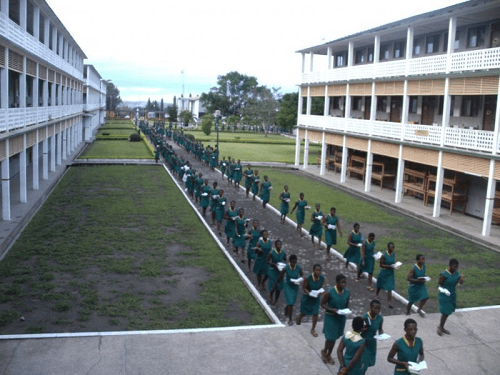

The Supreme Court has given the Board of Directors of Wesley Girls Senior High School 14 days to respond to allegations that the institution’s religious policies violate constitutional rights of Muslim students.
The seven member panel presided over by Justice Gabriel Pwamang delivered the directive on Tuesday, November 25, 2025, during proceedings in a case challenging what plaintiff Shafic Osman describes as discriminatory religious practices at the Cape Coast school.
Osman, a private legal practitioner and doctoral student in international law at the London School of Economics, filed the suit on December 24, 2024, under the Supreme Court’s original jurisdiction. He alleges that Wesley Girls Senior High School forces Muslim girls to attend Christian services and prevents them from practicing their religion.
The plaintiff contends that Muslim students are barred from wearing the hijab, fasting during Ramadan, and observing other Islamic rites. He argues these restrictions violate constitutional guarantees of freedom of religion, equality, and non discrimination under Articles 21(1)(b)(c) and 26 of the 1992 Constitution.
Justice Pwamang indicated that a formal response from the school’s board was necessary for the court to properly establish the factual issues before it. The panel stated the board needed to address these specific allegations if it wished to do so.
At the same sitting, the court granted Deputy Attorney General Dr Justice Srem Sai permission to file an amended statement of case on behalf of the Ministry of Education, replacing his earlier filing.
In the amended statement, Attorney General Dominic Ayine dismisses claims that Wesley Girls Senior High School is acting unlawfully. The government argues that the school, founded and operated by the Methodist Church of Ghana, is permitted to enforce rules consistent with its Methodist principles.
According to the Attorney General, the school’s faith based identity grants it authority to establish standards on religious conduct within the school environment, even where such standards limit the expression of other religious practices. The government maintains that Wesley Girls Senior High School is owned by the Methodist Church and not the state, giving it the right to practice its religion in line with the Methodist Christian faith.
The Supreme Court also granted Democracy Hub permission to file an address as a friend of the court in the case. The advocacy group will submit an amicus curiae brief offering additional perspectives on the constitutional questions raised.
Osman is seeking multiple declarations from the court, including a ruling that the school’s policy of compelling students to practice a compulsory school religion in a public institution contravenes the Constitution. He further contends that the restrictions conflict with international human rights standards recognized under Article 33(5).
In addition to the declarations, the plaintiff wants the court to direct the Ghana Education Service (GES) to develop constitutional guidelines to regulate religious practices across all public schools.
The case has sparked public debate about the balance between religious freedom and denominational school identity. Education advocate Kofi Asare questioned whether the school would collapse if it allowed Muslim students to observe Ramadan, noting that Presbyterian Boys Secondary School, another Christian institution, permits Muslim students to freely observe their faith practices.
Osman explained in an interview that his motivation for filing the suit stems from constitutional obligations to uphold religious freedom. He described the situation as one of religious non accommodation rather than outright discrimination, placing it on a spectrum of religious restrictions in mission schools.
The lawyer noted that he attended Presbyterian Boys Secondary School where Muslim students faced no restrictions on fasting or prayer, with designated prayer spaces available. However, he acknowledged that even PRESEC had a policy stating only Presbyterian students could be elected as head boy, which he suggested could also raise constitutional questions.
Osman emphasized that under Article 2(1) of the Constitution, every citizen has the right to challenge unconstitutional acts. He stated the case raises fundamental questions about whether public mission schools can compel students of diverse faiths to comply with particular religious practices.
The Supreme Court has directed Wesley Girls Senior High School, the Ghana Education Service, and the Attorney General to file their responses to the suit within the stipulated timeframe. The court is expected to hear substantive arguments after receiving these responses.