
What does it genuinely mean to develop the next generation of leaders, not in theory, but in practice, in communities under pressure and with limited resources? I keep returning to this question in my work.
In fact, it is a question that organizations, academics, and policymakers have wrestled with for decades. Harvard Business Review (HBR) has long argued that the urgency of leadership development has never been greater, noting that in today’s volatile, uncertain, complex, and ambiguous environment, the skills that helped institutions succeed in the past are no longer sufficient. The demand now is for something deeper. Human connection. Resilience. Adaptability. Imagination. Qualities that hold under uncertainty and cut across cultures.
In my humble view, here is what I think gets missed in much of that conversation. We tend to discuss leadership development as if it is primarily a question of curriculum design. We ask what young people should learn, what frameworks they need, which competencies to certify. What we discuss far less is the infrastructure of trust, the conditions under which young people, particularly from underrepresented communities, actually step into their own authority.
At the UN High-Level Meeting on the 30th Anniversary of the World Programme of Action for Youth in September 2025, speakers made clear that young people are too often shut out of decisions that shape their lives, despite being the very ones most affected by the crises their generation has inherited. Young people are not just beneficiaries of development. They are drivers of change. But the gap between that recognition and the structural conditions that make it real is enormous.
At UNGA80 that same month, a landmark moment occurred. For the first time in the UN’s history, youth were formally recognized as equal partners in shaping global priorities. Not relegated to side events, but speaking from the floor. Youth delegates delivered statements about 34 times at the plenary. As the World Economic Forum reported, it was a signal that inclusion leads to innovation. These are encouraging shifts. But institutions evolve slowly. The question for those of us working on the ground is: what do we do now, with the young leaders who are already in front of us?
HBR research on leading across cultures highlights that the most effective global leaders develop what researchers call “cultural intelligence”, a flexible lived fluency for adapting to complexity. But that kind of fluency is not required in a single workshop. It is built through sustained encounter, reflection, and crucially, through being accompanied by someone who believes in your potential before you fully believe in it yourself.
This conviction sits at the heart of some of the most important work being done in developing economies today. Stefan, whom I had the privilege of working with at enpact, holds firmly to the belief that mentorship is not a supplement to development programming. It is the programme. His work and leadership model rests on a simple yet radical premise. What social entrepreneurs and young leaders in emerging economies need most is not just a curriculum, but a relationship; someone experienced who walks with them, challenges them, and refuses to let them underestimate themselves.
It is a conviction worth taking seriously, and worth asking why it remains so underfunded and underbuilt across much of Africa in particular. The mentorship infrastructure that exists in Silicon Valley, in London, in Berlin; the density of experienced founders, investors, and development practitioners willing to give their time to the next generation, does not yet have an equivalent at scale on the continent of Africa. This is not a reflection of the talent that exists in Africa. It is a reflection of the investment that has not yet arrived. Reviving and institutionalizing mentorship in Africa, with the seriousness and resourcing it deserves, remains one of the most underdiscussed priorities in the leadership development space.
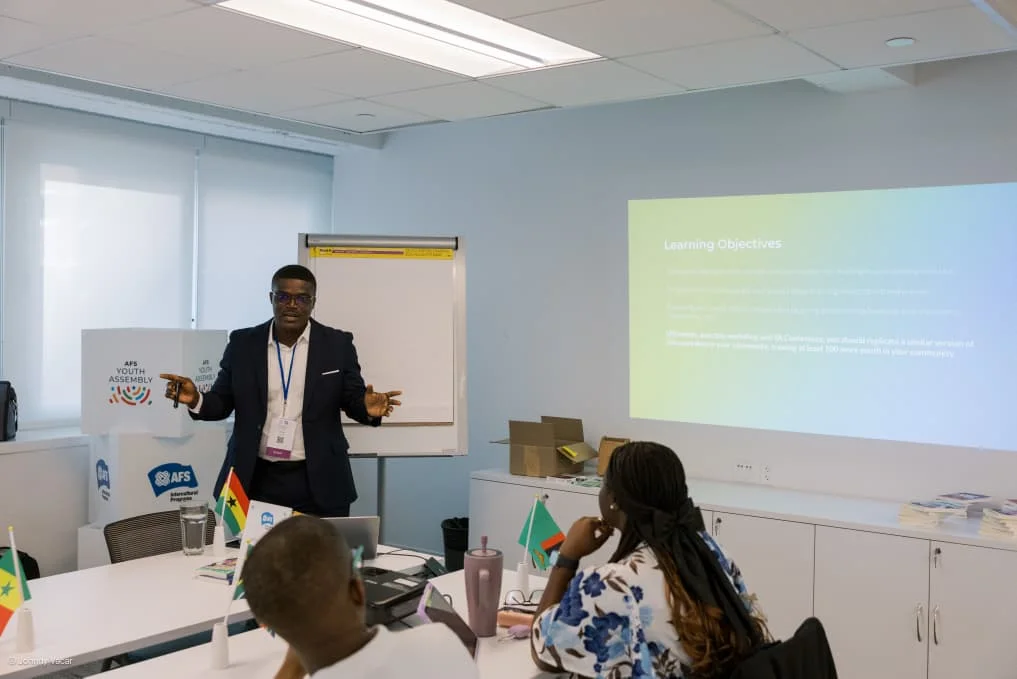
This is why the most effective youth leadership programs are the ones that build mentorship into their architecture. When young changemakers have someone consistently in their corner, someone who addresses not just their project metrics but their sense of self, something shifts. They begin to act not just as participants in someone else’s vision, but as originators of their own.
Read our annual Impact Report for context
One of the most meaningful recent developments in the field has been the move away from top-down global programming toward what I would describe as locally rooted, globally connected leadership formation. The difference matters greatly.
Global citizenship education, as the UN’s SDG 4 framework envisions it, is not about producing interchangeable international professionals. It is about equipping young people with the capacity to act with both local knowledge and global perspective at the same time; to address a problem in their village while understanding its systemic dimensions and being in conversation with peers facing analogous challenges in entirely different geographies.
What that dual capacity takes root, the results are striking. A teacher in West Africa developing pedagogy that raises literacy rates while simultaneously connecting to a global educator network. A young researcher in Kenya translating complex cancer data into accessible policy stories. A social entrepreneur in Colombia building a national tour of leadership workshops. These are not isolated heroic stories. They are evidence of what happens when young people are given structure, funding, mentorship, and community.
The European Union, in its statement to the UN General Assembly on the Report of the UN Youth Office, called for moving youth participation beyond symbolism. The UN Youth Office Strategic Plan 2025-2028 sets the same direction. These are important commitments. But they will remain aspirational unless matched by the patient, unglamarous work of building the conditions in which young leaders actually thrive: the mentorship relationships, the peer networks, the funding at the right moment, and the communities of accountability.
Consider what is happening right now across Africa, the continent with the world’s youngest and fastest-growing population. For the current cycle of the Sir Cyril Taylor Young African Leaders Program, a prestigious 12-month initiative supporting young Africans aged 18-35 who are driving SDG-aligned social impact in their communities, we received almost 6000 applications from across the continent. From this number, ten will ultimately be chosen. That is nearly 580 applicants for every available place. This is a measure of unmet need. It tells you something profound about how many young Africans have a serious, developed vision for change in their communities, and how few structured pathways exist to support them. The gap between those who apply and those who can be selected is one of the more honest diagnostics of the leadership development deficit I know.
Author
Ernest Armah
Global Alumni Coordinator
AFS Intercultural Programs
References:
Bennett, N. & Lemoine, J. (2014). What VUCA Really Means for You. Harvard Business Review. https://hbr.org/2014/01/what-vuca-really-means-for-you
United Nations (2025). High-Level Meeting on the 30th Anniversary of the World Programme of Action for Youth. https://www.un.org/youthaffairs/en/WPAY30
World Economic Forum (2025). How the UN General Assembly became a turning point for youth leadership. https://www.weforum.org/stories/2025/11/un-general-assembly-turning-point-for-youth-leadership/
Earley, P.C. & Mosakowski, E. (2004). Cultural Intelligence. Harvard Business Review. https://hbr.org/2004/10/cultural-intelligence
Kaplan, S.D. (2025). Growing Community Together. Stanford Social Innovation Review. https://ssir.org/articles/entry/bonton-farms-place-based-systems-change-bonding-bridging-capital
European Union (2025). EU Statement — UN General Assembly: Report of the United Nations Youth Office. https://www.eeas.europa.eu/delegations/un-new-york/eu-statement-un-general-assembly-report-united-nations-youth-office_en
United Nations Youth Office (2025). Strategic Plan 2025–2028. https://www.un.org/youthaffairs/en/WPAY30