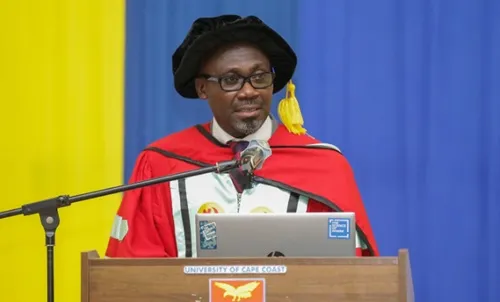


The University of Cape Coast (UCC) has appointed Professor Denis Worlanyo Aheto as interim Vice-Chancellor following a directive from the Ghana Tertiary Education Commission (GTEC) to remove Professor Johnson Nyarko Boampong over retirement age compliance.
The appointment was confirmed during an emergency meeting of the University’s Governing Council on September 24, 2025, according to a statement signed by Registrar and Secretary to Council Gideon Inoch Abbeyquaye. The Council indicated it was implementing instructions from GTEC regarding the leadership transition.
Professor Aheto, who currently serves as Pro Vice-Chancellor after assuming that role on January 1, 2025, takes over from Professor Boampong following GTEC’s determination that his continued tenure violates constitutional and institutional provisions regarding mandatory retirement age.
GTEC ordered Professor Boampong to step down, citing his surpassing of the mandatory retirement age of 60 in violation of Article 199(1) of the 1992 Constitution. The Commission also referenced the University of Cape Coast Act (PNDCL 278) and institutional statutes limiting the Vice-Chancellor’s tenure.
Professor Boampong was born on September 18, 1965, making him 60 years old as of September 18, 2025, according to court documents. The retirement age dispute has created complex legal proceedings involving constitutional provisions, institutional statutes, and existing court orders.
The matter remains before the Cape Coast High Court, with Professor Boampong’s lawyers citing a 2024 High Court injunction barring the university from removing or suspending him until a pending case concludes. GTEC has instructed that no substantive appointment should be made until the case is resolved.
Professor Boampong has rejected GTEC’s directive, maintaining that court orders keep him in office, creating an institutional standoff between the regulatory commission and the university leadership. His legal team described GTEC’s directive as unlawful and in direct violation of subsisting court orders.
Professor Aheto brings extensive academic credentials to the interim role, having previously served in various capacities within UCC’s administrative structure. He was appointed Pro Vice-Chancellor effective January 1, 2025, for a three-year term extending to December 31, 2027, positioning him as the natural successor for interim leadership.
The Governing Council has sought to reassure the university community that academic and administrative operations remain unaffected by the leadership transition. The Council assured stakeholders that UCC remains stable despite the administrative changes.
GTEC’s intervention reflects its regulatory mandate under the Education Regulatory Bodies Act, 2020 (Act 1023), which empowers the Commission to oversee tertiary education institutions and ensure compliance with statutory requirements. The Commission has suspended processing accreditation and other requests from UCC pending resolution of the retirement dispute.
The leadership dispute highlights broader questions about university autonomy versus regulatory oversight in Ghana’s tertiary education sector. The intersection of constitutional provisions, institutional statutes, and court orders creates complex legal terrain requiring judicial resolution.
University statutes specify that Vice-Chancellor appointments may be renewed for up to three additional years, provided extensions do not exceed the statutory retirement age of 60 years. This provision forms the basis for GTEC’s intervention in the current dispute.
The timing of the controversy coincides with critical periods in the university calendar, potentially affecting institutional planning and decision-making processes. Professor Aheto’s interim appointment aims to provide continuity while legal proceedings determine the permanent leadership structure.
Legal experts suggest the case could establish important precedents regarding regulatory oversight of university leadership and the balance between institutional autonomy and statutory compliance. The Cape Coast High Court’s eventual ruling may influence similar disputes across Ghana’s tertiary education sector.
The university community, including faculty, staff, and students, await clarity on the leadership situation as the academic year progresses. The Governing Council’s commitment to maintaining operational stability reflects efforts to minimize disruption to educational activities.
Professor Aheto’s academic background and administrative experience within UCC position him to provide effective interim leadership during this transitional period. His familiarity with institutional operations and strategic initiatives should facilitate continuity in university management.
The resolution of this leadership dispute will likely require balancing constitutional requirements, institutional needs, existing legal commitments, and regulatory oversight responsibilities. The Cape Coast High Court’s decision will determine whether GTEC’s directive stands or if alternative arrangements must be considered.
As Ghana’s tertiary education sector navigates evolving regulatory frameworks, the UCC leadership dispute represents a significant test case for the relationship between regulatory bodies and university governance structures.