

By Juliet Aguiar DUGBARTEY, Tarkwa
The University of Mines and Technology (UMaT), Tarkwa, has been urged to prioritise impactful research that directly addresses societal challenges and drives sustainable development.

At the university’s 2026 Research Week and Awards Ceremony, Prof. Peter Donkor – former Pro. Vice Chancellor and Founding Director, Office of Grant and Research at Kwame Nkrumah University of Science and Technology (KNUST) – stressed that research must move beyond academic publications to produce practical solutions whichimprove lives.
Speaking on the theme “Driving Research Excellence for Sustainable Development,” he noted that Africa continues to grapple with persistent challenges such as poverty, weak governance systems, environmental degradation and fragile health systems, all of which require innovative, research-driven responses.

“Research excellence is not merely about publishing in high-impact journals or securing large grants. It is about producing impactful knowledge that addresses complex challenges and benefits society,” he said.
Prof. Donkor further highlighted global issues including climate change, food insecurity, geopolitical instability and widening inequalities, depicting them as interconnected and requiring interdisciplinary and collaborative approaches.
He emphasised that modern research must be inclusive, actionable and well-supported, urging universities to break away from siloed approaches and foster collaboration across disciplines.
“Excellence today demands that we build bridges across disciplines and work together to solve problems holistically,” he stated.

He also called for stronger collaboration between academia, policymakers and industry to ensure research findings translate into policies and practical interventions.
Prof. Donkor stressed the need to build a strong research culture through mentorship, postdoctoral training and sustained investment, cautioning against over-reliance on external funding which could distort research priorities.
He underscored the importance of ethical standards, visibility of research outputs and effective communication of findings, while urging senior academics to mentor early-career researchers.
“Research leadership is a continuum. We must mentor younger colleagues to sustain progress,” he added.
He commended UMaT for advancing research through its Office of Research, Innovation and Consultancy (ORIC), urging researchers to focus on impact rather than personal gain.
“As we look ahead, we must ask ourselves what kind of legacy our research will leave behind,” he said.
The Dean of ORIC, Prof. Michael Affam, explained that the university’s Research Week and Excellence Awards aims to position research as a key driver of sustainable development.
According to him, the initiative provides a platform to showcase research outputs, strengthen industry collaboration and promote knowledge transfer to address real-world challenges.
He explained that ORIC remains committed to supporting innovation through funding mobilisation, grant management, consultancy services and commercialisation of research outputs.
Five individuals were honoured for outstanding contributions to research excellence, innovation and knowledge transfer, following a competitive selection process.
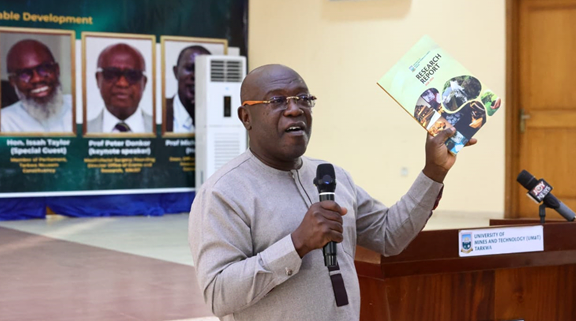
The event featured UMaT’s first Research Report unveilling.
Post Views: 1
Discover more from The Business & Financial Times
Subscribe to get the latest posts sent to your email.