
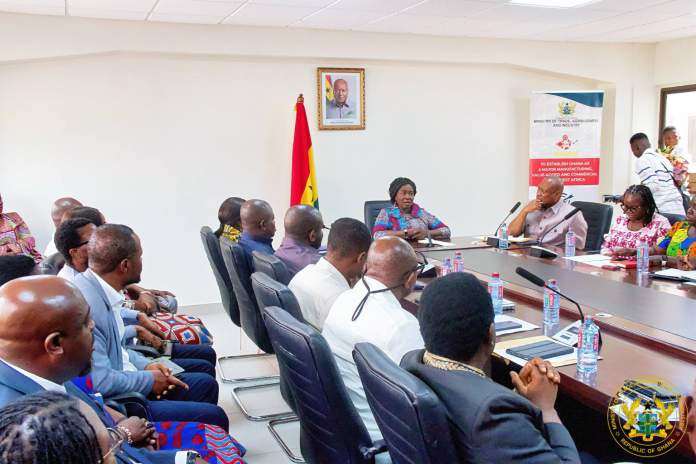

Vice President Jane Naana Opoku-Agyemang reaffirmed government commitment to strengthening Ghana’s trade and industrial base during a working visit Thursday to the Ministry of Trade, Agribusiness and Industry, promising to push for faster approval of investment incentives.
The assurance came during a meeting with Trade Minister Elizabeth Ofosu-Adjare, directors, staff and heads of agencies under the ministry. The visit forms part of broader engagements with key ministries to assess work, challenges and support needs, with particular attention to ministries led by women. Similar visits have been conducted to the Health, Education, Gender, Children and Social Protection, and Tourism, Culture and Creative Arts ministries.
Opoku-Agyemang praised the ministry’s focus on local production, value addition, women and youth empowerment, and efforts to position Ghana to fully harness natural resources and industrial potential. She stressed the importance of inter-agency collaboration, cautioning against siloed operations and urging institutions to work together to speed up national development. The vice president cited initiatives aimed at securing raw materials locally, including efforts to grow rubber for tyre manufacturing and revive the sugar value chain, noting that such projects generate employment across farming, processing, packaging and distribution.
The vice president commended renewed emphasis on Made-in-Ghana goods, describing local production as essential to economic resilience and self-sufficiency. She welcomed the ministry’s focus on women-led enterprises and youth employment, describing it as critical to inclusive growth, and encouraged agencies such as the GRATIS Foundation to cut imports by empowering more Ghanaians to produce locally. Opoku-Agyemang pledged to prompt the Minister of Finance to expedite approval of incentives and policies required to unlock investment and scale up industrial expansion.
Ofosu-Adjare outlined the ministry’s performance over the past year and plans for 2026 and beyond, citing reforms to reduce the cost of doing business, revitalize manufacturing and expand agribusiness through commercial contract farming and value-added production. She identified limited access to raw materials as a major constraint, with many factories operating below capacity, and said the ministry is addressing the challenge through land acquisition for commercial farming, backward integration and targeted support for agro-processing.
The minister announced key milestones including the extension of export proceeds repatriation from 60 to 120 days, deeper participation in the African Continental Free Trade Area, expanded access to global markets through trade fairs, and drafting of policies covering manufacturing, pharmaceuticals, automotive components and special economic zones. Ofosu-Adjare disclosed that land has been secured and engagements held with farmers to revive the Komenda Sugar Factory, expected to be operationalized by the end of 2026, alongside plans for new garment factories and agro-processing plants projected to create thousands of jobs.
The Komenda Sugar Factory, located in the Central Region, has been dormant since its commissioning in 2016 despite costing approximately 35 million dollars. The facility was built with Indian Exim Bank financing under a government-to-government arrangement and designed to process 1,250 tonnes of sugarcane daily. Subsequent administrations struggled to operationalize it due to inadequate sugarcane supply, technical challenges and financing constraints. The current government has identified the project as critical to import substitution efforts, given that Ghana spends significant foreign exchange importing refined sugar annually.
The ministry has acquired land for sugarcane plantation in the Komenda area and engaged local farmers who demonstrated readiness to cultivate the crop. Ofosu-Adjare urged investors to support sugarcane farmers with financial assistance and necessary inputs to sustain production. She noted that residents of the enclave possess traditional knowledge of sugarcane farming, reducing the need for extensive training. The successful operationalization of the factory would create hundreds of direct jobs and thousands of indirect employment opportunities along the sugarcane value chain.
Government policies on industrialization and private sector growth are beginning to yield results, with several manufacturing facilities expanding operations and creating employment. The vice president recently commissioned a new sanitary pad production line at Softcare Hygiene Product Factory in Weija, Accra, where she emphasized that the expansion demonstrated the effectiveness of creating a stable, business-friendly environment. The minister noted that until recently, Ghana imported nearly 70 percent of sanitary products, but local manufacturers now supply more than 65 percent of national demand.
The new production line at Softcare is expected to save the nation approximately eight million dollars in foreign exchange annually and create around 400 direct jobs and more than 1,200 indirect jobs. Ghana-made products are now entering other African markets, carrying the country’s name beyond its borders. The company donated 50,000 sanitary packs to the government to support the nationwide programme providing free pads to girls in basic and secondary schools. Government has allocated 292.4 million cedis in the 2026 Budget for the initiative, with a directive that all procured products must be manufactured in Ghana.
The vice president has emphasized that the government’s economic reset agenda prioritizes local manufacturing to promote import substitution, value addition and job creation. She stated that government is committed to reshaping the economy under the Ghana Framework for Industrialization, Revitalization, Support and Transformation, deliberately structured to strengthen domestic production and reduce overreliance on imports. Recent economic reforms including abolition of the COVID-19 Health Recovery Levy, reduction in effective VAT rates and digitization of tax administration are designed to make it easier and more profitable to do business in Ghana.
The flagship 24-hour economy policy is beginning to deliver tangible gains, with early pilot zones recording increases in industrial output and growth in night-shift employment. In locations such as the Tema light-manufacturing belt, significant increases in output and creation of new night-shift roles have been observed. The policy, which encourages round-the-clock production, is proving to be one of the administration’s most transformative interventions for strengthening industrial capacity. The model was designed to multiply capacity, maximize the use of resources and create more jobs, particularly within manufacturing and light industry.
Ofosu-Adjare stated that government is committed to creating a more predictable and competitive business environment, urging industry to prioritize quality standards, support export-earning repatriation rules and take full advantage of continental trade opportunities. She explained that digital transformation of trade systems is easing constraints for the private sector, as digitalization of business and trade operations from company registration to customs clearance removes bottlenecks and gives enterprises the certainty and predictability they need to grow.
The minister thanked the vice president for the visit, stating that it encouraged the ministry greatly and sent a signal that their work matters and receives support at the highest level. She commended Opoku-Agyemang for her leadership and inspiration to young girls across the country. The visit ended with renewed commitment from both political leadership and ministry staff to deepen reforms, strengthen local industry and work collaboratively to drive Ghana’s economic transformation.
The vice president’s series of working visits to women-led ministries reflects government emphasis on supporting female leadership and ensuring coordination across sectors. Opoku-Agyemang, who became Ghana’s first female vice president when she was sworn in on January 7, 2025, previously served as Minister for Education from 2013 to 2017 under President Mahama’s first administration. She was the first female Vice-Chancellor of a state university in Ghana, holding that position at the University of Cape Coast from 2008 to 2012, and served as Chancellor of the Women’s University in Africa in Zimbabwe until resigning in August 2024 ahead of the elections.
The emphasis on local production and industrialization aligns with broader government objectives to reduce import dependence, create employment and position Ghana as a competitive manufacturing hub within the African Continental Free Trade Area framework. The AfCFTA Secretariat, based in Accra, creates opportunities for Ghanaian manufacturers to export competitively across the continent to a market of 1.3 billion people with combined GDP of approximately three trillion dollars. Government has identified manufacturing, agribusiness and value addition as critical pillars for achieving sustainable economic growth and addressing unemployment, particularly among youth and women.