
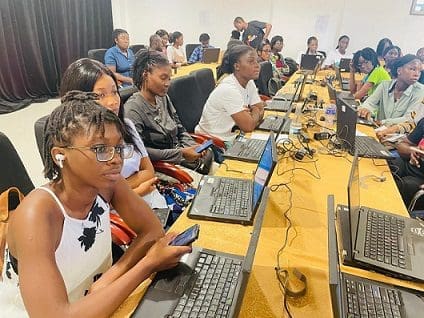

A resource-rich region long known primarily for its mining and cocoa sectors is quietly repositioning itself as a hub for scientific and technological education, as Ghana’s national STEM agenda takes root at the grassroots level.
The Western North Region is experiencing a renewed emphasis on practical Science, Technology, Engineering, and Mathematics education, reflecting government efforts to strengthen the country’s scientific and digital foundations. Students in this region now have access to specialized facilities and programs designed to transform how they engage with scientific disciplines, moving beyond theoretical instruction to hands-on experiential learning.
At the center of this educational transformation sits Awaso STEM Senior High School, one of five purpose-built STEM institutions completed under the government’s ambitious expansion program. The school, located in the region’s mining heartland, represents a strategic investment in developing homegrown technical talent in an area where extractive industries have historically dominated the economic landscape.
Awaso STEM SHS offers specialized programs in Engineering, Biomedicals, and related technical fields, providing students with opportunities that previously required leaving the region entirely. The residential facility gives young people from across Western North and beyond access to laboratories, workshops, and technological resources that remain scarce in many traditional secondary schools.
The timing of Western North’s STEM push carries particular significance. As the region grapples with environmental challenges linked to mining activities and seeks to diversify its economic base, developing a generation of scientifically literate citizens becomes not just an educational goal but an economic imperative. Technical skills in environmental monitoring, sustainable resource management, and industrial engineering could prove crucial to the region’s future development trajectory.
Government documents confirm that Awaso STEM Senior High School is among seven STEM-focused institutions now fully operational nationwide. The others include Abomosu STEM School in the Eastern Region, Bosomtwe Girls STEM School and Bosomtwe STEM School in the Ashanti Region, Kpasenkpe STEM Senior High in the Northeast Region, Koase Sec/Tech in the Ahafo Region, and Accra High School’s engineering-focused program in the Greater Accra Region.
This national network represents a fundamental shift in how Ghana approaches science education. Rather than concentrating advanced STEM facilities exclusively in urban centers like Accra and Kumasi, the strategy deliberately places specialized institutions in regions that have historically lacked such resources. Western North’s inclusion in this first wave signals recognition of the region’s potential to become more than just a source of raw materials.
The practical emphasis distinguishes these new STEM schools from traditional science programs. Students don’t just learn scientific principles from textbooks; they engage with equipment, conduct experiments, build projects, and develop troubleshooting skills that mirror real-world technical work. This hands-on approach aligns with global best practices in STEM education, which increasingly emphasize learning by doing rather than passive absorption of information.
For Western North specifically, the STEM focus connects directly to regional development challenges and opportunities. The region’s natural resource wealth, including gold, bauxite, and timber, requires sophisticated technical management to balance economic exploitation with environmental sustainability. Training young people in the sciences equips them to eventually assume leadership roles in managing these resources more responsibly.
Beyond extractive industries, Western North has potential for growth in agricultural technology, renewable energy, and ecotourism, all sectors that benefit from scientifically trained workforces. The region’s cocoa production, for instance, could be revolutionized by students who understand plant biology, soil chemistry, and agricultural engineering. Climate-smart farming techniques and post-harvest processing innovations all require the kind of scientific thinking that STEM education cultivates.
The infrastructure investment in schools like Awaso STEM represents only part of the equation. Sustaining momentum requires consistent funding for laboratory equipment, qualified teaching staff, and ongoing professional development to keep pace with rapidly evolving technologies. Some education experts have noted that while Ghana has made impressive strides in building STEM facilities, ensuring quality implementation remains an ongoing challenge.
Teacher training presents particular obstacles. Effective STEM instruction demands educators who themselves have strong technical backgrounds and can facilitate inquiry-based learning rather than traditional lecture formats. Attracting and retaining such talent in regions outside major urban centers often proves difficult when private sector opportunities offer better compensation for technical expertise.
Nevertheless, the Western North STEM initiative benefits from timing and context that previous educational reforms lacked. National awareness of digital skills gaps has intensified, particularly as Ghana positions itself as a technology hub within West Africa. Regional development authorities increasingly recognize that without locally trained technical workforces, communities remain dependent on outside expertise even for basic technological services.
Parents and students in Western North appear to be embracing the opportunities. Competition for admission to Awaso STEM and similar schools reportedly remains intense, with many families viewing these institutions as pathways to careers in engineering, medicine, information technology, and other high-demand fields.
The cultural shift required to fully realize STEM education’s potential extends beyond schools themselves. Communities must begin valuing scientific inquiry, encouraging curiosity, and supporting young people, particularly girls, who show aptitude for technical subjects. Traditional attitudes that sometimes steer capable students away from rigorous science programs need challenging if the region hopes to maximize its investment in STEM infrastructure.
Early indicators suggest Western North’s STEM push is generating genuine enthusiasm. Schools report students participating in science fairs, technology competitions, and collaborative projects that demonstrate both creativity and technical competence. Whether this translates into sustainable regional development depends on maintaining support, ensuring quality instruction, and creating pathways for graduates to apply their skills locally rather than immediately migrating to urban centers.
As government intensifies STEM education efforts nationally, Western North’s experience will offer valuable lessons. Success here, in a region facing complex development challenges, could validate the strategy of distributing specialized educational resources beyond traditional centers of academic excellence. Failure or mediocrity, conversely, might reinforce skepticism about whether resource-constrained regions can effectively deliver world-class technical education.
For now, the Western North Region is positioning itself as more than just Ghana’s resource basket. Through practical STEM education, it’s cultivating the human capital necessary to become a region where innovation happens, not just extraction. Whether that transformation fully materializes remains to be seen, but the foundation is being laid, one laboratory experiment and engineering project at a time.