


By Elizabeth PUNSU, Ejisu
The United Nations World Food Programme (WFP) has begun implementing a rice fortification project aimed at boosting the consumption of locally produced rice, supporting domestic rice millers and farmers and improving nutrition among students in public schools.
The project with funding support from the Foreign, Commonwealth & Development Office (FCDO), dsm-firmenich, and in collaboration with key government partners, including the Ghana School Feeding Programme (GSFP) under the Ministry of Gender, Children and Social Protection (MoGCSP), the Ghana Education Service (GES), the Ghana Health Service (GHS), and Women in Agriculture Development (WIAD) so far has procured and delivered four rice fortification equipment units valued at over US$80,000 to four millers across four regions including Ashanti Region.
Speaking to journalists during a facility visit, one of the beneficiary rice millers, Managing Director, Franco Food Processing and Farms, Franco Obour, competition from imported rice remains one of the major challenges confronting local rice producers.
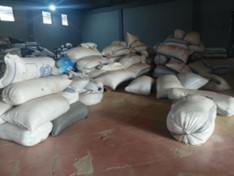
“At the moment, one of the key challenges in the industry is competition. Many farmers want to supply large quantities of rice, but due to limited storage space and low market demand for local rice, we often have to ask them to wait,” he said.
He explained that although imported rice is generally cheaper, it is often of inferior quality. However, with the easing depreciation of the dollar, imported rice has become more profitable, further disadvantaging local producers.
“Farmers are suffering. Rice is abundant, yet it is not being purchased. There does not necessarily have to be a total ban on imported rice, but a certain percentage of the market should be reserved for local rice. Our producers are struggling, even though their output is sufficient to feed all the secondary schools in the area,” he added.

To help address some of these challenges, WFP, under its fortified rice implementation initiative, has provided equipment valued at US$50,000 and fortified rice kernels to Franco Food Processing and Farms, a rice milling facility in the Ejisu Municipality of the Ashanti Region. Similar equipment installations have also been completed for two other rice millers in the Northern and Upper East Regions.
Following the installation of equipment at the three mills, WFP supplied 60 metric tonnes (MT) of fortified rice kernels, valued at over US$91,000, to the millers for fortification and distribution to schools. The fortified rice is distributed to basic schools through caterers and to senior high schools via the National Food Buffer Stock Company (NAFCO).
The initiative seeks to address micronutrient deficiencies, boost school enrolment and attendance, and ultimately improve academic performance in underserved communities. In all, 157,510 students in public schools nationwide are targeted, comprising 111,247 basic school pupils and 46,263 senior high school students.
For the pilot phase, WFP partnered with the Ghana Education Service (GES) and the Ghana School Feeding Programme (GSFP) to select 365 basic schools and 35 senior high schools across 12 districts in six regions — Upper West, Upper East, Northern, Ashanti, Oti and Greater Accra.
WFP noted that large-scale rice fortification has proven to be an effective intervention in many countries where rice is a staple food. Fortification involves adding essential vitamins and minerals to rice during milling or through heat extrusion. The pilot project in Ghana is intended to assess the feasibility and economic viability of scaling up rice fortification, while supporting millers to integrate fortification into sustainable business models and create market opportunities for local smallholder farmers.
So far, two rice millers, BBN Cooperative in the Upper East Region and Franco Farms in the Ashanti Region, have supplied a combined 170MT of fortified rice and 61.7MT of parboiled unpolished rice to nine selected senior high schools in the Upper East, Northern and Ashanti Regions.
In an interview with journalists, Headmistress of Ejisu Senior High Technical School, Grace Samani, described the initiative as timely and beneficial to student welfare.
“The project started about two years ago. Although we were more accustomed to white rice, we embraced the initiative after learning about the nutritional benefits of unpolished rice, as we believed it would help enhance students’ nutrition.
“The unpolished parboiled fortified rice contains more nutrients than the white rice we were used to. The price was almost the same as regular white rice on the market, so we did not face any cost challenges,” she added.
However, she acknowledged initial resistance from students who were used to perfumed white rice. “We educated the students before introducing it into meals and organised campaigns where Home Economics students prepared various dishes using the unpolished rice. Over time, acceptance improved. We did not experience any challenges with the white fortified rice,” Ms. Samani said.
Ashanti Regional School Health Education Programme (SHEP) Coordinator, Emmanuel Addo, said the initiative is intended to promote behavioral change by encouraging the consumption of fortified local rice instead of nutritionally poor alternatives.
He noted that the programme is particularly important in addressing nutrition-related challenges such as obesity, anaemia and malnutrition among students.
“The initiative is not meant for schools alone under the School-Based Behaviour Change (SBBC) approach; it is designed to drive broader societal change. Through students, nutrition education can reach households and communities,” he said.
Mr. Addo added that many students were consuming excessive amounts of fizzy drinks and unhealthy foods, making the introduction of fortified local rice a critical intervention to help restore lost nutrients.
Post Views: 3
Discover more from The Business & Financial Times
Subscribe to get the latest posts sent to your email.