
By Ernest Bako WUBONTO
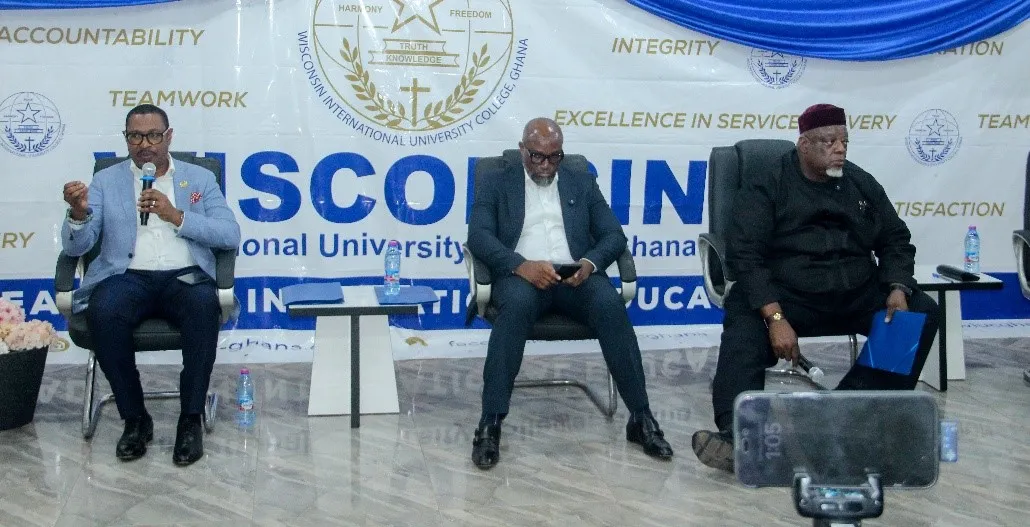
Wisconsin International University College (WIUC) Business School has hosted a high-level seminar to critically examine the architecture of the flagship 24-Hour Economy policy for easy understanding by the youth, especially students.

The event, themed “Building Ghana’s 24-Hour Economy: Challenges and Opportunities,” brought together the master planners of the initiative, the academia, captains of industry and students to move the conversation from political aspiration to economic implementation.
Director and Head of Innovative Finance, Partnerships and Markets at the 24-Hour Economy Secretariat, Dr. Ishmael Nii Dodoo, delivered a technical presentation, providing a comprehensive breakdown of what he termed a national re-engineering project.
He laid bare the economic realities necessitating this shift, pointing out the paradox of gross domestic product (GDP) growth that fails to create jobs, adding that Ghana exports raw materials without value addition and imports nearly 90 percent of its goods, effectively exporting jobs that were supposed to accompany GDP growth annually.
“The 24-Hour Economy is more than just a policy; it’s a catalyst for industrialisation, export promotion and job creation. It’s about building an economy that works for everyone, every hour of the day,” he said.

He framed the initiative, officially dubbed the 24-Hour Economy and Accelerated Export Development Programme (24H+), as a vision to transform Ghana into a self-reliant, industrially competitive and export-driven powerhouse for West Africa.
Dr. Dodoo further outlined the initiative’s structure, which rests on three pillars—production transformation, efficient and optimised market access, and integrated value chain development, supported by eight integrated sub-programmes.
These range from Grow24 (Agriculture for Sovereignty) and Make24 (Manufacturing Ghana’s Industrial Future) to Connect24 (Supply Chain Efficiency) and Aspire24 (Workforce Development).
The others are Show24 (Culture, Creativity and Tourism for National Identity and Jobs), Fund24 (Capital for Inclusive and Strategic Investment), Go24 (Civic Engagement and Government Alignment) and Build24 Infrastructure for the Integrated Growth real estate/ construction section.
He stressed that the approach is private sector-funded and driven, with the secretariat playing a coordinating role.
The director at the secretariat also highlighted the massive market opportunities of these initiatives, noting that Ghana annually imports over US$400million worth of fisheries and US$350million worth of chicken, representing significant targets for local substitution.
He also revealed governmental intent to alter procurement laws to enforce that 60 percent of rice consumption be sourced locally.
However, Dr. Dodoo was candid about the significant challenges ahead, including the need for adequate power supply, robust road and digital infrastructure, enhanced security for night operations, and a massive workforce retooling to drive the necessary mindset shift.
CEO of Dalex Finance, Joe Jackson, bringing a sharp private sector perspective, praised the intellectual coherence of the policy but warned that its greatest risk is not financial but operational interconnectivity and discipline. He argued that the issue is political alignment and the relentless execution of the vision.
“Intellectually, the 24-hour economy understands the problems of the economy. But the risk is not funding; it is coordination and discipline,” he cautioned.
He specifically addressed the Fund24 pillar, questioning why Ghana’s over 60 billion cedis in pension funds are largely locked in treasury bills.
“The patient funds and bonds we borrow from Europe are someone’s pension funds. Let’s release our own pension funds to finance our development,” he proposed.
In a demonstration of private sector commitment to the policy’s logistics pillar, CEO of the McDan Group, Dr. Daniel McKorley, announced that his company has acquired two vessels to directly address logistics constraints to intra-African trade under the 24-hour economy framework, supporting the Connect24 agenda.
Closing the event, the President of Wisconsin International University College and Chairman of the occasion, Dr. Lawrence A. Kannae, refocused the discourse on the human element.
He charged students to position themselves as problem-solvers, emphasising the need for discipline and self-motivation. “Don’t let challenges be obstacles, but building blocks for take-off.”
Director, 24-Hour Economy Secretariat, Dr. Ishmael Nii Dodoo,
Post Views: 19
Discover more from The Business & Financial Times
Subscribe to get the latest posts sent to your email.