

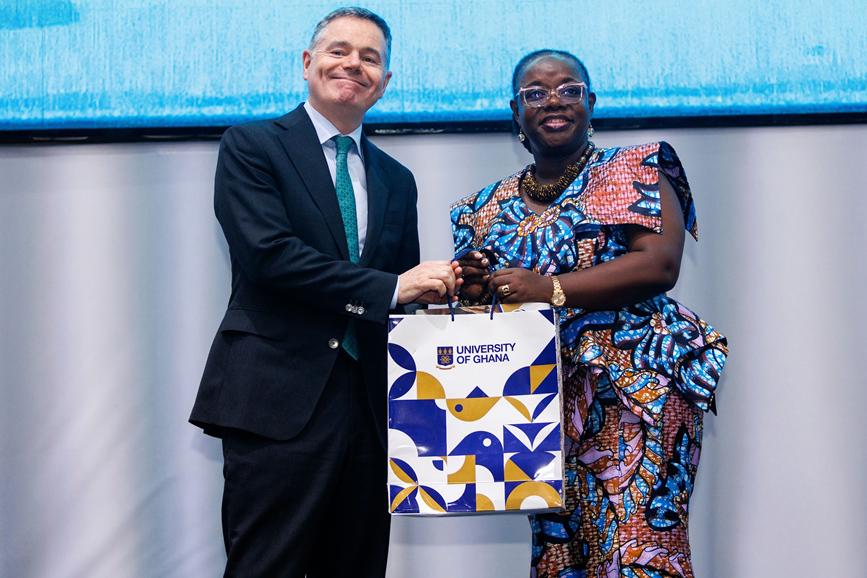
The World Bank Group has called on the domestic private sector to take a far more active role in shaping the country’s skills pipeline, warning that persistent employer passivity is deepening the mismatch between education outcomes and labour market needs at a time of rising youth dislocation.
Paschal Donohoe, Managing Director and Chief Knowledge Officer-World Bank, said firms must move beyond acting as passive recipients of graduates and instead help design curricula and training systems, arguing that: “The private sector is not a passive recipient of graduates; it must be a co-designer of the talent pipeline”.
Delivering the University of Ghana’s first Vice-Chancellor’s Occasional Lecture of the year, on the theme ‘Building Skills, Creating Jobs and Empowering Africa’s Future’, Mr. Donohoe described the issue as a structural coordination failure between education providers and employers rather than a simple shortfall in graduate capability.
The longstanding model, under which universities develop programmes independently and firms absorb available talent, is no longer fit for purpose in an economy being reshaped by artificial intelligence, automation and the green transition, he said.
The challenge’s scale is considerable, with data from Ghana Statistical Service showing that about 1.34 million young people aged 15 to 24 – equivalent to 21.5 percent of that cohort – are not in employment, education or training (NEET).
The figure mirrors a broader global pattern, with the International Labour Organisation (ILO) estimating that 262 million young people worldwide fall into the same category.
Across Africa, the imbalance is more acute; while roughly 10 to 12 million young people enter the labour force each year, only about three million formal jobs are created.
Mr. Donohoe identified four interlocking constraints driving the transition failure from education to work. The first is a persistent skills mismatch, rooted in curricula that evolve more slowly than labour market demand and are often designed without employer input.
The second is an experience gap, where graduates are required to demonstrate workplace exposure they have not had the opportunity to acquire. The third is an aspirational imbalance, with jobseekers concentrating on formal sector roles even as demand expands more rapidly in agribusiness, digital services and green industries.
The fourth and most consequential is a deficit in foundational skills, including analytical reasoning, writing and quantitative literacy – which limits graduates’ ability to adapt across sectors.
Responding to questions from students, Paschal Donohoe said the dynamics of work are shifting rapidly under the influence of technology, climate transition and changing business models, requiring all stakeholders – governments, universities and employers – to adapt with greater urgency. He cautioned against viewing a university qualification as a final destination, describing it instead as a foundation for continuous learning and reinvention.
“The degree is not the end point,” he said, noting that in a fast-evolving labour market graduates will need to update their skills repeatedly over the course of their careers to remain relevant.
“Training that happens in isolation from employers produces graduates who are ready for a job description, not a job,” he said.
Drawing on comparative evidence, Mr. Donohoe pointed to economies such as South Korea, Vietnam, Singapore and Ireland, where closer alignment between industry and education systems have helped narrow similar gaps.
In these cases, employers play a central role in curriculum design, certification and training delivery – often linked directly to national industrial strategies.
Within Africa, emerging models are also demonstrating results. These include the use of real-time vacancy data to guide digital skills training in East Africa and the integration of skills development into large-scale infrastructure projects, ensuring a direct pathway from training to employment.
The World Bank’s evolving approach, outlined during the lecture, centres on strengthening early-stage learning, improving classroom outcomes, aligning tertiary and technical education with labour market demand and enhancing job-matching systems. The institution currently supports more than 325 million students globally through its programmes.
However, Mr. Donohoe was explicit that the constraint is no longer one of diagnosis.
“The data is clear on what works. The question is not what to do, but whether there is the political will and institutional capacity to do it at scale,” he said.
Chairing the lecture, Vice Chancellor Professor Nana Aba Appiah Amfo signalled the university’s readiness to deepen collaboration with industry.
“Universities must remain intellectually rigorous, but also responsive. We welcome stronger partnerships with the private sector to ensure that our graduates are not only knowledgeable, but also equipped with the skills and adaptability required by a changing economy,” she said.
Post Views: 7
Discover more from The Business & Financial Times
Subscribe to get the latest posts sent to your email.