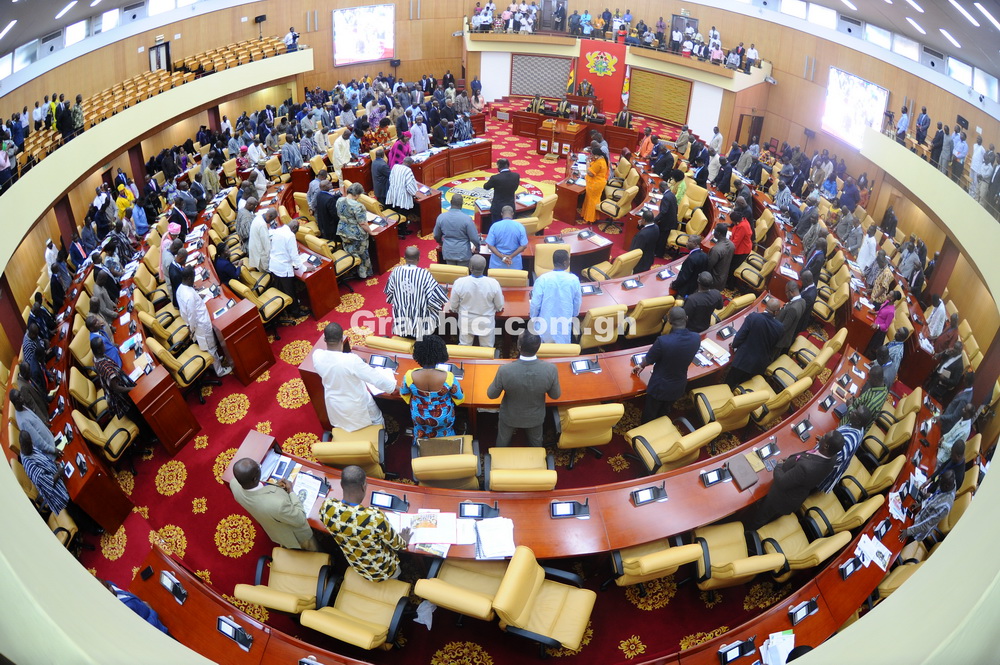
Parliament is being asked to approve a whopping GH¢30 billion for the New Economy Programme in 2027 without being told which institution will spend the money or what it will be spent on, according to an analysis by Africa Policy Lens.
The centrepiece of the 2027 Budget, presented to Parliament on November 12, is the New Economy Programme, under which Finance Minister Dr Cassiel Ato Forson announced that the government would invest US$10 billion between 2027 and 2030 across eight pillars, ranging from commercial agriculture and energy to textiles, pharmaceuticals and technology.
For 2027 alone, the Finance Minister said the government “will invest 1.5 percent of GDP, equivalent to GH¢30 billion, in the New Economy”.
Africa Policy Lens has, however, raised concerns over what it describes as an anomaly, following an examination of the Budget Statement’s economic and institutional classifications, as well as the government’s 182-page New Economy policy document.
In the economic classification (Appendix 3C, page 189), Africa Policy Lens said the New Economy appears as a single line of capital expenditure amounting to GH¢29,999,613,451.
The group said the amount “sits alongside, not inside, the capital budgets of ministries (GH¢30.7 billion) and the Big Push infrastructure programme (GH¢27.8 billion).”
In the institutional classification (Appendix 4A, page 195), the think tank further revealed that the same amount appears as item 42, “New Economy”, under the Multi-Sectoral heading.
“The entry carries no wages, no goods and services and no sub-lines. There is no breakdown by pillar, by project or by ministry,” the statement said.
It added that the Budget “names no New Economy secretariat, authority or fund.”
The 24-Hour Economy Secretariat receives a separate allocation of GH¢165 million in the Budget and GH¢131 million in the appendix tables, representing about half of one per cent of the New Economy allocation, according to the analysis.
The policy document, titled The New Economy, New Ghana: Jobs and Prosperity Programme 2027–2030, outlines a structure comprising a Cabinet-level Jobs and Prosperity Committee, a delivery unit for each pillar and the National Development Planning Commission as an independent verifier.
“But none of these bodies has a line in the Budget. And the document contains no cedi allocation at all: only four-year dollar totals for each pillar, with no split of the GH¢30 billion for 2027,” the statement said.
Ministries not funded to deliver
Africa Policy Lens compared Appendix 4A of the 2026 and 2027 Budgets and found that ministries most closely aligned with the programme’s pillars did not receive corresponding funding increases.
The Ministry of Trade, Agribusiness and Industry, which the group linked to the textiles and garments pillar, saw its total budget fall from GH¢378.6 million in 2026 to GH¢187.8 million in 2027, a 50 per cent decline. Its capital allocation fell from GH¢205 million to GH¢5 million.
The Ministry of Tourism, Culture and Creative Arts, linked to the tourism pillar, saw its allocation fall from GH¢207.0 million to GH¢185.7 million, a 10 per cent decline, with capital spending at GH¢31.0 million.
The Ministry of Communication, Digital Technology and Innovations saw its allocation fall from GH¢331.6 million to GH¢290.9 million, a 12 per cent decline.
The Ministry of Lands and Natural Resources received an increased allocation, rising from GH¢807.9 million to GH¢1,368.4 million, but its capital budget stood at GH¢15.1 million.
The combined capital budgets of the seven ministries most closely aligned with the programme’s pillars amounted to GH¢5.1 billion, less than a fifth of the central allocation, according to the analysis.
The statement noted that the policy document sets out its own test: “No major project will enter the budget without appraisal,” and every major intervention must have “a clearly identified implementing institution, a costed delivery plan, a financing structure, a timetable.”
“By that test, the GH¢30 billion has entered the Budget too early. Parliament is being asked to approve it as a block, before the projects exist on paper,” the statement said.
Africa Policy Lens called on Parliament to demand “a pillar-by-pillar, ministry-by-ministry schedule for the GH¢30 billion in 2027, laid before the Appropriation Bill is passed” and “a named spending authority for item 42, answerable to Parliament for commitments and releases.”
DISCLAIMER: The Views, Comments, Opinions, Contributions and Statements made by Readers and Contributors on this platform do not necessarily represent the views or policy of Multimedia Group Limited.
Tags:
DISCLAIMER: The Views, Comments, Opinions, Contributions and Statements made by Readers and Contributors on this platform do not necessarily represent the views or policy of Multimedia Group Limited.
Source link