
By: Celestine Avi and Seth Eyiah
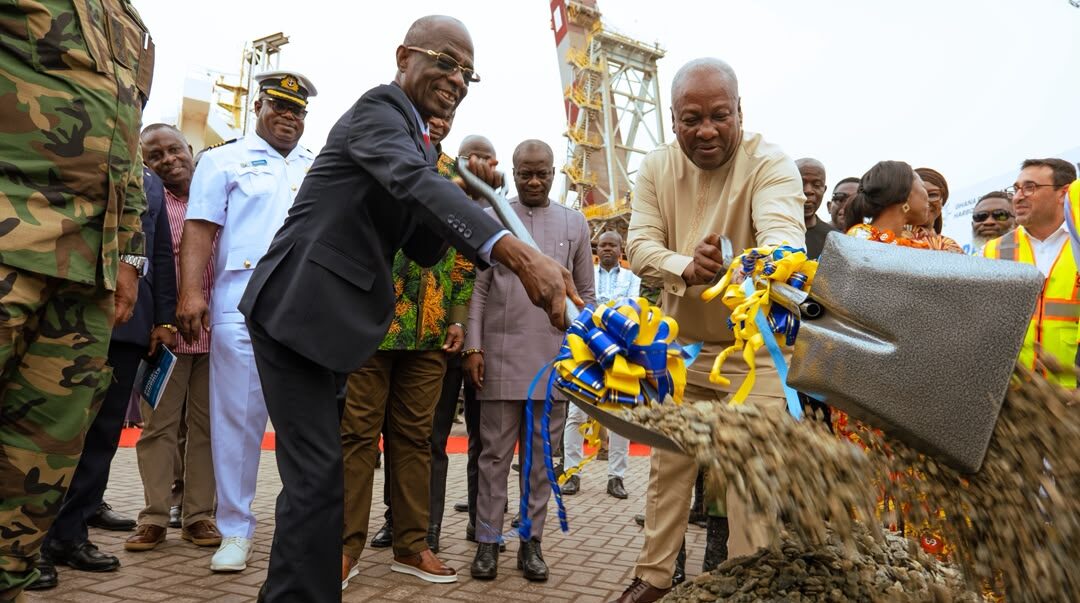
President John Dramani Mahama has broken ground for the 98-million-dollar expansion of Berth 19 at the Takoradi Port, a major infrastructure investment expected to increase the port’s capacity to handle mineral exports and imported dry bulk cargo.
The project forms part of government’s broader efforts to strengthen Ghana’s maritime infrastructure, improve trade logistics and position the country as a regional hub for shipping and cargo handling.

Speaking at the sod-cutting ceremony in Takoradi in the Western Region, President Mahama said the expansion had become necessary because of growing demand for the export of mineral ores and the importation of dry bulk materials, particularly clinker used by cement manufacturing companies.
He explained that although the Takoradi Port had undergone significant expansion over the years, its dry bulk terminal remained constrained and required additional capacity to accommodate increasing volumes of cargo.
President Mahama said the expansion would complement other investments at the port, including the container terminal, oil and gas services terminal and ongoing improvements to its marine infrastructure.
He recalled breaking ground for the expansion of the Takoradi Port in 2012, expressing satisfaction with the transformation of the facility from its traditional role as an export point for timber, cocoa, bauxite and manganese into a modern port handling both imports and exports.
The President said dredging works had also improved the port’s capacity to accommodate larger vessels, with a draft of up to 16 metres.
The Berth 19 project is expected to be completed within 26 months, with President Mahama expressing hope of returning to commission the facility after construction.
WESTERN RAILWAY LINE TO CONNECT MINERAL RESOURCES TO PORTS

President Mahama also announced government’s intention to prioritise the Western Railway Line under its new economy plan, describing it as one of the most commercially viable components of Ghana’s Railway Master Plan.
He said the project would be implemented in two phases.
The first phase will extend the railway line to Nyinahini to facilitate the transportation of bauxite and support the development of the area’s mineral resources.
The second phase is expected to extend the line through the Western Corridor to Hamile in the Upper West Region, creating a strategic transport connection between Ghana’s ports and Burkina Faso.
He said the railway would facilitate the movement of minerals, including manganese and bauxite, to the ports while also providing an alternative route for transporting containers and other cargo.
The President said the development would strengthen Ghana’s position as a regional logistics and trade centre.
NEW PORTS TO OPEN UP THE VOLTA CORRIDOR
As part of efforts to diversify the country’s port infrastructure, President Mahama disclosed that the International Finance Corporation had agreed to finance the proposed Esikuma Port project, being developed by LMI.
He said construction of the private-sector-led project had commenced, while another port was planned for Debre in the Savannah Region.
The proposed developments are expected to support the Volta Corridor and provide landlocked Burkina Faso with an alternative route for accessing its imports and exports.
An inland terminal at Debre is expected to reduce the distance cargo operators from Burkina Faso travel to access their containers, easing pressure on existing ports and improving regional trade efficiency.
ACCRA RESET AND THE NEED FOR LONG-TERM INFRASTRUCTURE FINANCING
President Mahama situated the port and railway investments within his broader Accra Reset agenda, which seeks to reduce Africa’s dependence on external support and build more resilient economies.
He said the initiative, which initially focused on health sovereignty following the cancellation of 174 million dollars in USAID funding for critical health interventions, had evolved into a wider advocacy for reforms in the global financial architecture.
The President argued that African countries continue to face disproportionately high borrowing costs because of risk premiums associated with political and security concerns.
He called for greater access to patient capital, particularly long-term financing that allows infrastructure projects with extended gestation periods to mature and generate returns.
President Mahama commended the financial institutions and pension fund investors supporting the Takoradi projects, stressing that sustainable economic development depended on strategic investments in ports, railways, roads and other critical infrastructure.
He said expanding the country’s logistics and transport infrastructure was essential to improving competitiveness, attracting investment and creating the conditions for sustained economic growth.
RELATED STORIES
GPHA invests US$98.41M in Takoradi Port expansion as Mahama cuts sod for Berth 19