
It’s too easy to feel fatigued in (and of) the world nowadays. So much has happened within the last five years and even in just 2025 that has overwhelmed many to the point of ‘zombieism’ (if such a word existed). Everybody is at some point either stuck in a political echo chamber (whether NDC-NPP, Left-Right, Labour-Conservative) or declaring themselves totally apolitical.
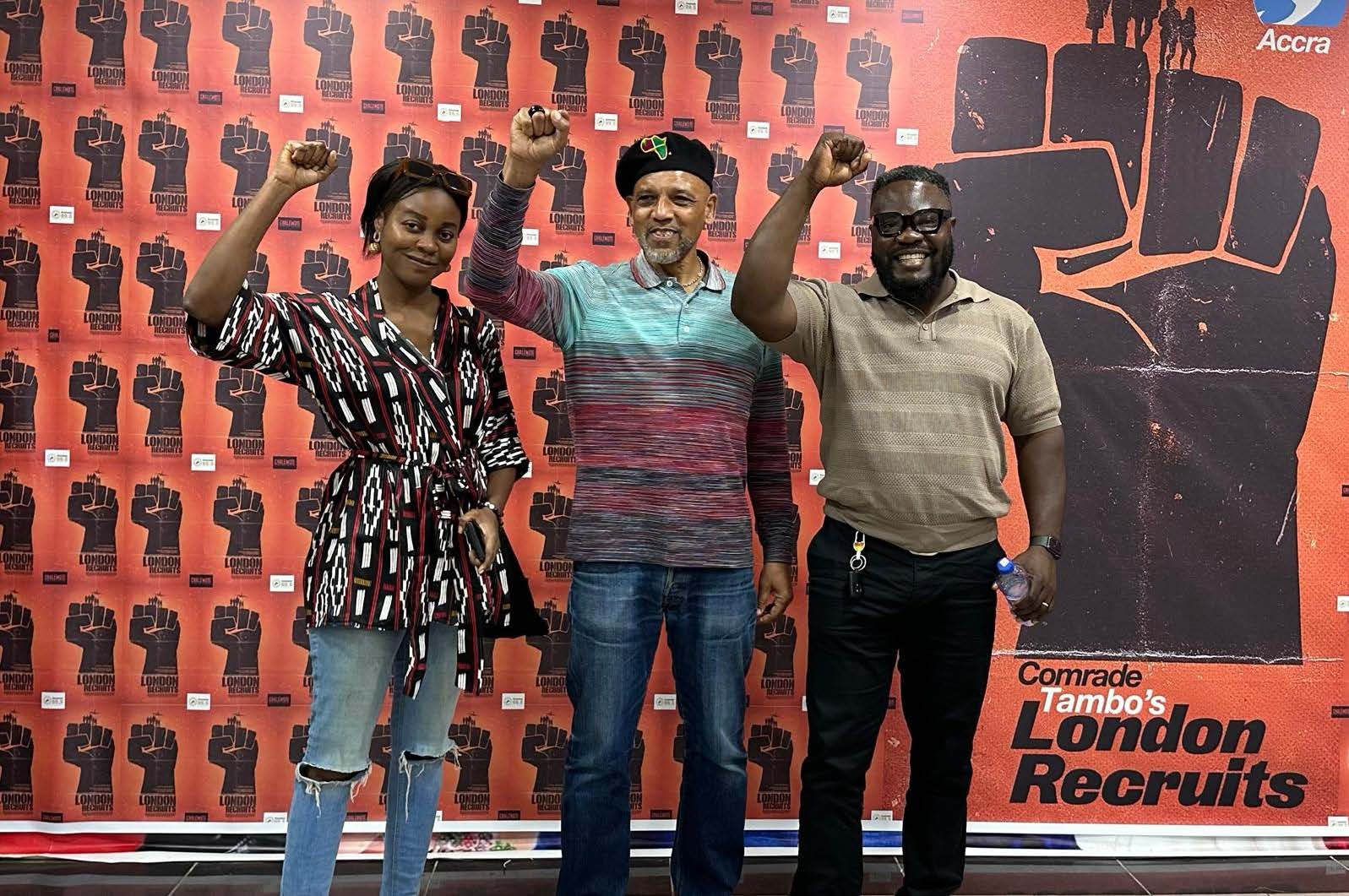
So, it was refreshing for me to receive an invitation out of the blue to the Accra Mall Silverbird premiere of a docu-thriller produced by a mix of English and Afro-English filmmakers about a clandestine anti-apartheid operation in 1970s South Africa led by a formidable black South African man but carried out by white, British, working-class youth. Because to me, the truth is usually found at intersections (and yes, truly stranger than fiction). Allow me to tell you a bit about the London Recruits.
The film, Comrade Tambo’s London Recruits (2024), written and directed by Welsh director/ producer, Gordon Main, follows Oliver Tambo, then President-General of the African National Congress (ANC), who initiates a secret plan while in exile [and Mandela was in jail], to send young, white freedom fighter, Ronnie Kasrils to London. From eight thousand miles away, Ronnie is tasked with convincing the apartheid authorities and the oppressed population that hope lives on, and that the ANC units are still operating right across South Africa. With almost no money, Ronnie and a small cell of fellow exiles turn to the ordinary young people of London for help. So begins a series of ever more daring undercover missions that sends shock waves through the regime. A potent mix of never-before-seen archive footage, action-packed drama and candid testimony from the recruits, eyewitnesses and secret police – London Recruits is a compelling journey into the heart of apartheid South Africa.
A compelling journey indeed, showing us life and activism in the gritty streets, homes and offices of 1970s London, Johannesburg, Durban and others. So compelling that it led me to do some research on the characters afterwards and learn that “When Tambo first began the work of lobbying for international recognition, almost the only head of government prepared to give him the time of day was Kwame Nkrumah, in Ghana.” (The Independent, 2007). Wow, I thought, happy to learn of yet another instance of pan-African solidarity led by the great Kwame Nkrumah (His excellency, our 1st president). But before I get ahead of myself to my post-cinema insights, I want to tell you about the excellent documentary filmmaking on this movie.
Let’s start from the never-before-seen archive footage. In the Q&A session after the screening, hosted by one of the producers, Colin Charles (a legend in the Ghanaian creative industry), he answered a question about how the film had such authentic looking scenes of everyday life in SA and the UK – they had sourced the footage by openly asking on social media for any home videos of those times that netizens had and didn’t mind sharing. And the Internet came through! For the action-packed drama, I think they did a brilliant job conveying the danger the young activists faced at every point of their operation, with the varied pacing, stylish edits, multicharacter
narration, the soul-stirring music… The music!! That uplifting, Sarafina-style folk singing that many oppressed peoples seem to come endowed with. Then there’s the candid testimony, genuinely given by the recruits, eyewitnesses and secret police, a mix of actors and the actual persons involved, an execution I remarked to my friend at
the cinema was a masterclass in casting – the younger versions of the characters truly looked like the actual personalities, and all the actors deserve praise for their embodiment of thecharacters, most with few words but more emotion. They certainly had big shoes to fill, those of iconic freedom fighters like South African journalist Joyce Sikhakhane-Rankin, who shared a bit of her spirited story alongside the portrayal…
Themes explored included the injustice of Apartheid and Oppression, the need for Solidarity, and the power of Hope and Bravery, all at the time when Mandela was in prison and it seemed all hope for liberation was lost… The daring “recruitment” of British citizens by African freedom fighters for the cause of African liberation itself offers a testament to African ingenuity and strategic thinking.
If I were to find any flaw in the film, I would incidentally have to point out that it’s a double edged sword – on the one hand, the gritty 1 hour 45 minute documentary thriller was succinct, straight to the point, with little appetite for hors d’oeuvres in today’s era of 3-min attention spans; on the other hand, this very conciseness, I feel, could have been sacrificed for an extra 30-45mins of even richer storytelling. The perspectives and attitudes of the elites of the time, for instance (in both SA and the UK), is one of the few additional insights I’d have liked to gain. Such context would provide a deeper education for new and younger audiences like myself… I loved however this concept (or observation) that Colin Charles shared, that the movie signals “there are 2 Britains…,” to which an attendee echoed, “there are also 2 Ghanas, and 2 Nigerias…”; 2 South Africas, 2 Cote d’Ivoires, 2 Americas, etc., a crisp commentary on the dichotomy between the classes in probably every nation on earth (it indeed signaled that, as it highlighted the warm, helpful attitudes of the young, working-class whites without showing the cold ones of their elites, hence my little recommendation above). I will conclude with my takeaways from this important piece of edutainment. The London Recruits were white – the very race that was oppressing the South Africans in their homeland. The existence of this network (and several others like it around the world) is proof that truth is not just black and white; sometimes, the truth is grey, and increasingly more nuanced…
The main import of the film though, is that at the end, after the London recruits’ support of the black fight – their contributing spark that reignited the passion to keep fighting – it was the black people themselves that achieved independence. With Nelson Mandela at the helm, black South Africa liberated herself. The post-Apartheid and post-Colonial fight yet remains to be won (and hopefully for good), but it’s refreshing to know that we have achieved monumental victories before, and that we have everything necessary to think and act outside the box in uncertain times. Comrade Tambo’s London Recruits comes at a very auspicious time. Amid intense global turmoil, we are forced to ponder, can we return to that kind of solidarity in today’s world of “the other”? My conviction is that if young white workers in Britain could empathize and work with the African people against their white oppressors at the height of Apartheid, then we can definitely do it again.
Explore all the juicy entertainment news you desire with GhanaWeekend on WhatsApp!
Click on the link to join the GhanaWeekend channel for curated, meaningful stories tailored just for YOU: https://whatsapp.com/channel/0029VaJ31iEDTkK8wIHNj31A