
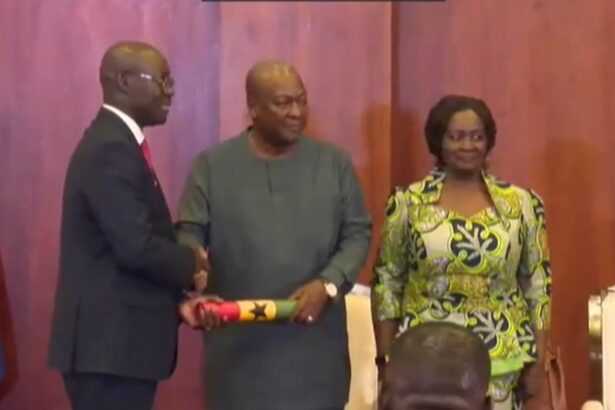
Bolgatanga Central Member of Parliament Isaac Adongo has publicly commended President John Dramani Mahama and Finance Minister Dr. Cassiel Ato Forson for displaying what he described as disciplined and decisive economic stewardship during the opening months of their administration.
The National Democratic Congress (NDC) lawmaker made these remarks during an appearance on GHOne TV, where he argued that the leadership duo deserves national recognition for their management approach since taking office in January 2025.
“Look the work that His Excellency and his Finance Minister have done. You see they need to applaud them. They need to get a Mallam who will pray for them for His Excellency John Mahama to start thinking from the other side and get to suddenly lose how it is to run an economy,” Adongo stated.
The MP, who also serves as a Bank of Ghana board member, emphasized that maintaining focus has proven critical to their performance thus far. He suggested that consistent execution of sound economic policies would eventually compel even critics to acknowledge their achievements.
“As long as they continue to keep the focus, my brother, they will be forced to sing praises,” he said.
Adongo highlighted the importance of presidential backing for finance ministers attempting to implement difficult reforms. He explained that without strong support from the head of state, finance ministers struggle to push through unpopular but necessary economic decisions.
“If you have a finance minister who doesn’t have the backing of the president, he will be a failure because there are certain difficult decisions that you will take that even your colleagues are not comfortable with. But that is what is required to swallow the bitter pill and heal,” the legislator observed.
The remarks come amid ongoing government efforts to renegotiate contracts and agreements that the NDC claims were inflated or poorly structured during the previous New Patriotic Party (NPP) administration. Adongo pointed to several instances where Dr. Forson’s team reportedly secured financial savings for the state through contract reviews.
He particularly praised the finance minister’s commitment to parliamentary transparency and due process. According to Adongo, Dr. Forson consistently returns to Parliament seeking approval for major financial decisions rather than attempting to circumvent legislative oversight.
“This thing requires the approval of the people of Ghana. So I’m going back to parliament. I want to be transparent. I want the people of Ghana to give me the mandate,” Adongo said, characterizing the minister’s approach.
He described this commitment to institutional processes as a hallmark of sound financial governance that would define Dr. Forson’s legacy. “That financial governance mentality will go down as one of his best,” he stated.
The Bolgatanga Central lawmaker has emerged as one of the most vocal defenders of the Mahama administration’s economic policies. His comments represent a marked shift from earlier this year when he publicly warned that Ghana’s International Monetary Fund (IMF) program faced serious challenges due to missed fiscal targets inherited from the previous government.
In March, Adongo revealed that Ghana recorded a primary balance deficit exceeding four percent in 2024, far from the projected 0.5 percent surplus required under the IMF Extended Credit Facility (ECF) agreement. He warned this shortfall threatened the entire $3 billion bailout program designed to support Ghana’s economic recovery.
However, by May, his tone had shifted considerably. Speaking on Joy News, he attributed recent stability in the Ghana cedi to deliberate, coordinated policy implementation between the Ministry of Finance and the Bank of Ghana rather than chance.
“What is happening now is an intentional policy implementation. It is a complementary effort from the Ministry of Finance and the central bank,” he explained, crediting both President Mahama and Dr. Forson for establishing what he called leadership with discipline.
Adongo also addressed earlier controversies surrounding his own appointment to the Bank of Ghana board. Some constituents in Bolgatanga Central had expressed disappointment that he was not selected as Finance Minister instead of Dr. Forson, with whom he has worked closely on financial policy matters for several years.
The MP defended Dr. Forson’s appointment, acknowledging that his colleague had always been ahead of him in parliamentary finance roles. He noted that when he first entered Parliament, Dr. Forson already served as Ranking Member on the Finance Committee.
“In the issue of Finance Minister proper, since I came to Parliament, I’ve always been behind Ato Forson,” Adongo stated on Asempa FM’s Ekosii Sen program in February.
He emphasized Dr. Forson’s previous experience as Deputy Minister of Finance in charge of revenue, which made him exceptionally qualified to lead the ministry during this challenging economic period. “He has what it takes to hit the ground running,” Adongo said, urging his constituents to remain patient.
In more recent statements, Adongo went further, privately telling Dr. Forson that his performance could position him as a future presidential candidate. “If you continue on the path that you are continuing, I don’t see the next president beyond you,” he reportedly said during their private conversation.
He clarified that his remark was not a formal endorsement but rather an assessment reflecting widespread impression among party members about the minister’s capabilities. “I’m not by this saying that Ato contests for president, but it is just to let him understand how I situate the work that he has done,” he explained.
The praise comes as the Mahama administration implements several flagship policies, including uncapping the Ghana Education Trust Fund (GETFUND) to provide dedicated funding for free secondary education. Dr. Forson presented this measure in the 2025 Budget Statement to Parliament in March.
Adongo defended the GETFUND decision, contrasting it with what he described as failures by the previous NPP government to provide adequate textbooks to senior high school students. “We were in this country when the NPP, instead of providing textbooks, will go and buy past questions for our children,” he said during parliamentary debate on the budget.
The government has also announced plans to pursue a 24 hour economy policy aimed at boosting productivity by encouraging businesses to operate around the clock. Dr. Forson indicated the policy would be formally presented to Parliament for approval as part of the administration’s job creation strategy.
Despite these initiatives, the government faces significant economic headwinds. President Mahama acknowledged during his State of the Nation Address in February that Ghana failed to meet several IMF benchmarks under the previous administration, particularly regarding inflation control and currency stability.
Inflation stood at 23.8 percent by the end of 2024, significantly exceeding the 18 percent target. The cedi lost 19 percent of its value against the dollar during 2024 after declining 27.8 percent in 2023.
However, recent months have shown improvement. The cedi’s volatility has calmed, and inflation has begun trending downward, though Adongo acknowledged the priority is achieving sustainable macroeconomic stability rather than dramatic currency appreciation.
“What we are looking for is stability, not a quantum jump of the cedi from ¢15 to ¢3. What we are doing now is to get the cedi to find the level that supports the economy,” he explained.
As Ghana awaits the IMF’s next program review, scheduled for later this year, the collaboration between President Mahama and Dr. Forson will face continued scrutiny from both domestic stakeholders and international creditors assessing the government’s commitment to fiscal discipline and economic reform.