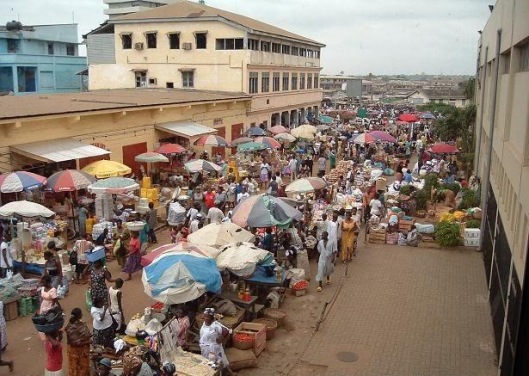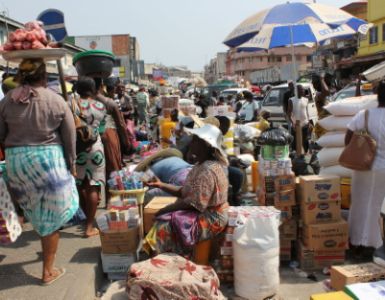
A larger part of economic activities in Africa is in the informal sector. About 85 percent of employment is informal but offers limited job security and access to social safeguards, according to the Africa Economic Outlook 2026 published by the African Development Bank (AfDB) at its ongoing Annual Meetings in Brazzaville, Congo.
The AfDB estimates indicate that shifting economic activity from the informal to the formal sector could generate up to $125 billion annually in additional revenue for Africa.
The Outlook argues that doing so would lead to improved access to finance, stronger property rights, and reduced competitive distortions.
“From a public finance perspective, formalization is a key lever for strengthening domestic revenue mobilization because it expands the tax base,” it said.
It states that recent estimates suggest that moving 10 percentage points of GDP from informality into formality could yield up to 2.6 percentage points of GDP in additional tax revenue annually, equivalent to about $75 billion.
These gains, it said, could strengthen fiscal sustainability while improving horizontal equity by narrowing gaps between compliant and noncompliant actors.
The Outlook notes that informality carries macroeconomic costs, which materialize in the short term through weak domestic revenue mobilization and persist over time through slower structural transformation and productivity growth.
Citing estimates, the Outlook says they indicate that each percentage point of GDP produced in the informal sector is associated with a loss of between 0.17 and 0.41 percentage points of GDP in tax revenue.
“These losses reflect both the narrowness of the effective tax base and the practical difficulty of capturing income and transactions generated by unregistered activity,” it said.
It further states that beyond revenue, informality constrains financial deepening because incomes remain outside banking channels, transaction records are limited and collateral is difficult to verify, which reduces financial intermediation and limits the ability o firms to invest and expand.
“By contrast, formalization, even when partial, can deliver sizeable growth and fiscal dividends. Building on global evidence, the AfDB (2025) estimated that a 10 percentage point reduction in the size of the informal sector could increase annual GDP growth in emerging markets and developing economies by about 1 to 2 percent,” it says.
It also added that these gains operate through higher productivity of formalized firms improved access to finance, stronger property rights, and reduced competitive distortions.
The Outlook points out that Africa’s weak labour markets and large informal sector contribute to income inequality. While the aggregate unemployment rate was reported at around 6.7 percent in 2024, about 85 percent of employment is informal, with limited job security and access to social safeguards.
In addition, it says about 29.3 percent of the people employed were categorized as working poor in 2024, earning less than $2.15 per day.
“Exogenous shocks, especially those that trigger oil and food price increases, tend to exacerbate inequalities by pushing more people into poverty. For example, 2022’s surge in international energy and food prices pushed 15 million people in Africa and the COVID-19 pandemic 43 million people, triggering a cost-of-living crisis, as real household incomes fell drastically,” it said.
The Outlook explains that low-skilled workers and those in vulnerable employment and informal jobs are especially prone to shocks, which tend to erode real incomes and heighten the poverty-reducing effects of economic growth.
“The overall impact disproportionately affects poorer households that spend 50-60 percent of their incomes on food. The poorest 10 percent of households spend on average 36.5 percent of their budget on food and 5.2 percent on energy,” it said.
It notes that Africa’s economies are projected to grow at 4.2 percent in 2026, moderating slightly from 4.4 percent in 2025, before rebounding to 4.4 percent in 2027.
The findings of the Outlook underscore the continent’s continued resilience in the face of geopolitical tensions, tighter global financial conditions, and supply chain disruptions.
The Annual Meetings holding from May 25 to 29, 2026 is under the theme: “Mobilising Africa’s development financing at scale in a fragmented world.”
By Emmanuel K Dogbevi, in Brazzaville, Congo