

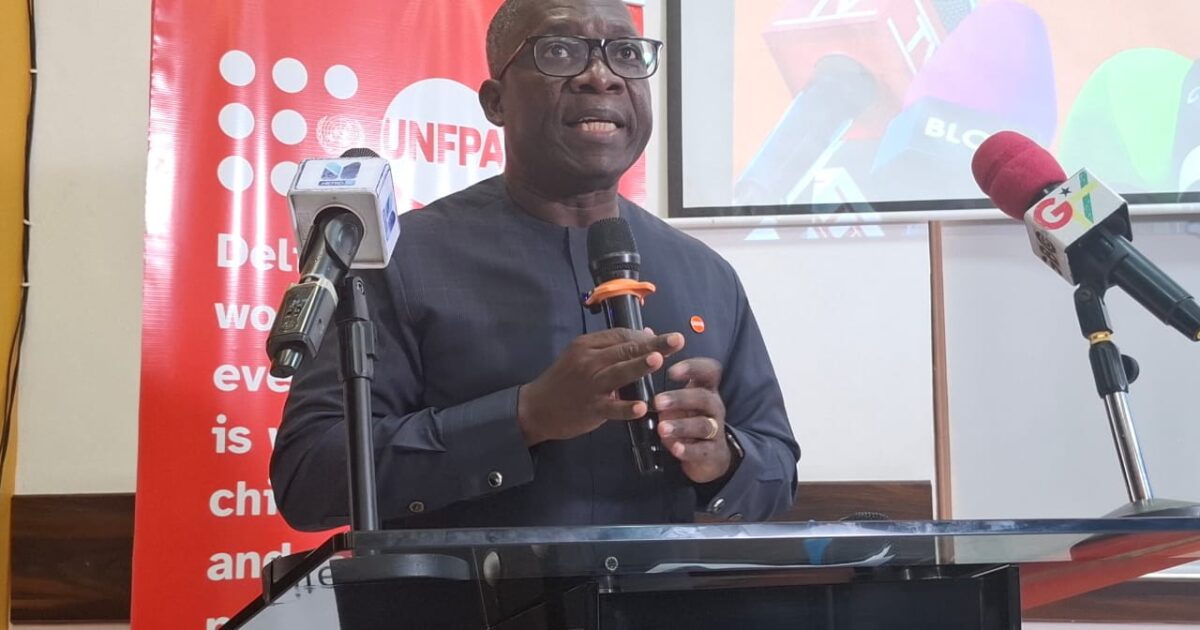
Dr. Sennen Hounton is the United Nations Population Fund (UNFPA) Regional Director for West and Central Africa.
The Regional Director of the United Nations Population Fund (UNFPA) for West and Central Africa, Dr Sennen Hounton, has called on African governments to increase domestic investment in healthcare, warning that inadequate and unsustainable financing remains a major obstacle to ending preventable maternal deaths across the continent.
Speaking during a press conference on the sidelines of the African Union Extraordinary Summit on Health Financing in Accra on Wednesday, July 23, Dr Hounton said governments have demonstrated political commitment to tackling maternal mortality, but persistent funding gaps and weaknesses within health systems continue to undermine progress.
“What is making it difficult for countries to achieve the target of maternal mortality elimination? It’s not lack of government will,” he said.
“In fact, in many countries you will see governments having even a presidential initiative to address that topic. But it’s a set of factors that is making it difficult.”
According to him, many women, particularly those living in rural and underserved communities, still lack access to quality maternal healthcare because health facilities and skilled birth attendants remain concentrated in urban areas.
“Not all women are still able to access quality and life-saving interventions. In many of our countries we have facilities in urban areas and we don’t have facilities covering the rural areas. We have midwives mainly in the cities and we don’t have midwives in the peripheral part of the countries,” he noted.
Dr Hounton stressed that reducing maternal mortality should no longer be viewed solely as the responsibility of ministries of health, but rather as a broader national development issue requiring coordinated action across government.
“We thought at UNFPA that it is important to move the conversation from a health sector perspective to a development multi-sectoral perspective,” he said.
“For far too long, we thought that maternal mortality and newborn mortality are just for the health sector. But we realised that even to have the midwives, the Ministry of Finance and Budget needs not only to appropriate money to recruit, but release this money so we can recruit and deploy.”
He explained that this thinking informed the African Union summit’s focus on domestic and sustainable financing for health.
“The financing is not that we didn’t know it was important, but it is more important and that’s why the topic of this AU Extraordinary Summit is domestic financing and sustainable financing,” he added.
The UNFPA Regional Director also called for stronger accountability mechanisms, urging governments to regularly review maternal health data and assess whether interventions are delivering results.
“We only make progress on what we measure,” he said.
“Annually or semi-annually, whether it is at the President’s Cabinet level or at the decentralised level of government, we need to sit down and look at the data. Are we making progress? Are we not making progress? And if we are not, what do we need to do?”
Dr Hounton further highlighted the importance of expanding health insurance coverage and providing targeted support for poor and vulnerable pregnant women who remain excluded from social protection schemes.
“Many people are still not part of this social safety net, or the cost is just too much for them,” he observed.
“We need to identify the extreme poor, those who, despite the national insurance, cannot pay the premium. We must find solutions to address that. Otherwise, they will continue to drive the number of maternal mortality.”
While acknowledging that African governments face competing demands for limited public resources, he said innovative financing mechanisms were needed to bridge the gap.
Dr Hounton revealed that UNFPA is working with the African Development Bank to establish financing instruments combining concessional loans and grants to enable countries to invest more in healthcare.
“Countries must have access to capital and resources to do the investment that they are doing,” he said.
“What we are doing with the African Development Bank is creating financing instruments. It’s a combination of concessional loans and grants, and countries can then have access and invest in the health of their communities.”
He maintained that all future investments in healthcare must prioritise equity to ensure people living in remote communities enjoy the same access to quality healthcare as those in major cities.
“As you raise capital, you need to be thinking about equity… those who are not only living in cities like you and I here, but those who are in the remote area of our countries and need also to enjoy full and dignified health,” he said.
Despite the challenges, Dr Hounton expressed confidence that African countries could significantly reduce maternal mortality if governments strengthened domestic financing, improved accountability and ensured equitable access to quality healthcare services.
DISCLAIMER: The Views, Comments, Opinions, Contributions and Statements made by Readers and Contributors on this platform do not necessarily represent the views or policy of Multimedia Group Limited.
DISCLAIMER: The Views, Comments, Opinions, Contributions and Statements made by Readers and Contributors on this platform do not necessarily represent the views or policy of Multimedia Group Limited.
Source link