

African oil-producing countries have been urged to strengthen local content development by creating a sustainable pipeline of upstream investments and projects, while maintaining an enabling business environment that attracts international investors.
The call was made at just ended Local Content Conference and Exhibition (LCCE), where industry stakeholders stressed that building a resilient, competitive and sustainable oil and gas sector requires more than policies promoting indigenous participation.
It also demands continuous exploration, new project development and strategic partnerships capable of generating lasting opportunities for local businesses.
Contributing to a panel discussion on enhancing local content for sustainable growth, Deputy Managing Director of Eni Ghana, Mr Baluri Kassim Bukari, said Ghana’s experience demonstrated that local content development was intrinsically linked to the level of activity and investment within the upstream sector.
He cited Ghana’s Offshore Cape Three Points (OCTP) project, operated by Eni Ghana, which currently supplies more than 70 per cent of the country’s domestic gas for power generation, as an example of how upstream investments could generate significant opportunities for indigenous businesses.

Mr Bukari recalled that during the project’s development phase, several international companies entered Ghana, established joint ventures with local partners and secured contracts under the country’s local content framework.
He disclosed that Eni Ghana awarded more than US$4 billion in contracts to local companies, including indigenous businesses and joint ventures, generating employment and stimulating economic activity.
He noted that Takoradi experienced a significant increase in commercial activity during the development phase, with hotels and other businesses benefiting from the presence of companies and workers engaged in the project. However, economic activity slowed following the completion of the development phase, leaving many local businesses with fewer opportunities.
According to him, this experience highlights a fundamental requirement for successful local content development: a sustained pipeline of upstream investments and projects.
“You can’t have local content without content,” he said, urging Ghana to accelerate the award of petroleum blocks, encourage exploration and facilitate the development of new projects.
Mr Bukari cautioned against a situation where indigenous companies obtain regulatory permits, establish offices and employ workers but struggle to secure contracts because of insufficient industry activity.
He stressed the need for Ghana to move beyond memoranda of understanding (MOUs) towards concrete agreements backed by firm investment commitments and Final Investment Decisions (FIDs).
On the capacity of indigenous companies, he observed that opportunities existed across the entire oil and gas value chain, although certain specialised activities required advanced technologies and technical competencies that were not yet fully developed locally.
He therefore called for deliberate investment in technical training, health and safety, operational standards and other specialised skills to strengthen the capacity of Ghanaian companies to compete for more complex industry assignments.
In highlighting local business participation, Mr Bukari emphasized the broader economic contribution of OCTP, particularly the supply of gas to the Ghana National Petroleum Corporation (GNPC) for domestic thermal power generation. He noted that the gas continued to support electricity supply to households, schools, churches, commercial establishments and industries.
Deputy Chief Executive for Finance, Commercial and Administration of GNPC, Mr Hamis Yussif, said Ghana’s local content strategy had been shaped by the need to attract international partners while progressively developing indigenous capabilities.
He explained that following the discovery of oil, GNPC’s accelerated growth strategy identified local content development as one of its key priorities.
He said Ghana’s ambition should extend beyond local employment and procurement to building indigenous companies capable of owning assets, developing technical expertise and competing in international markets.
Achieving this, he noted, would require sustained investment and a consistent pipeline of opportunities to enable local businesses to maintain, strengthen and expand their capabilities.
Mr Yussif cautioned, however, against viewing local content and foreign investment as competing objectives, stressing that without projects and investments from international oil companies, opportunities for indigenous businesses to participate in the industry would remain limited.
Sharing Nigeria’s experience, Eng. Bashir Ahmed, a representative of the Nigerian Content Development and Monitoring Board (NCDMB), underscored the importance of adapting local content policies to changing industry conditions.
He explained that Nigeria’s local content framework became more structured following the establishment of the NCDMB in 2010, after earlier policies failed to achieve the desired results.
Nigeria initially pursued an aggressive local content strategy, which contributed to the development of domestic fabrication, engineering and manufacturing capabilities.
Eng. Ahmed cited the integration of topside modules in Nigeria around 2013 as a significant milestone, alongside the growth of local manufacturers providing goods and services to the oil and gas industry.
However, he noted that the subsequent slowdown in major deepwater projects exposed the challenges of building local capacity without corresponding industry activity.
Although Nigerian companies had invested in fabrication facilities and engineering capabilities, the absence of new investment decisions by international oil companies limited the availability of projects and commercial opportunities for local businesses.
He said Nigeria subsequently reviewed its approach through executive orders, regulatory adjustments and tax incentives introduced around 2022 and 2023, with the aim of making its local content framework more supportive of investment while sustaining the country’s indigenous participation objectives.
Representing Angola, Ms Maura Nunes of the National Agency for Petroleum, Gas and Biofuels (ANPG) said the country’s local content policy was anchored on the principle of “For Angolans, by Angolans, with Angolans.”
She explained that a presidential decree introduced in 2020 established two principal objectives: increasing the participation of Angolan companies in the oil and gas industry and developing the skills and capabilities of the country’s human resources.
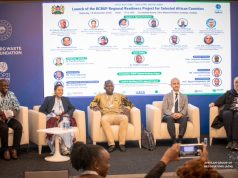
The panel discussion was moderated by the Chief Executive Officer of the Ghana Upstream Chamber, Mr David Ampofo.
DISCLAIMER: The Views, Comments, Opinions, Contributions and Statements made by Readers and Contributors on this platform do not necessarily represent the views or policy of Multimedia Group Limited.
DISCLAIMER: The Views, Comments, Opinions, Contributions and Statements made by Readers and Contributors on this platform do not necessarily represent the views or policy of Multimedia Group Limited.
Source link