By Joyce Gyekye
For fishing families along Ghana’s coastline, the threat of climate change is no longer a distant environmental concern. It is increasingly a question of whether their homes will remain safe, whether the sea will continue to sustain their livelihoods and whether future generations can depend on the ocean for their survival.
Rising sea levels, coastal erosion, flooding and changing marine ecosystems are putting growing pressure on communities whose lives and economies depend on the ocean.
The challenge extends beyond Ghana. Across Africa, coastal communities are confronting similar threats, even as governments seek to unlock the enormous economic opportunities offered by the continent’s blue economy.
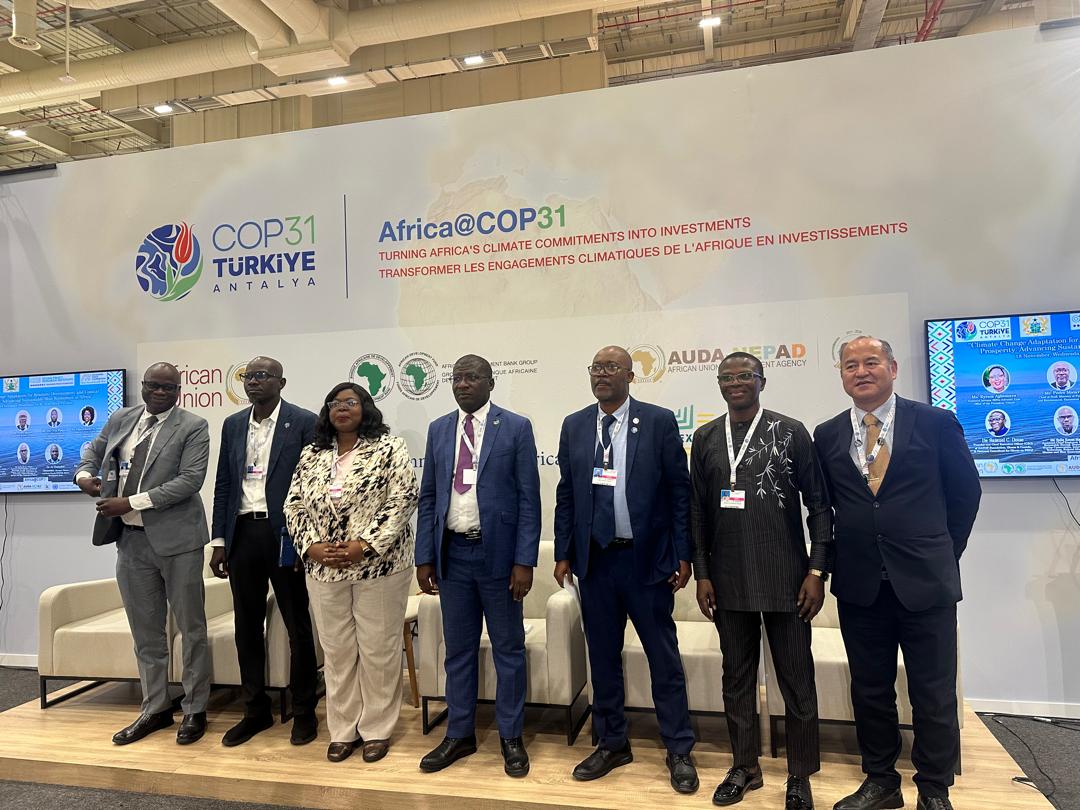
At a roundtable discussion on climate change adaptation for resilience development and coastal prosperity at COP31 in Antalya, Türkiye, experts and development representatives warned that Africa’s ambitions for a sustainable blue economy could be undermined unless climate adaptation, coastal protection and sustainable financing become central to development planning.
For Ghana, the urgency is particularly significant.
Technical Advisor to the SDGs Advisory Unit at the Office of the President, Eyram Agbemava, said the country’s coastline supported approximately 30 per cent of its population, while fishing provided livelihoods for about 10 per cent of the people. She cited estimates indicating that Ghana’s coastline was eroding at an average rate of approximately 0.86 metres annually, with sea levels projected to rise by 23.4 centimetres by 2060.
“For Ghana, climate adaptation and coastal resilience are not merely environmental priorities. They are fundamental to our economic development, food security, livelihoods and long-term national prosperity,” she said.
The figures underscore the growing pressure on coastal settlements and the need to move beyond emergency responses towards long-term adaptation measures.
Ghana is seeking to address the challenge through a combination of policy, institutional reforms and practical interventions.
Ms Agbemava said the country had published its Sustainable Ocean Plan in November 2025, providing a national framework for managing and protecting its marine and coastal environment.
This is complemented by the National Blue Economy Policy and Strategy, which seeks to align ocean wealth, knowledge, finance, equity, safety and security within a coordinated development framework.
She also highlighted Ghana’s first National Adaptation Plan, launched in December 2025, to identify climate vulnerabilities and prioritise interventions across sectors.
At the district level, climate hazard and vulnerability assessments are being undertaken across 39 districts, including adaptation planning for vulnerable coastal areas.
Other interventions include mangrove and wetland restoration, coastal protection, early warning systems and the integration of climate risks into infrastructure planning.
Ghana has also declared its first marine protected area, MPA in the Western Region, covering approximately 703 square kilometres, with further areas expected to follow.
But translating these commitments into lasting protection requires substantial financial resources.
Ms Agbemava said coastal adaptation plans must be converted into bankable projects capable of attracting public and private investment.
“Our coastal adaptation plans must be translated into bankable projects, supported by innovative financing instruments such as blue bonds, debt-for-nature swaps and blended finance,” she said.
She called for stronger cooperation among African countries, stressing that marine ecosystems, fisheries resources and climate vulnerabilities did not respect national boundaries.
The financing challenge is also central to the African Development Bank’s assessment of the continent’s blue economy potential.
Dr Al-Hamndou Dorsouma of the African Development Bank (AfDB), in charge of Climate change, said the sector offered significant economic opportunities, with estimates suggesting that Africa’s blue economy represented an investment opportunity exceeding 400 billion US dollars annually.
“The blue economy represents an investment opportunity of more than 400 billion US dollars per year in African countries,” he said.
He said the Bank had invested in the sector over the past two decades through programmes supporting fisheries, youth entrepreneurship, employment and coastal infrastructure.
Among the examples he cited was a 46-million-dollar programme in Zanzibar, Tanzania, to promote youth entrepreneurship and employment in the blue economy, and a 22-million-dollar investment in São Tomé and Príncipe to strengthen fisheries governance and rehabilitate coastal infrastructure.
The Bank had also invested approximately 400 million dollars in the fisheries sector in recent years, while providing technical assistance to countries including Burkina Faso, Cabo Verde and Benin.
Dr Dorsouma said Africa needed to strengthen its capacity to prepare feasibility studies and develop bankable projects that could attract financing.
However, he warned that the continent’s blue economy faced threats beyond climate change.
Illegal, unreported and unregulated fishing was among the major challenges, costing African economies an estimated 13 billion dollars annually.
“Illegal, unreported and unregulated fishing represents a cost of about 13 billion US dollars per year for African economies,” he said.
He called for stronger policies and regulatory enforcement to protect marine resources and fisheries livelihoods.
He also drew attention to the vulnerability of African ports to climate change, citing an AfDB study which found that many remained exposed to climate-related impacts.
Given the importance of ports to international trade and national economies, he warned that failure to strengthen their resilience could have serious economic consequences.
For the Chief Executive Officer of HATOF Foundation, Dr Samuel Dotse, however, the success of Africa’s blue economy must ultimately be judged by what it delivers to the people who depend on the ocean.
He argued that resilience should not be measured only by infrastructure investments or national economic indicators, but by whether coastal families could maintain their livelihoods, protect their homes and prepare for climate-related disasters.
“When we talk about resilience, we are looking at a home that remains safe, a fishing livelihood that remains viable, children who can continue to attend school and access to support before a disaster becomes a humanitarian crisis,” he said.
Dr Dotse cited the World Meteorological Organization’s State of the Climate in Africa 2025 report, which documented rising sea levels along some African coastlines and rapidly warming sea surface temperatures.
He also referred to estimates presented during the launch of Ghana’s West Africa Coastal Areas Management Programme (WACA) in August 2024, indicating that approximately 5.5 million coastal residents faced climate risks, with about 80 per cent of those living along the coastline experiencing high vulnerability to climate impacts. He called for a fundamental shift in how governments approach coastal ecosystems, arguing that their protection should be treated as an investment in national development.
“We should treat coastal ecosystems as development infrastructure. Mangroves, wetlands, lagoons and estuaries must feature in our national investment plans alongside roads and other infrastructure,” he said.
He further called for investments in small-scale fisheries, particularly to support women and young people through improved cold storage, safer landing facilities, better fish processing, accessible weather information and affordable financing.
On international ocean governance, Dr Dotse urged African countries, including Ghana, to connect their National Adaptation Plans with the implementation of the Biodiversity Beyond National Jurisdiction (BBNJ) Agreement.
He proposed scientific collaboration among universities, academic institutions and organisations holding marine data to support evidence-based implementation and strengthen national adaptation planning.
He also called for sustained coastal resilience investment programmes that connect national adaptation plans, ocean strategies and district-level development priorities.
For the three speakers, the message was clear: Africa cannot build a prosperous blue economy while the coastal ecosystems and communities that sustain it remain vulnerable. The continent’s ocean wealth can only translate into lasting prosperity if investment in economic opportunities goes hand in hand with climate adaptation, environmental protection and the resilience of the people whose lives depend on the sea.