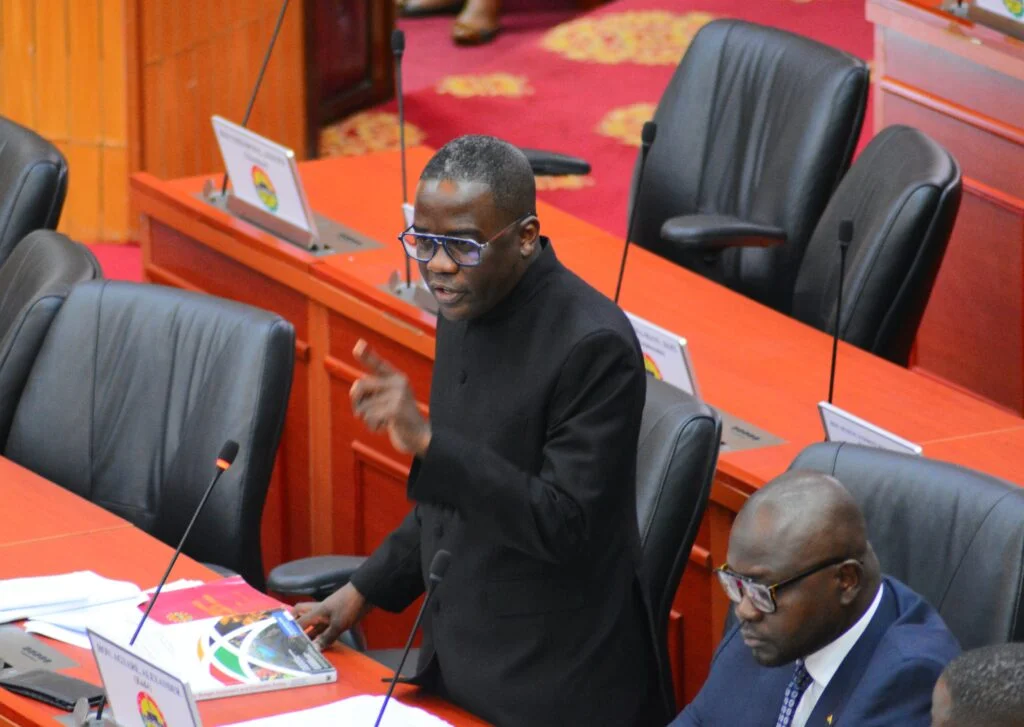
The Member of Parliament for Bekwai, Ralph Poku-Adusei, has described the 2027 Budget Statement as “jobs deficient”, accusing the government of introducing new economic programmes without accounting for employment commitments made in previous budgets.
Contributing to the parliamentary debate on the 2027 Budget presented by Finance Minister Dr Cassiel Ato Forson on November 12, 2026, the MP questioned the government’s record on job creation, expenditure and the implementation of flagship programmes.
Poku-Adusei, who is also Deputy Ranking Member of Parliament’s Select Committee on Sanitation and Water Resources, participated in the debate remotely while in Switzerland as part of a parliamentary delegation attending a conference.
He argued that the 2027 Budget failed to provide verifiable figures on the number of jobs created from the 800,000 projected in the 2026 Budget and the progress made under the 24-Hour Economy initiative, which was expected to generate 1.7 million jobs by the end of 2028.
He also questioned the government’s introduction of the US$10 billion New Economy programme, which is expected to run from 2027 to 2030, arguing that the administration had yet to account adequately for its previous employment commitments.
The MP recalled that the 2025 and 2026 budgets allocated funds to several initiatives, including the Big Push Programme, Adwumawura, the Women’s Development Bank, the National Apprenticeship Programme and the National Coders Programme.
He noted that the Women’s Development Bank received allocations totalling GH¢452.5 million across the two budgets but had yet to commence lending operations as of November 2026. He also questioned the implementation of other programmes, including the National Coders Programme and Feed Ghana.
Poku-Adusei further challenged the government’s expenditure performance, citing figures which he said showed that only GH¢6.5 billion of the GH¢30 billion allocated to the Big Push Programme in 2026 had been spent by mid-year.
He also questioned the GH¢30 billion earmarked for the New Economy programme in 2027, arguing that budgetary allocations must translate into actual releases and completed projects.
Turning to the Ashanti Region, the Bekwai MP said the GH¢685 million allocation for the completion of Kejetia Market Phase Two was the most prominent specifically named project with a direct allocation for the region in the 2027 Budget.
He questioned the absence of more visible infrastructure and industrial investments in Kumasi and other parts of the region, while describing the proposed Accra-Kumasi Expressway and Western Corridor Railway extension to Nyinahin as projects yet to make tangible progress on the ground.
Poku-Adusei also raised concerns about the country’s foreign exchange reserves, the resources generated through gold transactions and the rising cost of living, arguing that improvements in macroeconomic indicators had not sufficiently translated into better conditions for households and businesses.
He maintained that the government must provide a clear account of its previous commitments, including the number of jobs created, funds released and projects completed, before introducing additional targets.
“A budget must be judged not by what it announces, but by what it releases,” he said, insisting that Ghanaians deserved measurable results rather than new promises.