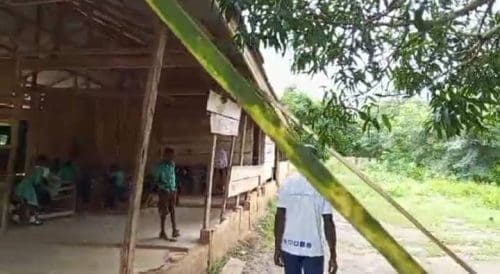


Parents in Berekum are pleading for government intervention as the kindergarten block at Berekum Senior High Basic School deteriorates into what they describe as a death trap, forcing students to evacuate whenever rain threatens.
The school, established in September 2003 and taken over by the government in 2004, has seen its kindergarten facilities neglected for more than a decade. Now parents warn that without urgent action, the crumbling structure could cause a disaster.
Elder Samuel Sarfo, chairman of the Parents Association, told 3News that children lack even basic amenities. “They don’t even have a place of convenience,” he said, appealing to authorities to build a new classroom block as a matter of urgency to promote an effective learning environment.
The deteriorating conditions are affecting enrollment. Madam Anima Ellen, a parent, explained that the school’s population is gradually declining because of the classroom structure’s poor state. Another parent, Mame Ameyaa, stressed that whenever rain approaches, pupils must close early and go home—disrupting their education and leaving them behind academically.
The situation at Berekum Senior High Basic School reflects broader challenges facing Ghana’s basic education infrastructure. Supply-side deficiencies manifested in absent or poorly maintained facilities in underserved communities represent a major driver of the country’s out-of-school challenge, according to a recent Africa Education Watch report.
The quality of education in rural schools is severely impacted by inadequate infrastructure, a problem that undermines Ghana’s educational outcomes. Many schools operate in dilapidated buildings with limited access to essential facilities like laboratories, libraries, clean water, and sanitation.
At current pace, Ghana would take another 58 years to bridge the infrastructure gap between primary and junior high schools. That projection comes despite government allocating a record GH¢9.1 billion to basic education in the 2025 budget—the largest single investment in the sector in over five years.
The government’s decision to uncap the Ghana Education Trust Fund (GETFund) could free approximately $2.8 billion in the medium term for infrastructure financing between 2025 and 2028. However, analysts warn that amount alone would be inadequate due to competing demands from consumption expenditure.
Stakeholders have called on government to adopt an equitable framework for distributing education funds, with priority given to basic education as the foundation of the system. They emphasize bridging the quality gap between rural and urban schools through deliberate investment.
For parents in Berekum, these policy discussions feel distant when their children study in facilities they fear could collapse. The kindergarten block’s neglect over 10 years suggests that even when schools come under government control, sustained maintenance and upgrades often fail to materialize.
The pattern repeats across Ghana’s educational landscape. Infrastructure deficiencies are widespread, with many basic schools operating in conditions that compromise both safety and learning quality. Some students don’t even have classrooms, receiving instruction under trees instead.
Rural students face particularly acute challenges. Daily commutes can be long, difficult, and unsafe. Lack of water forces students to leave during school hours seeking water from distant sources. Children with disabilities often find existing classrooms inaccessible.
What makes the Berekum situation especially frustrating for parents is how preventable it seems. The school exists. It was taken over by government two decades ago with the presumption that public management would ensure proper maintenance. Instead, the kindergarten block has been allowed to deteriorate to the point where parents genuinely fear for their children’s safety.
The declining enrollment that Madam Ellen described suggests families are voting with their feet, moving children to schools with better facilities when possible. That creates a vicious cycle where neglected schools lose students, making it even less likely they’ll receive investment to improve conditions.
For Elder Sarfo and other parents, the appeal is straightforward: build a new classroom block before the old one causes harm. Whether authorities will respond with the urgency parents say is needed remains uncertain. But as rain clouds gather over Berekum, parents know their children will once again be sent home early—another day of learning lost to crumbling infrastructure.