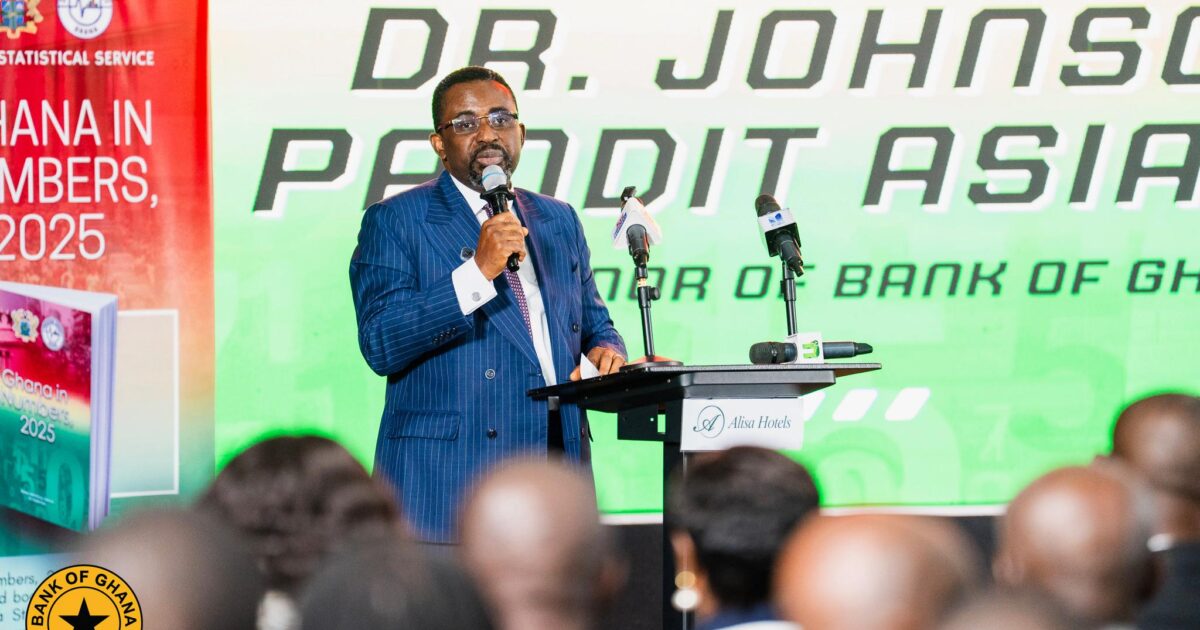

The Governor of the Bank of Ghana (BoG), Dr Johnson Pandit Asiama, has called for a dedicated digital platform to make the country’s official statistics more accessible, saying wider access to reliable data could improve economic research, policymaking and investment decisions.
He said making underlying data available in machine-readable formats would allow researchers, policymakers and businesses to deploy artificial intelligence (AI), machine learning and other analytical tools to identify economic trends and relationships that might not be apparent from published tables and charts.
Dr Asiama made the call at the launch of the maiden edition of Ghana in Numbers 2025, an initiative of the Ghana Statistical Service (GSS), on Thursday, October 29.
He commended the GSS for bringing together authoritative information on the country’s socio-economic conditions, describing the report as an important resource for understanding national progress, identifying emerging challenges and setting development priorities.
He said the publication would be particularly useful if official statistics were made easier for policymakers, businesses, researchers, development partners and the public to access and use.
Data at the heart of monetary policy
Dr Asiama said accurate and timely statistics were essential to the central bank’s work, particularly in setting monetary policy and regulating the financial sector.
As an inflation-targeting central bank, he said, the BoG relied on data to assess price movements and their relationship with exchange rates, economic activity, credit conditions and developments in the external sector.
Such assessments, he explained, required sound economic research and analytical methods supported by reliable statistics.
“Reliable statistics do more than inform policy. They strengthen transparency, enhance accountability and promote public confidence in institutions,” he said.
He added that dependable economic data also helped businesses and investors assess prevailing conditions, manage risks and make informed investment decisions.
The Governor welcomed the inclusion of a dedicated monetary and financial-sector section in Ghana in Numbers 2025, which draws substantially on official data produced by the BoG.
Information on inflation, interest rates, lending to businesses and households, foreign reserves and banking-sector conditions, he said, offered a clearer picture of the country’s economic and financial environment.
Push for AI-driven economic analysis
Dr Asiama said advances in data science, artificial intelligence and machine learning presented opportunities to improve economic forecasting, identify patterns and assess risks.
He noted that these technologies could complement conventional economic analysis and strengthen the central bank’s ability to respond to changing economic conditions.
To realise those benefits, however, he said the data underpinning publications such as Ghana in Numbers needed to be available in formats that could be readily accessed and analysed electronically.
A dedicated portal offering machine-readable datasets, he said, would allow researchers, academics and policymakers to examine information in greater depth and investigate relationships across different economic indicators.
The proposed platform could extend the usefulness of the report beyond its published tables and charts by allowing users to conduct their own analysis using advanced digital tools.
BoG builds capacity, prepares AI rules
Dr Asiama said the central bank was strengthening its own capacity to use data analytics and emerging technologies in policy development and institutional decision-making.
As part of that effort, the BoG has established a Data Analytics and Artificial Intelligence Department to improve data governance, expand analytical capabilities and support the responsible use of new technologies.
He also disclosed that the bank was developing a directive to regulate the use of artificial intelligence in the financial sector.
The proposed directive, he said, formed part of the central bank’s approach to encouraging innovation while addressing risks associated with the growing use of AI.
His remarks highlighted the importance of combining reliable official statistics with modern analytical tools to strengthen economic decision-making, while ensuring that the use of emerging technologies in the financial system is appropriately governed.
DISCLAIMER: The Views, Comments, Opinions, Contributions and Statements made by Readers and Contributors on this platform do not necessarily represent the views or policy of Multimedia Group Limited.
DISCLAIMER: The Views, Comments, Opinions, Contributions and Statements made by Readers and Contributors on this platform do not necessarily represent the views or policy of Multimedia Group Limited.
Source link