

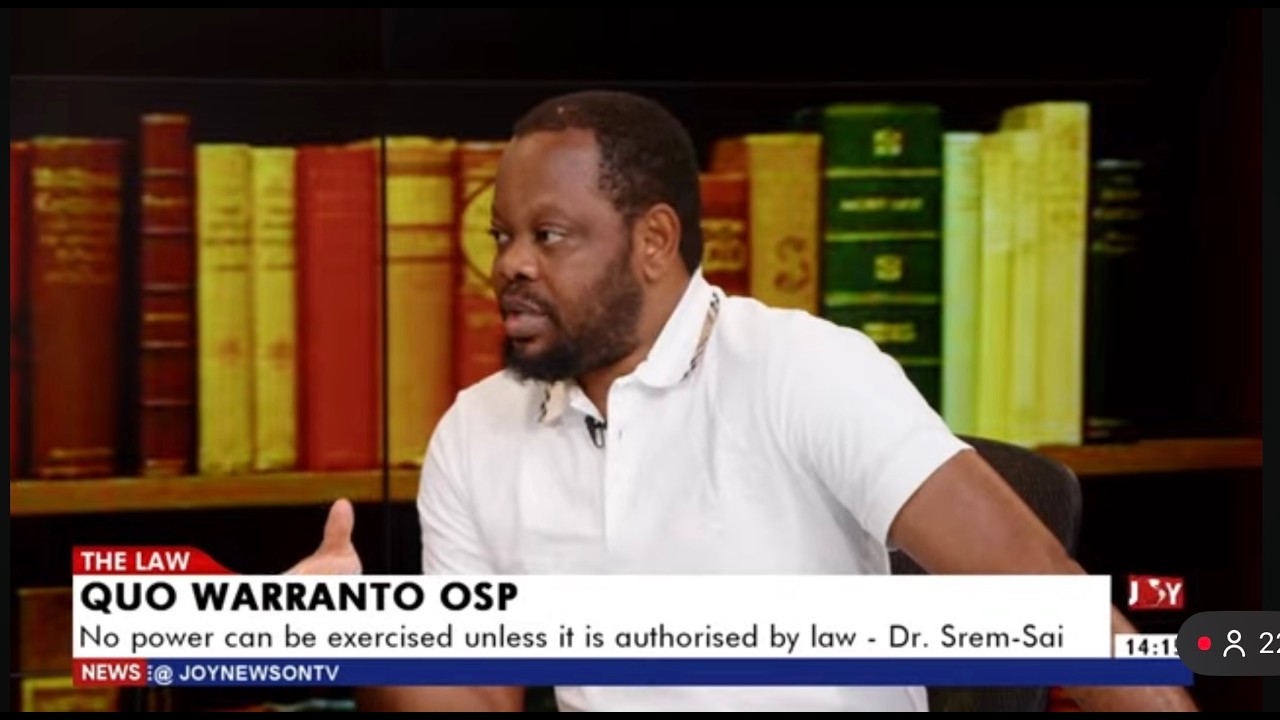
Deputy Attorney-General and Minister for Justice, Dr Justice Srem-Sai, has argued that Ghana cannot establish an independent prosecutorial authority or vest the Office of the Special Prosecutor (OSP) with independent prosecutorial powers without first amending Article 88 of the 1992 Constitution.
According to him, the Constitution unequivocally vests prosecutorial authority in the Attorney-General, making it impossible for Parliament to create an independent prosecutorial body through ordinary legislation alone.
His comments come in the wake of the recent Quo Warranto ruling involving the OSP, which has reignited debate over whether the anti-corruption body can independently prosecute criminal cases.
Speaking on The Law with Samson Lardy Anyenini on Sunday, 26 July, Dr Srem-Sai said the High Court’s decision reflected the long-held position of constitutional lawyers, as well as current and former holders of the Office of the Special Prosecutor.
“I do not know any lawyer who believes that it could create an independent prosecutorial authority without amending Article 88 of the Constitution,” he said.
“Every lawyer that I’ve spoken with and that I’ve heard hold one position, and this includes even the persons who have occupied and are still occupying the office of the Special Prosecutor. They’ve all held one position, and the position is simple: to be able to create an independent prosecutorial authority in Ghana, you need to amend Article 88.”
Dr Srem-Sai maintained that although the Office of the Special Prosecutor Act established the OSP, it could not override or amend constitutional provisions governing prosecutorial authority.
He stressed that constitutional amendments must be carried out through the procedures prescribed in the Constitution and not by ordinary legislation passed by Parliament.
“I cannot stand anywhere, either before a court of law, give an opinion to the government or a private person, or publish any article in any academic journal or anywhere, and say that you can use legislation to amend a provision of the Constitution. I can’t do that.”
He added that successive constitutional review processes had all recognised that any changes to entrenched constitutional provisions must follow the amendment procedures set out in the Constitution.
“This whole idea of Constitution Review Commission, Constitution Review Committee and Constitution Review Implementation Committee is because we all agree and understand that the only way we could amend the Constitution is to go by the process of amendment specified by the Constitution.”
Dr Srem-Sai further argued that the Office of the Special Prosecutor Act was enacted as ordinary legislation under Article 106 of the Constitution and, therefore, could not confer powers that were inconsistent with Article 88.
“The OSP Act is an ordinary legislation passed under Article 106, not under the constitutional amendment procedures. It is difficult for me to say or to accept the view that the OSP Act has changed the provision of the Constitution.”
He concluded that anyone seeking to make the OSP a truly independent prosecutorial authority must pursue constitutional reform rather than rely on statutory interpretation.
“The only way to do what we seek to do is to amend Article 88.”
Supreme Court to rule on OSP’s prosecutorial powers on July 29
Meanwhile, the Supreme Court is expected to deliver judgment on 29 July 2026 in a suit challenging the prosecutorial powers of the Office of the Special Prosecutor.
A seven-member panel chaired by Chief Justice Paul Baffoe-Bonnie fixed the date after parties concluded their arguments in the case brought by private legal practitioner Noah Adamtey.
Mr Adamtey is challenging the constitutionality of the Office of the Special Prosecutor Act, 2017 (Act 959), arguing that it unlawfully grants the OSP independent prosecutorial authority.
He is seeking a declaration that provisions of the Act conferring original and insulated prosecutorial powers on the OSP are inconsistent with Articles 1(2), 88(3) and (4), 93(2), and 296 of the 1992 Constitution and are therefore null and void.
He further contends that Sections 3(3) and 4 of Act 959, which make the OSP independent of the Attorney-General in initiating, conducting and terminating prosecutions, violate the Constitution.
Representing the Attorney-General in the case, Dr Srem-Sai argues that Article 88(3) vests prosecutorial authority exclusively in the Attorney-General. He contends that Parliament acted unconstitutionally by requiring the Attorney-General to delegate part of those powers to the OSP.
According to him, the legislation effectively limits the Attorney-General’s constitutional responsibility for prosecuting criminal offences by carving out categories of cases for the OSP.
In January, the Supreme Court unanimously dismissed an application by the OSP to join the proceedings as an interested party, holding that the constitutional issues could be fully determined between the plaintiff and the Attorney-General without the OSP’s direct participation.
However, the court granted an application by 14 civil society organisations to join the proceedings. Their lawyer, Kizito Beyuo, argued that the organisations played a significant role in the establishment of the OSP and possessed expertise that could assist the court.
The organisations, including Transparency International Ghana, CDD-Ghana, IMANI Africa, and the Ghana Anti-Corruption Coalition, say their intervention is driven by a commitment to constitutionalism, accountability, anti-corruption efforts, and the preservation of independent public institutions.
DISCLAIMER: The Views, Comments, Opinions, Contributions and Statements made by Readers and Contributors on this platform do not necessarily represent the views or policy of Multimedia Group Limited.
DISCLAIMER: The Views, Comments, Opinions, Contributions and Statements made by Readers and Contributors on this platform do not necessarily represent the views or policy of Multimedia Group Limited.
Source link