


By Kizito CUDJOE
The country’s plan to expand public transport with 300 newly procured diesel buses is raising questions about policy coherence, as the move apparently runs counter to ambitions of accelerating electric vehicle (EV) adoption and cutting transport-sector emissions.
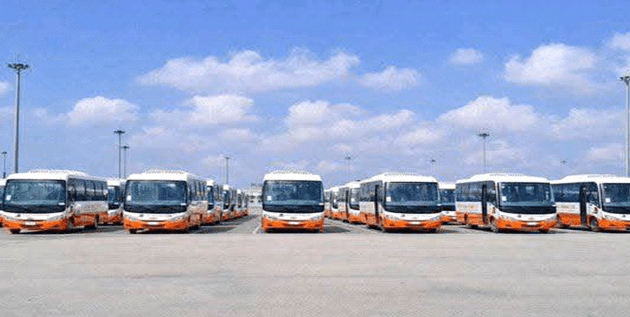
The first batch of 100 Isuzu-manufactured 29-seater buses has arrived, with further deliveries expected in August and November, Minister of Government Communications Felix Kwakye Ofosu has said.
The buses are intended to ease mounting commuter pressure and support state operators, including Metro Mass Transit (MMT) and State Transport Corporation (STC).
While the intervention addresses an immediate transport shortfall, it has drawn scrutiny against the backdrop of Ghana’s National Electric Vehicle Policy and broader energy transition commitments.
The EV policy, introduced in 2023, sets out a roadmap to promote clean mobility, reduce fossil fuel dependence and position the country as a hub for electric transport by leveraging opportunities such as its lithium deposits. It targets about 35 percent EV penetration in new vehicle sales and 60 percent electrification of government fleet by 2035.
Against these goals, it is seen that the decision to scale up internal combustion engine (ICE) vehicles risks complicating the transition pathway.
Public transport buses typically remain in service for more than a decade. The current procurement therefore extends the operational life of diesel-powered assets well into the period when EV adoption is expected to accelerate, raising concerns about long-term emissions and cost implications.
The move also carries signalling effects. Government is one of the largest buyers in the transport sector and its procurement decisions can influence private investment in emerging industries. Continued reliance on ICE vehicles, energy experts say, may weaken momentum for EV-related infrastructure, financing and supply chains.
Government officials have however defended the decision as a necessary short-term intervention.
The Director of Renewables-Ministry of Energy and Green Transition, Seth Manu, said the buses were procured under the transport ministry’s mandate to address urgent mobility challenges, particularly during peak commuting hours.
“In terms of alignment with our energy transition agenda, we are looking at a transition over a long period – up to 2070 – for us to be able to fully transition,” he said.
He noted that the transition does not imply an immediate elimination of internal combustion technologies, but rather a gradual shift in which emissions from fossil-based systems are offset by investments in cleaner energy solutions.
“The modern energy systems that we bring on board, when you look at their carbon mitigation potential against emissions from hydrocarbon-based sources, should net up to zero,” he said, adding that the buses are relatively energy-efficient and intended to ease productivity losses linked to transport bottlenecks.
Some energy experts also argue that the issue is less about whether ICE vehicles should exist during the transition and more about how procurement decisions are sequenced and justified.
The Senior Project Officer-Centre for Extractives and Development, Africa (CEDA), Shika Akpaloo, said each of the 300 buses is likely to operate for 10 to 15 years; effectively locking in fossil fuel use during a period when Ghana is expected to scale up electric mobility.
“The credibility gap is real,” she said, noting that governments in transition economies often face trade-offs between immediate service delivery and long-term decarbonisation.
“However, credibility requires not just acknowledging that tension but actively managing it. Procuring ICE buses at scale without transparently assessing electric alternatives suggests that such management is not happening,” she added.
The country’s updated Nationally Determined Contributions (NDCs) under the Paris Agreement identify electric mobility as a key pathway for reducing emissions, improving urban air quality and lowering health risks associated with pollution.
The National Energy Transition Plan (2022–2070) similarly outlines a long-term strategy to reach net-zero emissions, with transport sector reforms forming a critical component.
Ms. Akpaloo pointed to examples such as Kenya, Rwanda and India, where public transport electrification has gained traction through targetted financing models and policy alignment – suggesting that accelerated transitions are achievable under the right conditions.
For Ghana, the challenge lies in aligning near-term interventions with long-term policy direction.
Each diesel bus introduced today will still be in operation well into the next decade, competing for fiscal resources and institutional focus with future EV investments. Whether the country can meet its 2035 targets may therefore depend not only on future policy decisions, but also how current ones shape the transition pathway.
Post Views: 1
Discover more from The Business & Financial Times
Subscribe to get the latest posts sent to your email.