
By: Nana Karikari, Senior Global Affairs Correspondent
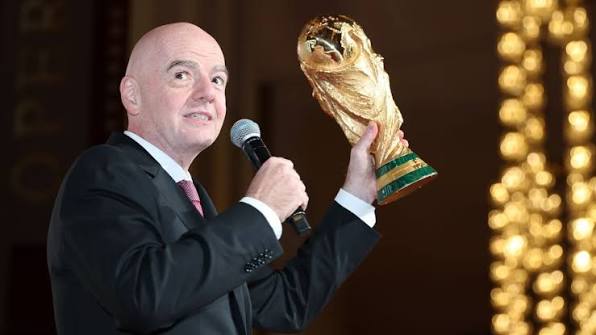
FIFA President Gianni Infantino received a previously undisclosed compensation payment from the operational entity managing the 2026 World Cup, according to official tax documents and financial filings.
The revelation has raised serious questions about governance transparency at football’s global governing body. The decision to withhold details about the additional payment may represent a breach of internal FIFA regulations.
Internal Revenue Documents Expose Secret Payout
Records filed with the United States Internal Revenue Service (IRS) show that Infantino received $1.72 million (approx. GH₵20.1 million) in 2024. The payment came directly from FWC2026, the official U.S.-based entity established by FIFA to oversee and execute the tournament.
The figure was reported on Form 990, an annual information return required for U.S. tax-exempt non-profit organizations. Tax year 2024 represents the most recent period for which FWC2026’s Form 990 filing is publicly available.
FIFA Financial Reports Omit Extra Earnings
The $1.72 million (approx. GH₵20.1 million) disbursement was paid in addition to Infantino’s official base salary and executive benefits for 2024. FIFA’s annual financial report indicated that his base compensation package totaled 4.274 million Swiss francs, or approximately $4.86 million (approx. GH₵56.7 million).
However, FIFA omitted any mention of the extra FWC2026 funds in its annual financial statements. The omission was first revealed in an investigative report published by The Times.
Mandatory Rules Require Full Transparency
The non-disclosure appears to run counter to governing statutes established by FIFA itself. Article 43, paragraph 13 of the statutory code explicitly dictates governance protocol:
“The Compensation Sub-Committee shall in particular define Compensation Rules and determine the compensation of the FIFA President, the members of the Council and the FIFA Secretary General. The individual compensation of the FIFA President, the members of the Council and the FIFA Secretary General shall be made public.”
FIFA Rejects Statutory Breach Allegations
Spokespersons for football’s governing body maintain that all regulatory and legal guidelines were followed meticulously.
Reached by text message, a FIFA spokesperson told ESPN:
“FIFA fully complies with all reporting requirements and strongly rejects any suggestion there has been a violation of FIFA’s Statutes.”
Former Governance Chief Cites Clear Violation
Governance experts view the matter differently. Miguel Maduro, who previously served as chairman of the FIFA governance committee, told The Times that the failure to publish the secondary income stream breaks established protocols.
“is a clear contravention of the rules if he is paid other amounts by companies related to FIFA and it is not made public. The FIFA statutes impose an obligation of full transparency. It is not appropriate for the FIFA compensation sub-committee to authorize other forms of remuneration. I agree the president of FIFA needs to be very well paid, but that needs to be transparent.”
Commercial Venture Sparked Executive Revolt
The compensation dispute represents the latest in a series of administrative crises surrounding Infantino’s leadership. Tensions escalated sharply after plans leaked regarding an effort to sell a 20% equity stake in the World Cup to private investors.
The proposed business venture, named Football Forward Enterprises, was led by investor Joshua Kushner. Kushner is the younger brother of Jared Kushner, son-in-law to U.S. President Donald Trump.
Infantino cultivated close diplomatic ties with Trump leading up to the 2026 tournament hosted across the U.S., Canada, and Mexico, making frequent official visits to the White House. Following the revelation of the commercial equity proposal, leaders from UEFA, Concacaf, and the Asian Football Confederation (AFC) jointly demanded Infantino’s immediate resignation.
UEFA threatened a complete boycott of future FIFA events. Despite the high-level standoff, scheduled competitions proceeded, including the FIFA U-20 Women’s World Cup that concluded in September. Infantino subsequently sought to reconcile with the regional confederation heads, sending a letter agreeing to a proposal to allocate $10 million (approx. GH₵116.7 million) directly to each member association.
Political Intervention Overrode Disciplinary Sanctions
Infantino also drew heavy criticism over his direct handling of player discipline during the World Cup. American forward Folarin Balogun received a mandatory red card during the U.S. team’s 2-0 victory against Bosnia & Herzegovina in the round-of-32.
The penalty automatically carried a standard one-match suspension for the upcoming round-of-16 match against Belgium. However, following a personal phone call from Trump to Infantino regarding the disciplinary action, Balogun’s suspension was unexpectedly commuted to probation.
The decision permitted Balogun to play in the match, which the U.S. ultimately lost to Belgium 4-1.
FIFA Council Prepares for Zurich Summit
The accumulating administrative challenges and financial disclosures come at a critical juncture for international sports administration. The FIFA Council is scheduled to convene for its next formal meeting on Thursday in Zurich.
As global football leaders prepare to meet in Zurich, the governance debate surrounding Infantino highlights the ongoing challenge of balancing FIFA’s expanding commercial enterprise with statutory transparency obligations. Whether the upcoming council sessions lead to tighter reporting guidelines or further institutional friction remains a defining test for the organization’s leadership