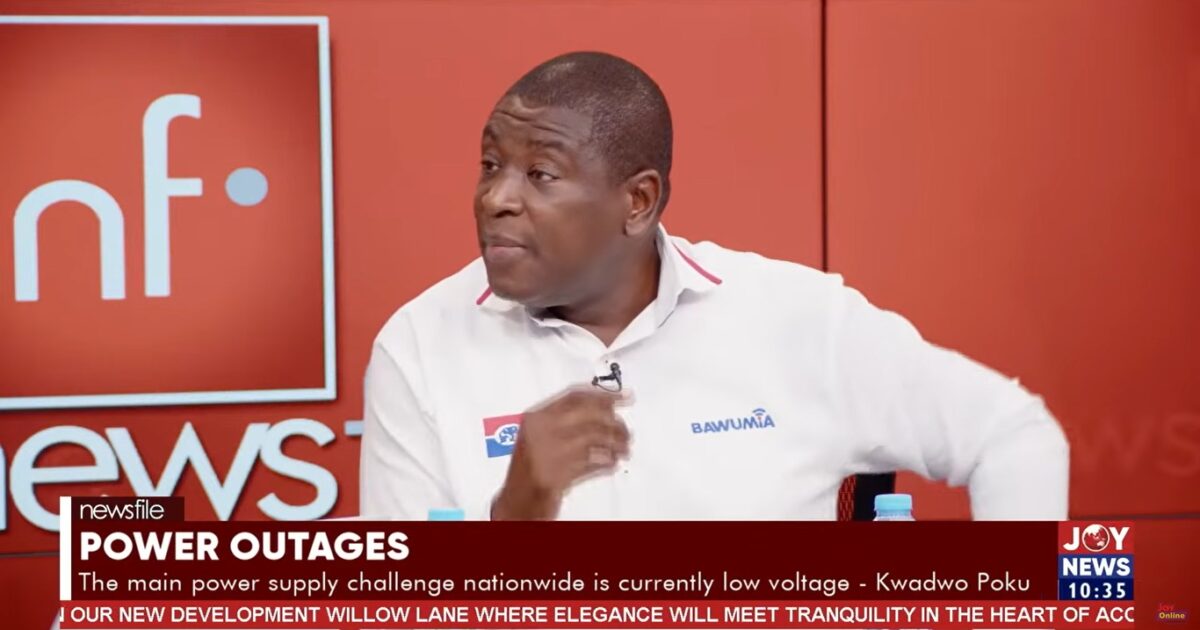

The Executive Director of the Institute of Energy Policies and Research, Kwadwo Poku, has accused the Finance Minister, Dr Cassiel Ato Forson, of delaying the release of funds needed to improve Ghana’s electricity transmission infrastructure.
He says the delay in securing financial authorisation for a US$50 million component of a US$250 million World Bank facility is affecting efforts to strengthen the national grid and address persistent power outages.
Speaking on JoyNews’ Newsfile on Saturday, November 28, 2026, Mr Poku said the funding was intended to support transmission interventions by the Ghana Grid Company (GRIDCo), including the development of the Takoradi-Kasoa 161kV transmission line.
He explained that the US$50 million allocation was tied to specific performance conditions under a results-based financing arrangement, meaning GRIDCo had to meet certain requirements before the World Bank could release the funds.
Mr Poku said one of the requirements was for GRIDCo to develop and submit a methodology for implementing security-constrained economic dispatch to the Energy Commission.
However, he cited the World Bank document as indicating that GRIDCo had not completed the methodology or procured the necessary consultants.
He said the report also identified the absence of commitment authorisation from the Ministry of Finance as a factor preventing progress towards meeting the required targets.
“Actual current, it says that GRIDCo is yet to prepare the methodology and yet to procure the consultants, no commitment authorisation from the Ministry of Finance to allow for the disbursement needed to facilitate the achievement of this target,” he stated.
Mr Poku questioned why the government had not prioritised the release of the funds for transmission infrastructure while pursuing plans to expand electricity generation capacity.
“The Finance Minister, who wants to build a 1,450 megawatt plant in the Central Region, has not made sure that the money, 50 million dollars, for GRIDCo to achieve this, for that money to be released to build the Takoradi-Kasoa 161 KV line,” he said.
He warned that the planned expansion of generation capacity could face challenges if the transmission infrastructure required to evacuate the additional electricity was not upgraded.
According to him, the existing transmission corridor in the Central Region is ageing and may not have the capacity to transport the additional power to areas of demand.
“The central corridor line was built in 1960. Most of the fittings are rusted,” he said.
Mr Poku argued that increasing generation capacity without corresponding investment in transmission would not adequately address Ghana’s electricity supply challenges.
He maintained that the country needed to strengthen its transmission network to ensure that electricity generated could be transported reliably to consumers.
DISCLAIMER: The Views, Comments, Opinions, Contributions and Statements made by Readers and Contributors on this platform do not necessarily represent the views or policy of Multimedia Group Limited.
DISCLAIMER: The Views, Comments, Opinions, Contributions and Statements made by Readers and Contributors on this platform do not necessarily represent the views or policy of Multimedia Group Limited.
Source link