
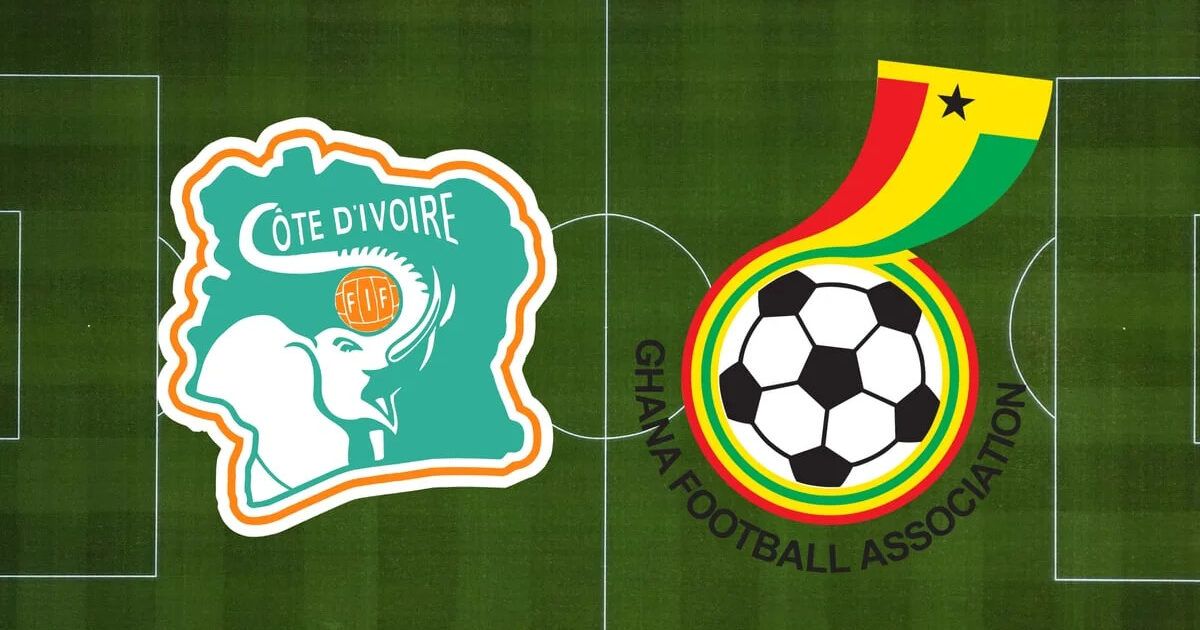
Under the bright lights of the Stade de la Paix in Bouaké, Ghana and Côte d’Ivoire will renew one of West African football’s most enduring rivalries.
When the Black Stars walk onto Ivorian soil tonight, they will be playing for more than three points in their opening 2027 Africa Cup of Nations qualifier.
They will also confront memories of two painful AFCON finals, decided by penalty shootouts, that have helped shape the history of this rivalry.
For Ghana, the match comes after missing the last AFCON for the first time in 20 years.
The Black Stars are beginning another qualifying campaign hoping to reclaim their place on the continent’s biggest stage.
For Côte d’Ivoire, the fixture comes on home soil and offers another chapter in a rivalry that has produced some of African football’s most dramatic encounters.
Where it all began
The rivalry stretches back to the 1965 Africa Cup of Nations in Tunis.
Ghana, featuring players such as Osei Kofi and Cecil Jones Attuquayefio, beat tournament debutants Côte d’Ivoire 4-1 in the group stage before going on to win their second continental title.
But it was the 1992 AFCON final in Cotonou that transformed the contest into one of the continent’s most memorable rivalries.
With Ghana’s star playmaker Abedi Pele suspended, neither side could find a goal during 120 minutes at the Stade de l’Amitié.
The final was decided by a penalty shootout that, at the time, became the longest in AFCON final history.
All 12 players were required to take penalties before Ivorian goalkeeper Alain Gouaméné saved Anthony Baffoe’s second attempt.
Côte d’Ivoire eventually won 11-10, leaving Ghana to contemplate another missed opportunity to lift the continental trophy.
Twenty-three years later
The two nations met again in an AFCON final in 2015, this time in Bata, Equatorial Guinea.
The tournament itself had been thrown into uncertainty before it began after Morocco withdrew as hosts because of concerns over the Ebola virus outbreak.
Equatorial Guinea stepped in to host the competition.
Ghana had reached the final after negotiating a group containing Senegal, Algeria and South Africa, with Avram Grant rebuilding the side after the disappointment of the 2014 World Cup.
Côte d’Ivoire, meanwhile, were coached by Hervé Renard and were carrying the expectations of a golden generation that had previously fallen short in 2006 and 2012.
The final was another tense encounter.
Christian Atsu and André Ayew both struck the crossbar for Ghana, but neither side could score during 120 minutes.
Once again, penalties would decide the destination of the trophy.
Ghana took an early 2-0 lead after Mubarak Wakaso and Jordan Ayew converted, while Wilfried Bony hit the crossbar and Tallo Gadji missed for Côte d’Ivoire.
But the Ivorians fought back.
Boubacar Barry saved Afriyie Acquah’s penalty and Frank Acheampong missed his attempt as Yaya Touré and Salomon Kalou kept Côte d’Ivoire in the contest.
After all 10 outfield players had taken their penalties, the shootout stood at 8-8.
The decision then fell to the goalkeepers.
Ghana’s Razak Brimah saw his penalty saved by Barry, who was struggling with cramp. The Ivorian goalkeeper then converted his own spot-kick to give Côte d’Ivoire a 9-8 victory.
Once again, Ghana had been left heartbroken by a penalty shootout against Côte d’Ivoire.
Two nations, different paths
The years since that night in Bata have taken the two teams in different directions.
Côte d’Ivoire eventually moved beyond the generation led by Didier Drogba, Yaya Touré and Gervinho and built another strong side around players including Sébastien Haller, Franck Kessié and Simon Adingra.
That rebuilding process culminated in the Ivorians winning the Africa Cup of Nations on home soil.
Ghana’s story has been less successful.
The Black Stars endured coaching changes and disappointing tournament campaigns before missing the 2025 AFCON, their first absence from the competition in two decades.
Tonight’s meeting therefore carries significance for both sides, although for different reasons.
Renard against Queiroz
The tactical battle adds another layer to the fixture.
Côte d’Ivoire are led by Hervé Renard, who is the only coach to have won the Africa Cup of Nations with two different countries, doing so with Zambia in 2012 and Côte d’Ivoire in 2015.
Renard’s teams are associated with intensity, pressing, structured formations and quick attacks through the wings.
Across the technical area will be Ghana coach Carlos Queiroz, whose approach has traditionally placed emphasis on defensive organisation, compactness and tactical discipline.
Queiroz has previously guided South Africa to the quarter-finals of the 2002 World Cup and Egypt to the 2021 AFCON final.
The Portuguese coach will now attempt to give Ghana a solid foundation as they begin another qualification campaign.
Another chapter
The Stade de la Paix will provide the setting for another chapter in a rivalry that has already produced two unforgettable AFCON finals.
The memories of Cotonou and Bata remain part of the story, but tonight’s match belongs to a new generation.
Ghana are seeking to return to the AFCON after missing the previous edition, while Côte d’Ivoire will look to make home advantage count.
The managers have prepared their teams. The history is already written.
Now, in Bouaké, Ghana and Côte d’Ivoire have another 90 minutes, and perhaps more, to add a new chapter to a rivalry built on glory, disappointment and unforgettable nights.
Ghana face Côte d’Ivoire at the Stade de la Paix in Bouaké on Thursday, 24 September, with kick-off at 19:00 GMT.
DISCLAIMER: The Views, Comments, Opinions, Contributions and Statements made by Readers and Contributors on this platform do not necessarily represent the views or policy of Multimedia Group Limited.
DISCLAIMER: The Views, Comments, Opinions, Contributions and Statements made by Readers and Contributors on this platform do not necessarily represent the views or policy of Multimedia Group Limited.
Source link