
By: Franklin ASARE-DONKOH
Ghana has permanently etched its name into the annals of global trade history by becoming the first nation to sign the United Nations Convention on Negotiable Cargo Documents, officially christened the Accra Convention.
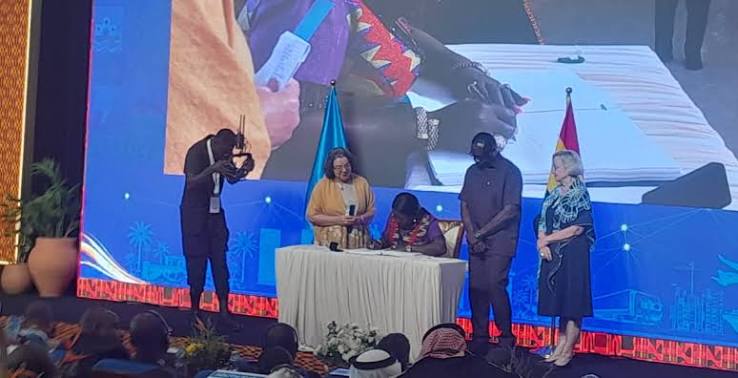
The historic signing ceremony took place on Monday, October 26, 2026, in Ghana’s capital, coinciding with the landmark 60th anniversary of the United Nations Commission on International Trade Law (UNCITRAL).
By the close of the opening day, a total of 26 countries followed Ghana’s lead in appending their signatures to the treaty.
The Accra Convention bridges a massive gap in international shipping by establishing a harmonised global legal framework for negotiable cargo documents across all modes of transport—including road, rail, air, and sea.
Crucially, the treaty gives electronic cargo documents the same legal weight as traditional paper records. This digital evolution is expected to be a massive boon for businesses, making it vastly easier to secure bank financing against goods while they are still in transit.
Experts estimate the framework will directly target Africa’s staggering US$74 billion to US$92 billion trade finance gap.
The journey to the Accra Convention began in 2019 when China originally proposed a framework to govern multimodal cargo transport.
UNCITRAL finalised the text in July 2025, and it was officially adopted by the United Nations General Assembly on December 15, 2025.
Signing the document on behalf of President John Dramani Mahama, Ghana’s Minister of Trade, Agribusiness and Industry, Mrs. Elizabeth Ofosu-Adjare, expressed immense pride in the nation’s leadership.

She announced that Ghana is already initiating immediate domestic legal reviews to ensure it is also among the very first to deposit its instruments of ratification.
According to her, the agreement would help address longstanding barriers preventing businesses, particularly small and medium-sized enterprises (SMEs), from accessing finance using goods in transit as collateral.
The trade minister further explained that while maritime cargo documents have traditionally enabled traders to use goods in transit to secure bank financing, comparable arrangements have been limited for goods transported by road, rail and air.
Mrs Ofosu-Adjare cited estimates that road transport accounts for 80 to 90 per cent of Africa’s freight movement, while intra-African trade represented just 14.4 per cent of the continent’s total trade in 2024.
The treaty requires ratification from 10 member states before it officially enters into force.
This is not the first time Ghana has led the world on the United Nations stage. Exactly 36 years ago, Ghana made history as the very first country in the world to ratify the United Nations Convention on the Rights of the Child (UNCRC).
With the signing of the Accra Convention, the West African nation has once again cemented its role as a pioneer in international law and global economic cooperation.