
By Juliet ETEFE
Bilateral trade between Ghana and China hit US$14.1billion for 2025 as both countries pushed to deepen cooperation in trade, industrialisation, mining, infrastructure and people-to-people exchanges.
This represents a 19.3 percent year-on-year increase – reaffirming China’s position as one of Ghana’s largest trading partners.
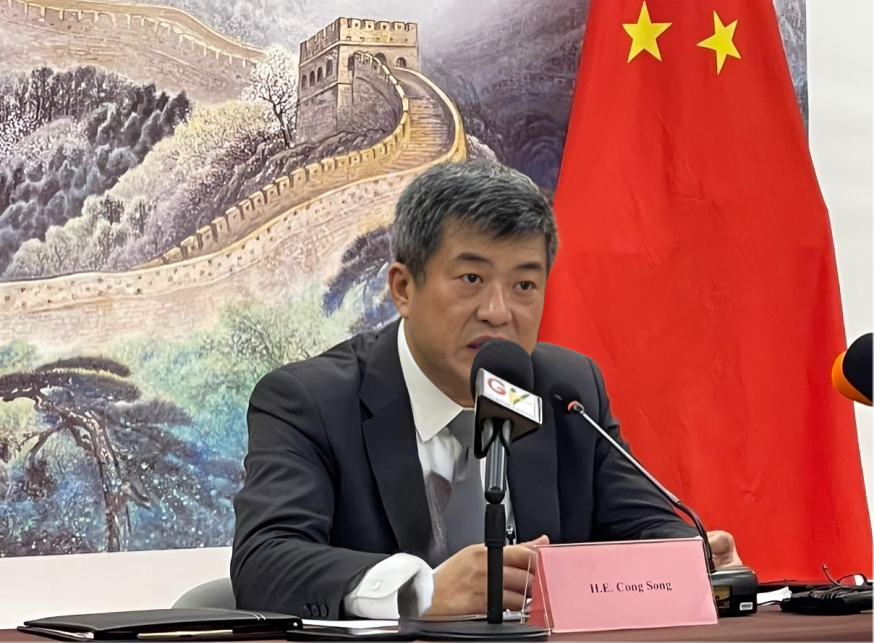
The Chinese Ambassador to Ghana, Cong Song, disclosed this at his first official press briefing in Accra, where he outlined China’s priorities for trade, investment, mining cooperation and people-to-people exchanges with Ghana.
However, provisional Ghana Statistical Service (GSS) trade data indicate that the trade relationship remains heavily tilted toward imports from China. China was Ghana’s largest source of imports in 2025, accounting for GH¢57.6 billion or 22.7 percent of total imports, while Ghana’s exports to China stood at GH¢19.6 billion, representing 4.9 percent of total exports for the year.
The trade imbalance has renewed focus on China’s recently introduced zero-tariff policy for African exports, which Ghanaian officials and policy analysts see as an opportunity to expand exports and improve access to the Chinese market.
The ambassador commended Ghana’s recent macroeconomic performance of 6 percent GDP growth for 2025 with inflation easing to 3.4 percent in April 2026, noting that China is willing to participate in government’s ’24-Hour Economy’ and ‘Resetting Ghana’ agenda.
He also expressed China’s readiness to support Ghana’s industrial transformation efforts including the proposed Volta Economic Corridor, through investment, technology transfer and industrial collaboration.
“China is willing to actively participate in the ’24-Hour Economy’ and ‘Resetting Ghana’ agenda; assist Ghana in building the Volta Economic Corridor; bring more capital, technology and management experience to Ghana; promote the deep processing of agricultural products and extension of the industrial chain; and stimulate Ghana’s indigenous development momentum,” he said.
He described Ghana-China relations as strategically aligned, given that both countries are pursuing economic transformation agendas anchored on industrialisation and growth.
While China begins implementation of its 15th Five-Year Plan focused on high-quality development and technological advancement, Ghana is pursuing economic recovery under government’s 24-Hour Economy and Resetting Ghana agenda.
Zero-tariff for exports
The renewed cooperation push comes as China rolls out zero-tariff treatment for exports from 53 African countries with diplomatic relations, including Ghana.
The policy, announced earlier this year by Chinese President Xi Jinping and implemented from May 1, removes import duties on all qualifying exports from participating African countries.
Ambassador Cong said the initiative is expected to improve the competitiveness of Ghanaian products in the Chinese market while creating opportunities for export expansion.
“For example, Ghanaian cocoa previously had a tariff of 8-22%, but after the zero-tariff treatment took effect on 1st May cocoa and other products enjoy zero tariffs on exports to China,” he explained.
He noted that products including cocoa, cashew, shea butter, textiles and handicrafts stand to benefit from the arrangement.
The ambassador further said the policy could attract additional investment into Ghana’s manufacturing and agro-processing sectors by encouraging local processing for exports to China.
Production capacity concerns
Think-tank representatives described China’s zero-tariff initiative as a major opportunity for Africa to transition from aid dependence toward export-led industrialisation – reiterating that the policy gives African countries access to China’s 1.4 billion-person market and could boost local manufacturing and value addition.
However, they stressed that the benefits will depend on Africa’s ability to improve production capacity, standards, logistics and industrial coordination.
The initiative was described as “a shift of narrative” from dependence on loans toward economic competitiveness, noting that the responsibility now lies with African countries to build the capacity needed to take advantage of the market access.
Illegal mining
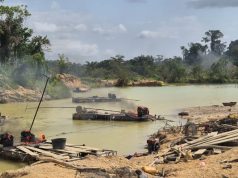
On illegal mining, popularly known as galamsey, the ambassador reiterated China’s opposition to the involvement of Chinese nationals in unlawful mining activities and pledged continued support for Ghana’s efforts to combat the menace.
“The Chinese government has always requested its citizens overseas to abide by the laws and regulations of host countries,” he said.
He added that China shares Ghana’s interest in protecting forests, water-bodies and promoting environmentally sustainable mining practices.
The ambassador also outlined plans to strengthen cultural, educational and youth exchanges between Ghana and China under the 2026 China-Africa Year of People-to-People Exchanges initiative.
Activities expected this year include film festivals, cultural performances, educational programmes and youth exchange initiatives aimed at strengthening ties between citizens of both countries. More than 10,000 Ghanaian students are currently studying Chinese language and culture, according to the ambassador.
Post Views: 1
Discover more from The Business & Financial Times
Subscribe to get the latest posts sent to your email.