

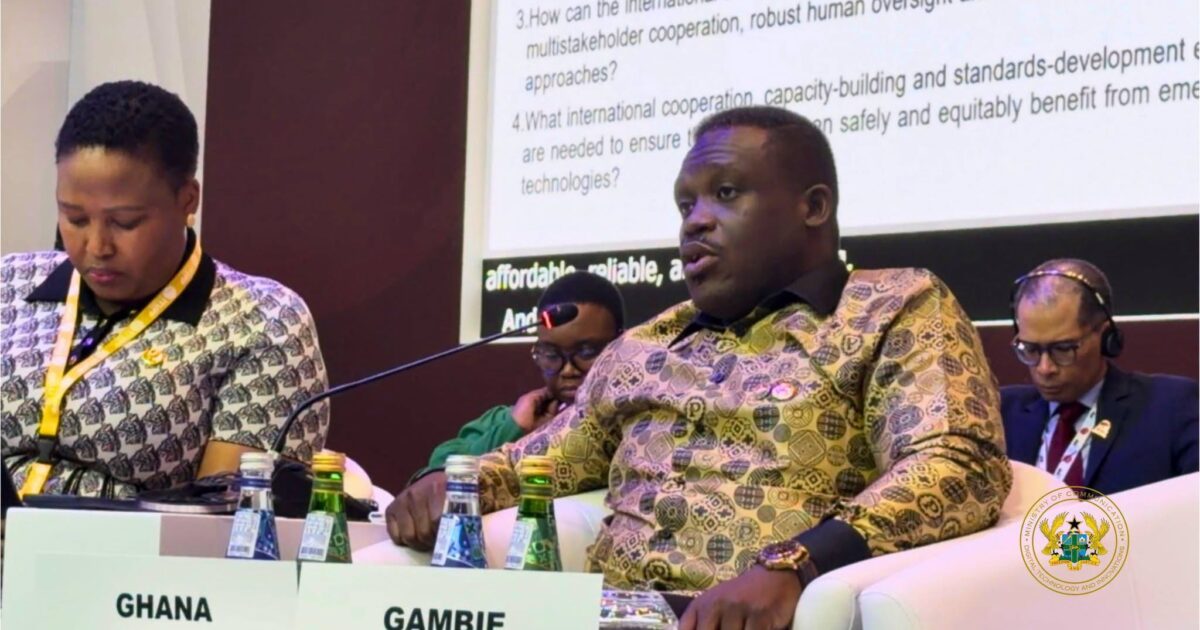

Ghana has called for artificial intelligence (AI), satellite connectivity and other emerging technologies to be designed around people’s needs, warning that technological advancement must not deepen existing inequalities or leave underserved communities behind.
The Minister for Communication, Digital Technology and Innovations, Samuel Nartey George, made the call during a panel discussion on emerging technologies at the ongoing International Telecommunication Union (ITU) Plenipotentiary Conference 2026 in Doha, Qatar.
He used the experiences of four hypothetical Ghanaians to show how international decisions on technology and digital policy could shape access to healthcare, connectivity, and economic opportunities.
Highlighting AI’s potential in healthcare, the Minister cited an AI-powered service that lets pregnant women seek emergency assistance through basic mobile phones without needing internet access.
He said the service had registered more than 7,000 mothers and expectant mothers at a single hospital in Ghana, showing how accessible technology could improve maternal healthcare.
On digital connectivity, Mr George argued that extending network coverage alone was not enough, insisting that access must also be affordable, reliable and useful to communities.
He called for increased investment in digital infrastructure, skills development and locally relevant content, particularly to address the needs of communities with limited access to technology.
The Minister also raised concerns about allocating and managing satellite spectrum and orbital resources, stressing that these limited resources must be accessed fairly.
He cautioned against allowing countries or companies that launch satellites first to claim ownership or exclusive control over space resources.
On artificial intelligence, he advocated responsible, accountable systems that recognise local languages, reflect the realities of different communities, and provide avenues for explanation and redress when automated decisions affect individuals.
“The question is not whether AI will shape Africa, but whether Africa will help shape AI,” he said, calling for stronger cooperation among governments, technology companies, academia and civil society to develop policies and standards that can work across national borders.
Mr George also highlighted Ghana’s efforts to develop local technological expertise through the One Million Coders Programme, which has attracted more than 140,000 registrations.
He said young people must be equipped not only to use emerging technologies but also to develop solutions, create innovations and participate meaningfully in the digital economy.
The Minister further called for international partnerships that strengthen local capacity rather than create long-term dependence on external technologies.
He identified technology transfer, increased investment, South-South cooperation, and the development of standards that address developing countries’ priorities as key areas for collaboration.
He reaffirmed Ghana’s commitment to working with international partners to ensure emerging technologies advance digital inclusion, public trust and sustainable development.
DISCLAIMER: The Views, Comments, Opinions, Contributions and Statements made by Readers and Contributors on this platform do not necessarily represent the views or policy of Multimedia Group Limited.
DISCLAIMER: The Views, Comments, Opinions, Contributions and Statements made by Readers and Contributors on this platform do not necessarily represent the views or policy of Multimedia Group Limited.
Source link