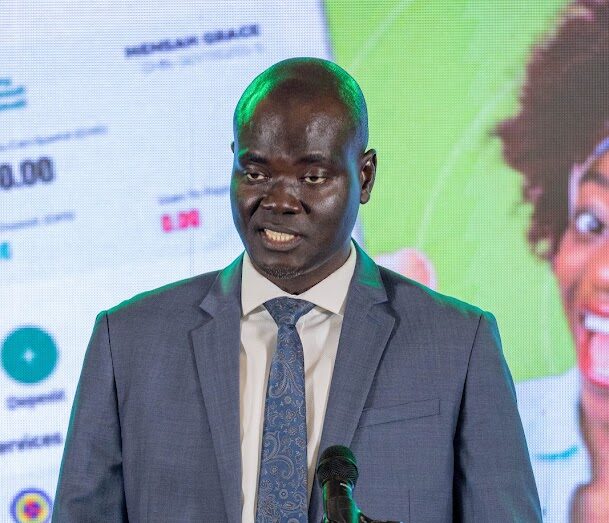
The Chief Executive Officer of Hubtel, Alex Bram, says Ghana’s economic power has shifted decisively from boardrooms to ordinary people. However, he notes that the country’s rapidly expanding digital economy remains constrained by its heavy reliance on cash and debit payments.
Speaking at the launch of Albrim Pay Small Small, a new product by Albrim Microfinance, Mr. Bram said the shift became particularly evident following the COVID-19 pandemic in 2020.
“There were times that the entire economic power of the country was controlled from boardrooms. If you don’t chase boardrooms, get a contract from a boardroom, get a check from the boardroom, your business is not going anywhere,” he said.
“But that has changed.”
Mr Bram pointed to Ghana’s growing transaction economy, noting that if all mobile money and electronic transactions are put together, they amount to almost GH¢6 trillion, while GDP is about GH¢ 1.3 trillion to 1.4 trillion.
“So you can see where the power is right now,” he said.

He described Ghana as having one of the most active transaction economies in Africa, built on micro-transactions: the small payments people send each other every day, market payments, airtime top-ups and electricity purchases.
“Together they form one of the most active transaction economies in Africa. But this small-small economy has a quiet problem. It runs almost entirely on cash in your hand. Debit only transactions,” he said.
In his view, that is the missing ingredient holding Ghana back.
“In Africa, whilst the rest of the world is running on credit, if you go to any developed country, 40% of the adult population has a credit instrument ,something they can pay with and go sort it out later,” he said.
“In Ghana, everything is debit. If you are trying to use mobile money, you are trying to use your bank account, you must have the cash lying in there, otherwise it is not going to work.”
He said commerce stops the moment a wallet owner runs out of cash.
“And it’s not because our people are unwilling to work or we don’t work as hard as they do in America or in the US or anywhere else. It’s just because the system gives their work no credit at all,” he said.
Mr Bram said Ghana, as one of Africa’s leading middle-income countries, now faces the question every such country faces: how to rise to high-income status.
He noted that at the start of 1960, there were 101 middle-income countries in the world, underscoring how difficult that transition has been for many nations.
“What we are here to do today is try to fix the missing ingredient,” he said.


More Stories Here