
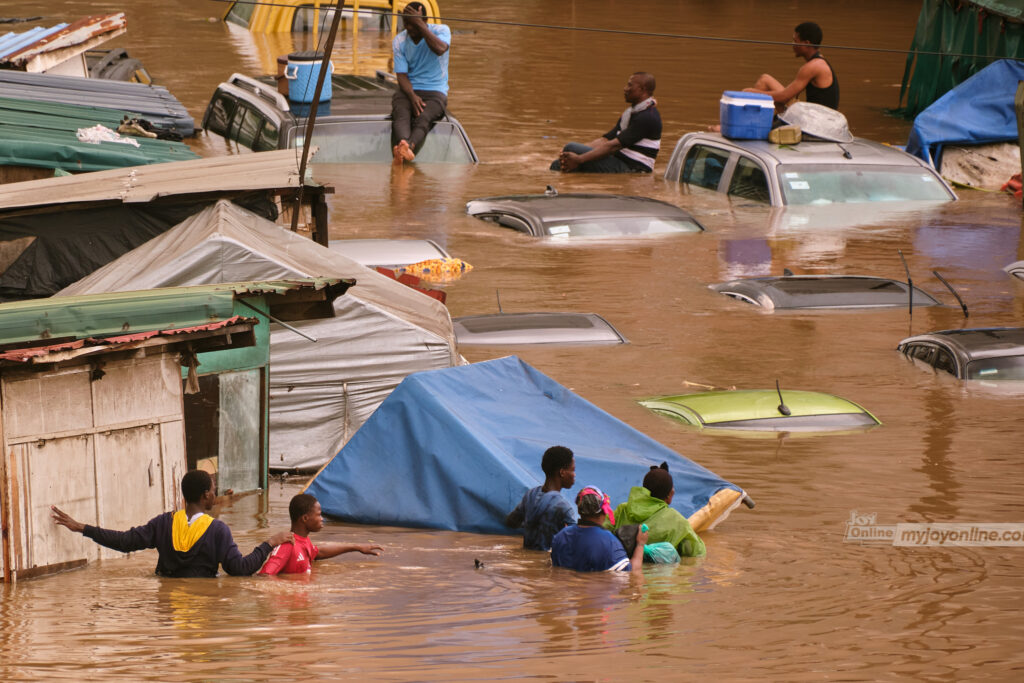
The Ghana Medical Association (GMA) has called for urgent national action to address Ghana’s recurring flooding crisis, warning that the increasing frequency and severity of floods pose a major threat to public health, lives, livelihoods and critical infrastructure.
In a statement issued on Friday, July 3, 2026, the Association expressed concern over the devastation caused by recent floods across parts of the country, particularly in Accra, and urged authorities to move beyond temporary responses by implementing long-term solutions.
The GMA said perennial flooding continues to cause loss of lives, displacement of families, destruction of property, disruption of transportation systems and interruptions to emergency healthcare and relief services.
“The Ghana Medical Association (GMA) expresses grave concern over the perennial flooding affecting major cities and communities across Ghana, particularly Accra,” the statement said.
“These recurring floods continue to result in the loss of lives, displacement of households, destruction of livelihoods and property, disruption of transportation networks, interruption of emergency healthcare and relief services, and an increased risk of disease outbreaks,” it added.
The Association noted that Accra has battled flooding for many years, with major incidents recorded in 2010, 2015 and 2021. It said recent flooding events have affected several regions, including Greater Accra, Central, Western and Volta.
According to the GMA, initial reports indicate that the latest floods have resulted in 12 deaths and seven missing persons in the Greater Accra Region, with 38,802 people and 7,761 households affected.
It further noted that 18 deaths had been recorded in the Central Region, including fatalities linked to building collapse, while about 1,200 people had been displaced in the Samreboi enclave of the Western Region. In the Volta Region, about 60 communities have also been affected.
The GMA attributed the recurring floods to several longstanding challenges, including poor drainage systems, rapid urbanisation, deforestation, climate change, poor waste disposal practices and the destruction of natural watercourses.
It also identified encroachment on wetlands, illegal mining, popularly known as galamsey, weak enforcement of zoning laws, political interference, limited public education and infrastructural deficiencies as contributing factors.
The Association said the situation has been worsened by illegal developments in flood-prone areas, inadequate funding for monitoring and enforcement, weak sanctions against offenders and insufficient logistics for emergency rescue operations.
While commending the Ministry of the Interior for its early public risk communication during the recent floods, as well as emergency response efforts led by the National Disaster Management Organisation (NADMO) and the Ministry of Health, the GMA called for a stronger and more coordinated national response.
“The Association calls on all relevant state institutions to sustain and strengthen emergency response measures, including the provision of food, shelter, and medical care to affected persons,” the statement noted.
The GMA also called for intensified community engagement, comprehensive flood risk assessments, routine drainage and waste clearance exercises by Metropolitan, Municipal and District Assemblies, as well as stronger collaboration with development partners.
As part of measures to prevent future disasters, the Association urged government to invest in the rehabilitation, expansion and regular maintenance of drainage systems to improve stormwater management.
It further called for strict enforcement of land use regulations to prevent construction in flood-prone areas and protect wetlands and natural waterways.
The GMA also recommended sustained public education campaigns on flood preparedness, environmental sanitation and responsible waste disposal, alongside improved urban planning that prioritises sustainable development and environmental protection.
The Association further demanded stronger accountability systems in flood prevention initiatives to reduce corruption and improve institutional responsibility.
It also called for flood prevention efforts to be depoliticised, urging national consensus in dealing with the problem.
“Build broad national consensus on flood prevention and mitigation strategies, while ensuring that political considerations do not undermine enforcement of planning regulations,” the statement said.
“Public officials and other actors who facilitate or permit non-compliant developments that endanger public safety should be held accountable,” it added.
The GMA further called for NADMO, the Ghana National Fire Service, hospital emergency departments and the Department of Social Welfare to be adequately resourced and equipped to respond effectively to flood-related emergencies.
It urged President John Dramani Mahama to take bold steps to permanently address the problem.
“We urge the President to take tough and decisive decisions and actions that will bring significant and lasting solutions to the perennial flood situation in Accra and other communities,” the Association stated.
Meanwhile, the GMA has advised residents in flood-affected communities to adopt proper public health practices to reduce the risk of disease outbreaks.
It urged affected persons to wash their hands regularly with soap under running water, drink safe water, eat freshly prepared hot meals, dispose of waste properly and seek immediate medical care if they experience diarrhoea or other symptoms of illness.
The Association reaffirmed its commitment to working with government, development partners, civil society organisations and other stakeholders to support practical and evidence-based reforms aimed at reducing the frequency and impact of floods in Ghana.
DISCLAIMER: The Views, Comments, Opinions, Contributions and Statements made by Readers and Contributors on this platform do not necessarily represent the views or policy of Multimedia Group Limited.
DISCLAIMER: The Views, Comments, Opinions, Contributions and Statements made by Readers and Contributors on this platform do not necessarily represent the views or policy of Multimedia Group Limited.