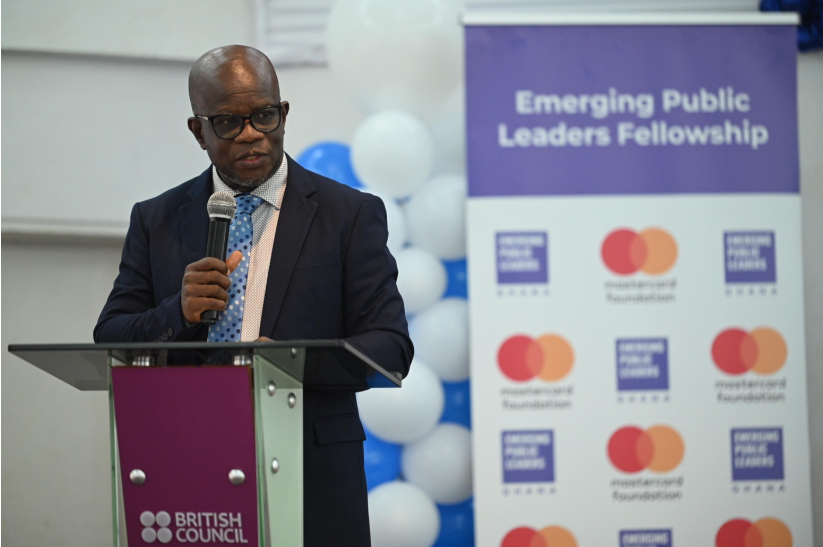

Prof. Kpessa-Whyte made the economic case for institutional reform — and issued a specific warning about the cost of opacity in state institutions at Ghana’s most consequential fiscal moment
Among the many things that distinguished Prof. Michael Kpessa-Whyte’s keynote address at Tuesday’s EPL Ghana Seventh Cohort inauguration from the standard vocabulary of public service ceremony was this: the SIGA Director-General made an explicitly economic argument. Not a moral one dressed in economic language. An economic one — with a clear causal chain, identifiable mechanisms, and a direct connection to Ghana’s present fiscal circumstances.
The argument, delivered without slides or data but with the precision of someone who inhabits this analysis daily, ran as follows: the quality of public institutions is not an abstract governance indicator. It is a determinant of economic performance — measurable in investor confidence, tax compliance, business formation rates, and the social trust that underpins voluntary participation in the formal economy.
“A transparent and responsive public sector reduces the cost of doing business,” Prof. Kpessa-Whyte told the assembled fellows and officials. “It attracts investment. It builds the tax morale that funds the schools and clinics and roads that determine whether the next generation gets a fair start.”
For readers of this news story, that formulation will be immediately recognisable as a statement of what economists and governance scholars variously call administrative capacity theory and institutional quality research — the body of evidence, accumulated since at least Douglass North’s foundational work on institutions and economic performance, that identifies the character of public governance as a first-order determinant of long-run development outcomes.
What is notable is that Prof. Kpessa-Whyte anchored this argument not in global theory but in Ghana’s specific present-day context — and did so with considerable directness.
“Ghana stands at a consequential moment. We are emerging from fiscal turbulence, rebuilding credibility with international partners, restructuring public debt, and asking ordinary Ghanaians to bear extraordinary burdens with dignity and patience.”
The reference to Ghana’s fiscal circumstances was not accidental or incidental. It was structural to the speech’s argument. In the context of the ongoing IMF Extended Credit Facility programme, debt restructuring negotiations, and a revenue mobilisation imperative that places the government’s relationship with taxpayers under acute pressure, the SIGA Director-General was making a pointed case: that the quality of public institutions is not a luxury reform question for prosperous times, but an urgent economic requirement for recovery.
The mechanism he identified was tax morale — a term from public finance referring to citizens’ intrinsic willingness to comply with taxation obligations, distinct from compliance driven by enforcement. Tax morale research consistently finds that it is highly sensitive to perceptions of institutional fairness, transparency, and responsiveness. Where citizens believe government wastes resources, evades accountability, or treats them as supplicants rather than principals, compliance erodes — and with it, the revenue base on which development expenditure depends.
ANALYTICAL NOTE
The IMF’s 2024 Article IV Consultation on Ghana identified governance and institutional capacity as critical variables in the medium-term fiscal consolidation path. SIGA’s oversight role over state-owned enterprises — which collectively represent substantial contingent fiscal liabilities — sits directly within this framework. Prof. Kpessa-Whyte’s remarks can be read as a strategic signal about the governance reform agenda attached to Ghana’s recovery programme.
Prof. Kpessa-Whyte did not use the phrase ‘tax morale’ in his address. But the concept was unmistakably present in his articulation of the civic compact between state and citizen.
“When citizens experience government as fair, they comply,” he said. “They participate. They build. They stay.”
The reverse formulation — what happens when they do not experience it as fair — was left implicit but required no elaboration in a country where the size of the informal economy, tax gap estimates, and capital flight patterns all speak to a civic compact that has been placed under significant strain.
The Director-General’s remarks on institutional responsiveness carried a parallel economic implication. The cost of bureaucratic friction — delays in licensing, registration, procurement approvals, and public service delivery — falls disproportionately on small and medium enterprises that lack the resources to navigate opaque systems or the connections to accelerate them. The culture he described, in which ‘citizens feel like supplicants,’ is not merely a dignity problem. It is a barrier to economic formalisation and firm entry that suppresses productivity and investment at scale.
His specific reference to the market woman in Kejetia and the farmer in rural Ghana alongside the suited professional — his insistence that responsive institutions must serve all three equally — was, from an economic development standpoint, an argument for the institutional foundations of inclusive growth. Economies that concentrate effective public service access among those with social capital or financial resources to navigate them produce neither equitable nor efficient outcomes.
Perhaps most significant for policy observers was the directness with which Prof. Kpessa-Whyte connected individual officer behaviour to these macro-level outcomes.
The accumulation of your choices is governance, he told the fellows. Stripped of its rhetorical register, this is a precise description of how institutional quality is actually produced: not by policy declarations or reform frameworks, but by the thousands of daily decisions made by officers at every level of the public system.
This framing has practical implications for how Ghana approaches governance reform. If institutional quality is the emergent product of individual choices — rather than solely the output of structural reform, legislation, or external pressure — then investments in the formation of public officers, precisely of the kind that EPL Ghana’s fellowship programme represents, carry real economic returns alongside their civic ones.
The Business & Financial Times will continue to track the policy dimensions of the governance agenda that Prof. Kpessa-Whyte’s address illuminated. At a moment when the credibility of Ghana’s institutions is both a sovereign credit variable and a development imperative, the argument he made on Tuesday deserves sustained attention well beyond the ceremony that occasioned it.
Post Views: 1
Discover more from The Business & Financial Times
Subscribe to get the latest posts sent to your email.