
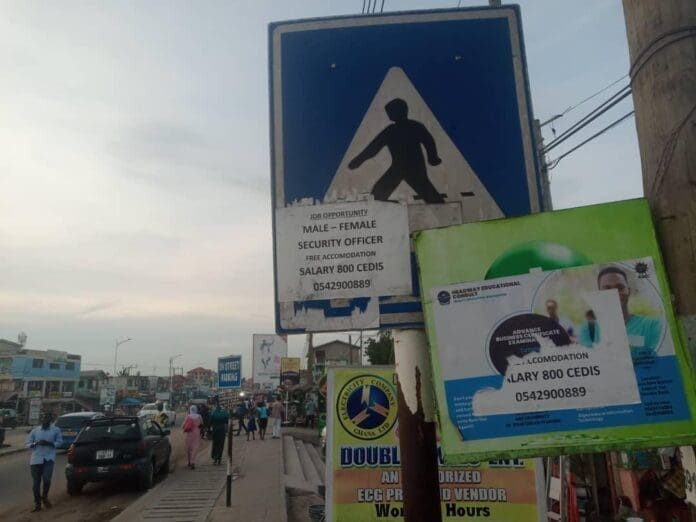

Deputy Minister Rita Naa Odoley Sowah announced Thursday that Ghana has begun a nationwide exercise to regulate and standardize billboards and signage, with Greater Accra Region serving as the starting point.
The Deputy Minister of Local Government, Chieftaincy and Religious Affairs disclosed the initiative during a media interaction following a monitoring tour conducted as part of National Sanitation Week activities, which runs from December 13 to 20 as the Christmas Edition of the government’s Clean Up Ghana Agenda. Sowah, who chairs the 15-member Technical Committee on the Regulation and Standardisation of Signage across Ghana, said the exercise addresses the uncontrolled proliferation of billboards and signage that poses challenges to visibility, pedestrian safety and urban cleanliness.
The committee, working in collaboration with Metropolitan and Municipal Assemblies, has already identified and removed some improperly sited billboards in parts of Accra. Sowah indicated that additional removals are expected in coming days as enforcement intensifies across the capital. Notices have been issued to billboard owners requiring them to regularize or remove structures that fail to meet required standards, particularly those obstructing human visibility, road medians or pedestrian walkways.
The deputy minister emphasized that many existing signages are temporary structures erected without proper authorization from district assemblies. She explained that assemblies are empowered by law under spatial planning regulations to remove any signage that creates public safety hazards or violates urban planning guidelines. The initiative builds on broader spatial planning reforms introduced by the government through the Land Use and Spatial Planning Authority, including the Revised Manual for the Preparation of Spatial Plans, Zoning Guidelines and Planning Standards launched in November 2025.
Sowah cautioned owners of unauthorized or poorly positioned billboards to take the exercise seriously, stressing that enforcement would be sustained nationwide rather than limited to a one-time cleanup. The warning reflects government determination to enforce compliance with planning laws, which have historically been weakly enforced despite mounting concerns about chaotic urban development patterns. Billboard regulation represents one element of comprehensive efforts to restore order to Ghana’s rapidly urbanizing cities, where indiscriminate signage has become increasingly problematic.
The technical committee was inaugurated in October 2025 by Local Government Minister Ahmed Ibrahim, with membership including technical experts from the Land Use and Spatial Planning Authority, National Road Safety Authority, Ghana Institute of Planning, and representatives from metropolitan and municipal coordinating offices. Committee members include Dr. Benedict Mensah Arkurst, Deputy Director of Plan and Preparation at LUSPA, Emmanuel Selasi Adjetey, GIS Officer at LUSPA Greater Accra, Dr. Emmanuel Basie, Dean of Metropolitan, Municipal and District Coordinating Directors at Korle Klottey Municipal Assembly, Kwame Kodua Atuahene, Director of Regulations, Inspection and Compliance at the National Road Safety Authority, and Anaab Bukari, President of the Ghana Institute of Planning.
During her acceptance speech at the committee’s inauguration, Sowah assured stakeholders that the body would approach its assignment with diligence and dedication. She stressed that regulating signage was not about restriction but about promoting order, safety and national pride. The deputy minister urged committee members to work together to develop guidelines that would leave behind cities future generations could be proud to inherit.
The billboard regulation exercise coincides with National Sanitation Week declared by the Ministry of Local Government, Chieftaincy and Religious Affairs as part of efforts to ensure clean, safe and healthy environments ahead of the Christmas festive season. Minister Ahmed Ibrahim announced the December 13 to 20 sanitation week and called on all Metropolitan, Municipal and District Assemblies, stakeholders and citizens to actively participate in the nationwide exercise. National Sanitation Week is intended to promote collective responsibility and community action to improve environmental cleanliness, particularly during the Christmas period when population movement and waste generation increase significantly.
President John Mahama relaunched National Sanitation Day in September 2025 after years of inconsistent implementation, making it a key performance indicator for all district chief executives. The president directed that 80 percent of District Assemblies’ Common Fund payments go directly to assemblies rather than being held in Accra, removing resource constraints as an excuse for poor sanitation performance. The government has established a dedicated sanitation hotline enabling citizens to report public cleansing nuisances directly to the ministry, with reports catalogued, verified and followed up with relevant assemblies for immediate action.
Sowah appealed to the public and billboard operators to cooperate fully with the technical committee and local authorities to ensure smooth and successful implementation of the exercise nationwide. The call for cooperation reflects recognition that effective regulation requires partnership between government enforcement agencies and private sector operators who own and manage commercial signage across the country. Stakeholders described the committee’s inauguration as timely and in the right direction, pledging support and commitment to ensuring it achieves its objectives.
The billboard regulation initiative addresses longstanding concerns about visual pollution, traffic safety hazards and the lack of coherent urban aesthetics in Ghanaian cities. Unregulated proliferation of signage has been particularly acute in commercial areas where competing businesses erect increasingly large and poorly positioned structures to attract customer attention. The exercise represents part of broader urban planning reforms under the Mahama administration’s reset agenda, which emphasizes enforcement of existing regulations rather than creating new laws that remain unenforced.