
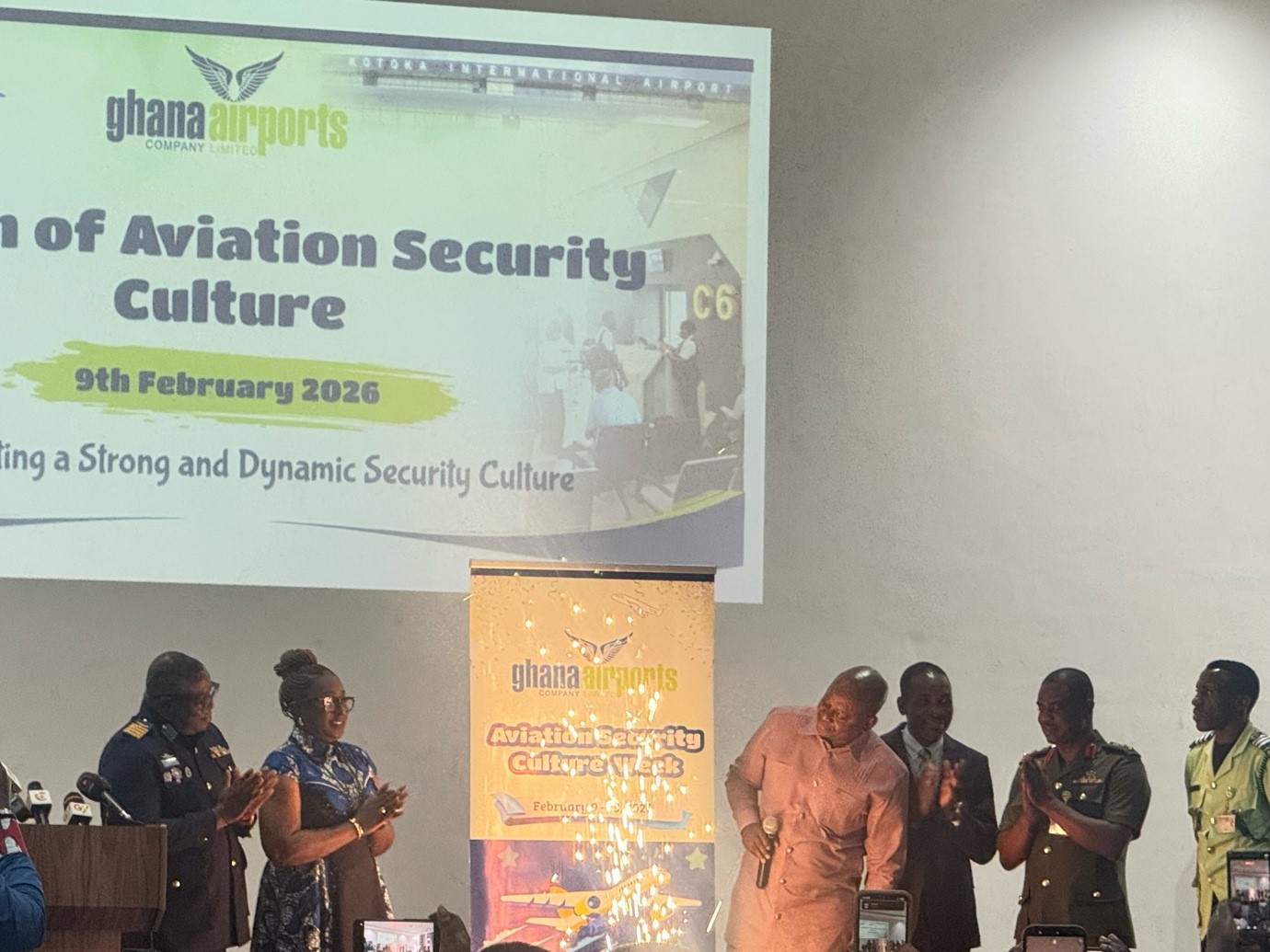
The government has reaffirmed its commitment to strengthening aviation security as it launched Ghana’s Aviation Security Culture Week, a move officials say is aimed at restoring confidence in air travel and protecting the country’s growing aviation industry.
Speaking at the launch in Accra, Transport Minister Joseph Bukari Nikpe said aviation security had become more critical following global shocks such as the COVID-19 pandemic and past security incidents that disrupted travel and trade worldwide. He said Ghana could not afford to lag behind as other countries reinvest in security systems and culture.
The aviation industry is among the fastest-growing sectors globally, Mr. Nikpe said, adding that developing countries must move faster to meet international standards. He said the government views the security culture initiative as a key step toward rebuilding trust in public institutions and the wider economy.
“The impact of global developments, including COVID-19 and past security incidents, created fear and uncertainty,” Mr. Nikpe said. “As a government, we have to look at the damage and also look at how we bring back confidence and trust for the economy and for the people.”
He said aviation security should not be seen as the sole responsibility of the state but as a shared duty involving passengers, airport workers and private operators. He noted systems have been introduced to improve passenger identification and threat detection, adding that authorities would not allow security risks to undermine the sector.
“Aviation security is a shared responsibility,” he said. “That is why this initiative is important. Government on its own is working to ensure seamless travel, but everyone must be alert so that we create a safe and secure environment for the travelling public.”
The Aviation Security Culture Week is being held under the theme “Promoting a Strong and Dynamic Security Culture,” reflecting renewed global focus on aviation safety under standards set by the International Civil Aviation Organization. The programme was first introduced in 2019 but was disrupted by the pandemic.
The Managing Director of Ghana Airports Company Limited, Yvonne Nana Afriyie Opare, said Ghana’s participation signals its commitment to internationally accepted aviation security standards. She said security must be embedded in daily operations until it becomes routine across the airport ecosystem.
“At its core, security culture is about embedding security into our daily processes and practices until it becomes second nature,” she said. “Our message is simple: ‘See it, Say it, Secure it.’ This reminds us that security is everyone’s responsibility, regardless of role or rank.”
Ms. Opare said threats to aviation had become more complex, ranging from improvised weapons to the misuse of advanced technology, making vigilance and innovation essential. She added that Ghana aims to position itself as a leading aviation hub in West Africa, a goal that depends on strong security systems.
She also cited Ghana’s performance in an aviation security audit conducted in February 2024, where the country recorded strong results, as evidence of progress made so far.
Officials from the security services echoed the call for cooperation, with the Ghana Air Force assuring stakeholders of its readiness to safeguard Ghana’s airspace.
Authorities said the week-long programme will involve stakeholder engagements and awareness activities designed to deepen security consciousness and protect airports, passengers and national assets as air travel continues to recover.
Post Views: 10
Discover more from The Business & Financial Times
Subscribe to get the latest posts sent to your email.