By: Ashiadey Dotse
The Executive Director of Revenue Mobilization Africa, Geoffrey Ocansey, has called on the government to suspend further water privatisation projects and high-risk Public-Private Partnerships (PPPs) pending an independent review of the water sector.
Mr Ocansey said financial challenges surrounding the Teshie-Nungua Desalination Project showed the need for a comprehensive review of water-sector agreements to safeguard taxpayers and consumers from potentially unsustainable financial obligations.
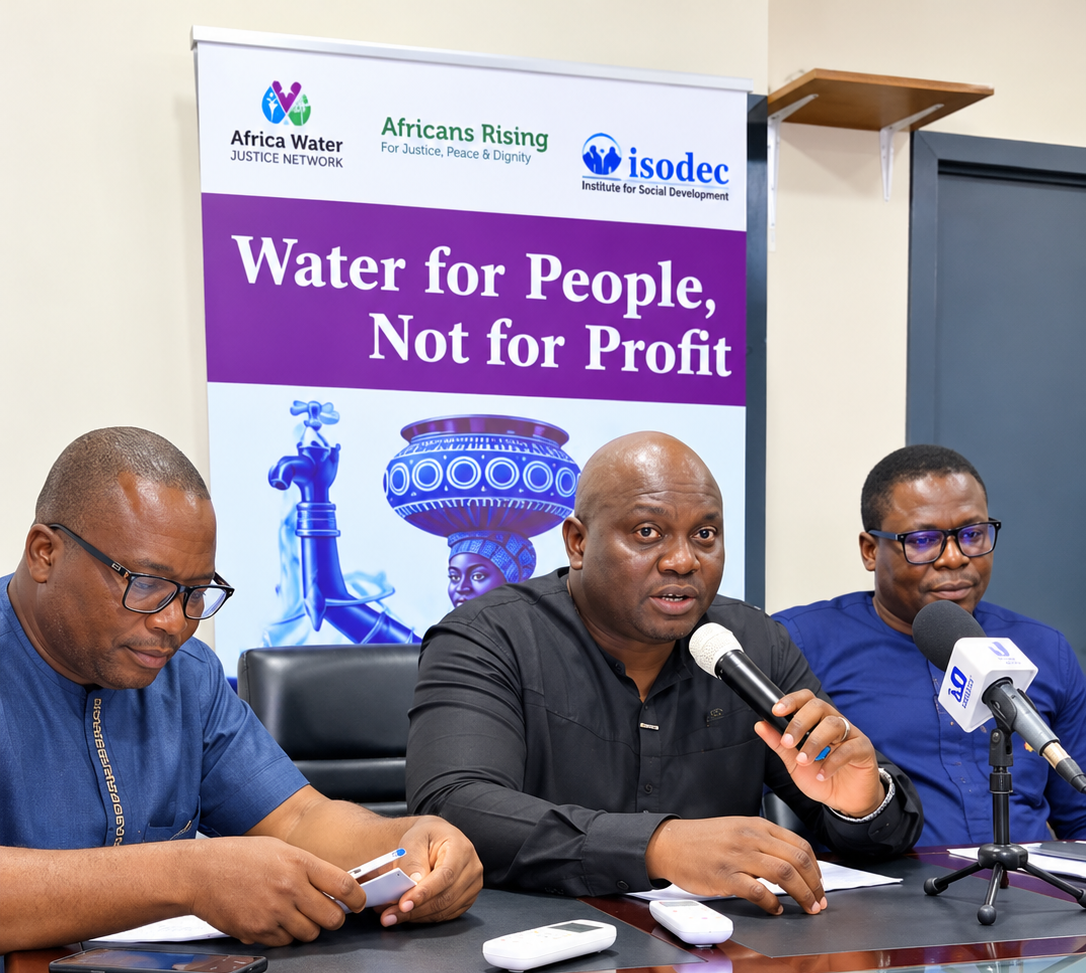
He made the call at a press briefing organised by the Ghana Water Justice Network (GWJN) as part of the Africa Week of Action Against Water Privatisation 2026. The event was held at the ISODEC Conference Room in Kokomlemle, Accra, on Tuesday, November 3, 2026.
The briefing focused on the financial risks associated with water privatisation and the need to guarantee affordable and reliable water supply.
According to the network, the Teshie-Nungua Desalination Project has imposed significant financial obligations on the state, raising questions about whether the arrangement has delivered value for money.
The concerns follow a September 17, 2026, arbitration ruling that awarded approximately US$235 million in termination-related payments to Befesa Desalination Development Ghana Limited and Standard Bank of South Africa Limited following the termination of the Water Purchase Agreement with Ghana Water.
A related arbitration proceeding under the State Guarantee also principally held the Republic liable for Ghana Water’s obligations.
However, the arbitration tribunal dismissed a separate claim of approximately US$402 million for alleged unpaid charges, ruling that the contractual claims could not be recovered cumulatively.
The network stressed that the US$235 million award related mainly to termination liabilities and should not be interpreted as an additional payment for the alleged unpaid charges.
The GWJN further raised concerns about the level of government financial support extended to the project. It said government support to Ghana Water amounted to approximately US$57.38 million between 2020 and 2024, with about US$9.77 million remaining outstanding at the end of 2024.
It also cited approved tax exemptions of US$72.83 million, of which US$31.55 million had been utilised.
The network warned that the financial consequences of the project must not be transferred to consumers through increased water tariffs.
It maintained that access to safe and affordable water must remain a national priority, describing water as essential to public health, human dignity and livelihoods.
As part of its demands, the GWJN called for an independent investigation into the project, including its procurement process, financial arrangements and concerns raised by affected communities and civil society organisations.
It also urged the government to subject its proposed acquisition of the desalination facility to independent financial and technical assessments to establish its value, operational performance, rehabilitation costs and potential implications for taxpayers.
The network further called for the disclosure of the Water Purchase Agreement, its amendments, the State Guarantee and relevant arbitration findings, subject to legitimate legal restrictions.
It also advocated increased public investment in Ghana Water, improved operational efficiency, regular infrastructure maintenance and greater participation by workers, communities and consumers in decisions concerning the water sector.
The GWJN said the Teshie-Nungua project should serve as a warning against agreements that expose the state and consumers to substantial financial risks without clearly demonstrated public benefits.
Reaffirming its position, the network insisted that water should be treated as a public good and a human right rather than a commodity driven primarily by private profit.
“Water is life. Water is a human right. Water must remain in public hands,” the network stated.