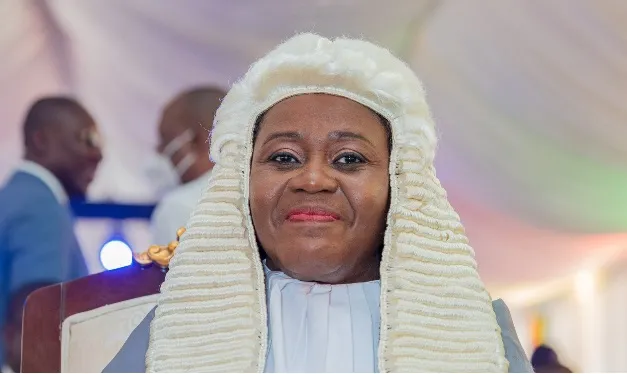

The Chief Executive Officer of the Ghana Shippers Authority, Professor Ransford Gyampo, has made an unusual appeal to President John Dramani Mahama to pay former Chief Justice Gertrude Araba Sackey Torkornoo her entitlements on humanitarian grounds, despite her removal from office following a finding of misconduct.
Prof. Gyampo’s call comes as Torkornoo escalates her legal battle against the government, filing fresh court applications to halt the vetting and appointment of Justice Paul Baffoe-Bonnie as the new Chief Justice. She’s also seeking to prohibit the denial or withdrawal of her salary, benefits, and other entitlements.
In remarks that acknowledge the complexity of the situation, Gyampo conceded that Justice Torkornoo may have misconducted herself while serving as Chief Justice, which led the Justice Pwamang Committee to recommend her dismissal. However, he suggested that paying her entitlements could prevent further legal actions and ongoing controversy.
“I am part of the school of thought that wants to appeal to President Mahama to consider paying the removed Chief Justice her entitlements on humanitarian grounds,” he stated, emphasizing that such a gesture might help close the chapter on what has become Ghana’s most dramatic judicial crisis in recent memory.
President Mahama removed Torkornoo from office on September 1, 2025, after a constitutional inquiry established grounds of stated misbehaviour. The removal followed recommendations by a committee that reviewed 10,000 pages of evidence submitted by 13 witnesses on behalf of the first petitioner, Daniel Ofori, a businessman who brought allegations against the Chief Justice.
The investigation found three main grounds for removal: alleged financial misappropriation involving payments to her husband and daughter for a trip, questionable judgment in several court cases including decisions that observers claimed violated natural justice principles, and questionable administrative decisions that critics said amounted to abuse of discretionary power.
Torkornoo had been suspended since April 22, 2025, after President Mahama received petitions from three sources: Daniel Ofori, a group called Shining Stars, and police official Ayamga Yakubu Akolgo. Justice Gabriel Pwamang chaired the five-member committee that investigated the allegations, and under Article 146(9) of the 1992 Constitution, the President was required to act in accordance with the committee’s recommendation.
The case marks unprecedented territory in Ghana’s judicial history. Torkornoo is the first sitting Chief Justice to be investigated and dismissed, and her removal attracted international attention, with Reuters, BBC, and other major outlets covering the story.
Following her removal, Torkornoo filed a judicial review application seeking to stop the consideration and appointment of Baffoe-Bonnie as Chief Justice. She submitted reports from a committee chaired by Justice Dr. Owusu-Dapaa and the National Signals Bureau, both identifying Francis Baiden, a Judicial Service staff member in charge of the e-Justice system, as the prime suspect in tampering with judicial documents.
Torkornoo argues it’s illogical and irrational to remove her from office for transferring Baiden after evidence showed he was involved in document tampering in the Gyakye Quayson case. She contends her removal is unfair and based on flawed reasoning.
She also filed an application at the ECOWAS Community Court of Justice seeking suspension of the removal proceedings and her reinstatement with full entitlements, pending determination of the substantive matter. The ECOWAS court has yet to deliver its ruling.
Gyampo’s position represents a shift from his earlier statements. In May 2025, he stated emphatically that “If she is wrong, the law must act; if she is not, the law must act. Araba is not above the laws of Ghana.” He also questioned claims that the removal process was unfair, asking whether the opinion of 46 lawyers who criticized the process should outweigh legal procedures already in motion out of over 6,000 lawyers in Ghana.
Now, however, he appears to be advocating for a more conciliatory approach. His appeal for payment of entitlements on humanitarian grounds suggests he believes ending the legal battles and allowing Torkornoo to receive benefits might serve the national interest better than prolonged litigation.
Whether President Mahama will heed this advice remains uncertain. Former Special Prosecutor Martin Amidu has argued that Torkornoo’s legal challenges are “frivolous, vexatious and abusive” uses of court processes, claiming her interest appears to be prolonging the controversy through lawfare in hopes of reaping benefits, including continued use of her judicial title.
The government’s position has been firm. Article 146 of the 1992 Constitution provides that once a committee finds grounds of stated misbehaviour and recommends removal, the President must act accordingly. Officials argue this constitutional process was followed meticulously.
A former Deputy Attorney General, Alfred Tuah-Yeboah, has criticized the decision to remove the Chief Justice, saying it sets a dangerous precedent. He questioned whether the threshold established by the petition was sufficient to warrant removal and expressed fear for the future of the judiciary.
Torkornoo, who was nominated as Chief Justice in April 2023 by former President Nana Akufo-Addo and served from June 12, 2023, until her dismissal, was Ghana’s third female Chief Justice. She had previously survived a removal request under Akufo-Addo, who found that petition to have several deficiencies.
The controversy surrounding her removal has divided opinion sharply along political lines. The main opposition New Patriotic Party held press conferences and protests between April and May 2025, calling the suspension a political witch hunt and an attempt to undermine judicial independence.
As Baffoe-Bonnie awaits vetting and parliamentary approval to become Ghana’s next substantive Chief Justice, the legal battles continue. Whether Gyampo’s appeal for humanitarian consideration will influence the administration’s approach to Torkornoo’s entitlements remains to be seen.
For now, the unprecedented nature of Ghana’s first removal of a sitting Chief Justice continues to generate debate about judicial independence, constitutional processes, and how the country treats its highest judicial officers after they leave office under controversial circumstances.