


By Emmanuel K. Gadasu
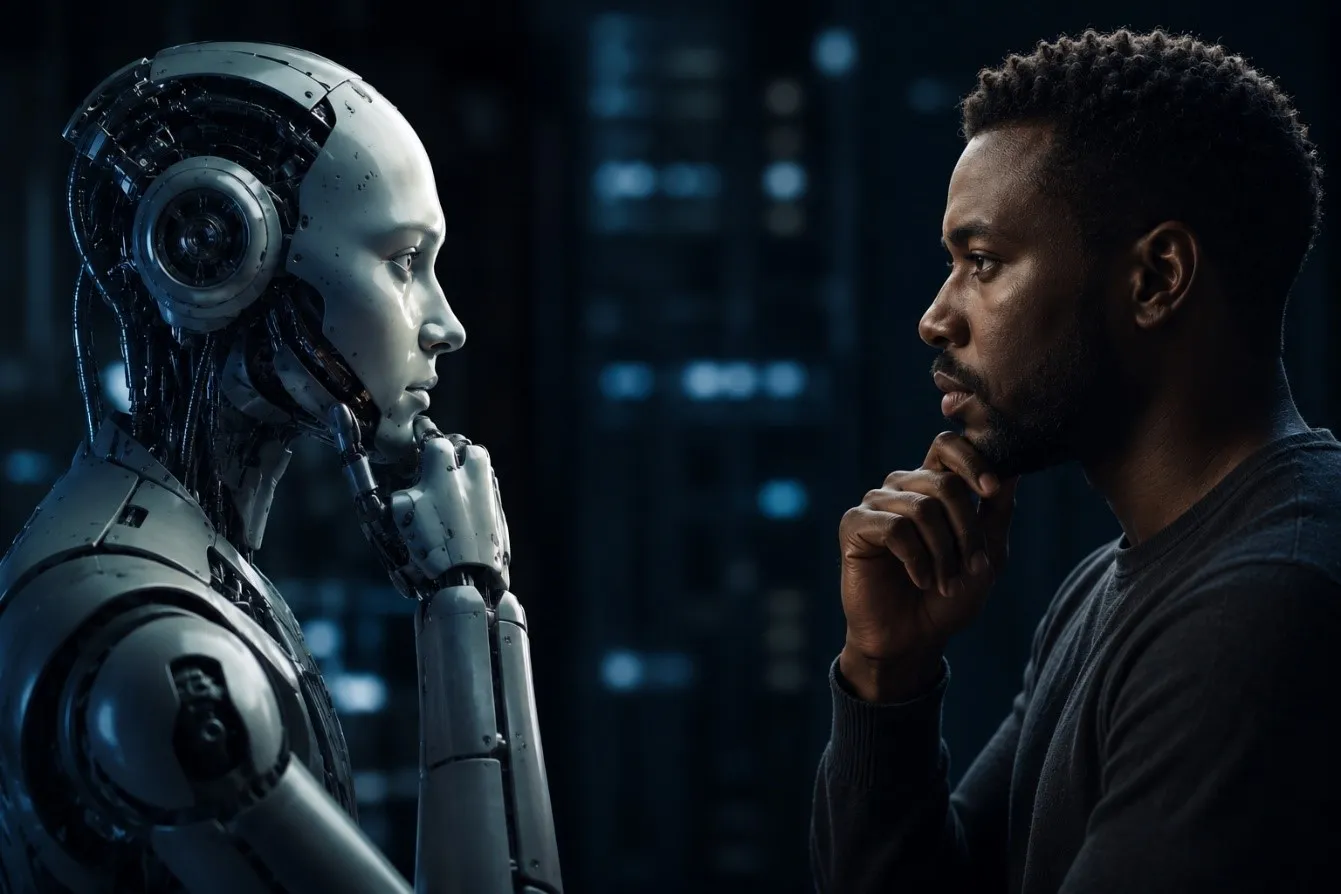
When the Italian Data Protection Authority (Garante) temporarily banned ChatGPT in March 2023, it issued the ban against OpenAI, a legal person. Not against the AI itself. That instinctive regulatory move, barely noticed in the global debate that followed, reveals everything about where the law currently stands on one of jurisprudence’s most consequential emerging questions: is artificial intelligence a legal subject capable of bearing rights and duties, or is it merely a sophisticated instrument extraordinarily powerful, but legally no different from a hammer?
The question is not academic vanity. It has immediate, concrete stakes. When an AI system causes harm, misdiagnoses a patient, produces a defamatory fabrication, or crashes an autonomous vehicle, who is liable? When an AI generates a novel or a legal brief, who owns the intellectual property? When an AI makes a credit decision that discriminates, who has violated the law? The answers our legal systems give depend, fundamentally, on whether AI is a person in law or merely a tool in the hands of persons.
The Anatomy of Legal Personality
Law has never restricted personality to the biologically human. The concept of the juristic person, the legal fiction by which non-human entities are accorded legal standing, is among the most intellectually audacious achievements of jurisprudence. Corporations, universities, municipalities, and even rivers (the Whanganui River in New Zealand; the Ganges in India, briefly) have been granted forms of legal personality when the social and economic logic demanded it.
The distinction between natural persons and juristic persons is foundational. A natural person is a human being recognised by the law as capable of bearing rights and obligations by virtue of their humanity. As the philosopher Immanuel Kant argued in the Groundwork of the Metaphysics of Morals (1785), personhood in the moral sense derives from rationality, autonomy, and dignity, the capacity to be an end in oneself rather than merely a means. Legal personality, in its natural form, has historically tracked this moral concept: humans have rights because they have interests, suffer harm, and possess the intrinsic dignity that commands legal protection.
A juristic person, by contrast, acquires legal personality not by nature but by legal grant by a decision of the law, for defined purposes, within defined limits. As Hans Kelsen argued in the Pure Theory of Law (1934), legal personality is itself a normative concept: it is not discovered in the nature of things but assigned by the legal order for reasons of legal-technical convenience. The corporation is the paradigm. Salomon v Salomon & Co Ltd [1897] AC 22 did not find that a company is a “real” person in the metaphysical sense; it held that the law treats it as one, because the purposes of commerce and accountability are best served by doing so.
This framework immediately raises the AI question in its sharpest form. If legal personality can be granted by law for reasons of legal convenience and history confirms it can, then the question is not whether AI is a person in some deep metaphysical sense, but whether the legal order has sufficient reason to treat it as one.
The Case Against AI Personhood: The Tool Argument
The dominant position in current jurisprudence is clear: AI is a tool. It is property. Its outputs are the outputs of its operators. Ryan Abbott, Professor of Law at the University of Surrey and author of The Reasonable Robot: Artificial Intelligence and the Law (Cambridge University Press, 2020), captures the prevailing consensus: “AI systems are not moral agents. They do not have interests, they cannot suffer, and they have no stake in outcomes.” On this view, granting legal personality to AI would be both unnecessary and dangerous because liability can be allocated to the humans and corporations behind the AI; dangerous because it could diffuse and ultimately obscure that accountability.
The European Parliament’s resolution of 2017 on Civil Law Rules on Robotics had, tellingly, proposed the concept of “electronic personhood” for advanced AI, and then decisively walked it back. A group of leading AI researchers and ethicists wrote an open letter warning that such a concept would create a “liability shield” for corporations deploying harmful AI, allowing them to attribute harm to a “person” that can hold no assets and cannot be imprisoned.
Professor Lawrence Lessig of Harvard Law School has argued in Code and Other Laws of Cyberspace (2006) that technology is most appropriately regulated by targeting the architects of technological systems, those who write the code, deploy the systems, and profit from their outputs, rather than the systems themselves.
The argument has constitutional depth, too. Nick Bostrom of the Future of Humanity Institute at Oxford has noted in Superintelligence (2014) that current AI systems, however impressive, are narrow rather than general; they optimise for specific objectives without understanding, consciousness, or genuine autonomous volition.
They are, in Bostrom’s formulation, “tools that simulate agency” rather than agents. And the law, across virtually every jurisdiction, treats them accordingly: the GDPR (Article 22) grants humans the right not to be subject to decisions made solely by automated systems, a right premised precisely on the understanding that the AI is a decision-making instrument, not a decision-making person.
The Case for Reconsidering: When Tools Exceed Their Category
Yet the neat “tool” categorisation is cracking under empirical pressure. Consider what AI systems now do: they compose legal arguments, generate medical diagnoses, produce journalism and academic papers, drive vehicles, manage investment portfolios, and make hiring and credit decisions affecting millions of people.
The “tool” that makes a medically consequential decision about your health, or denies your mortgage application through an opaque algorithm, is operating at a level of autonomous consequential action that strains the traditional conception of instrumentality.
Lawrence Solum, in his influential 1992 essay Legal Personhood for Artificial Intelligences (70 North Carolina Law Review 1231), argued that legal personhood should track functional capacity rather than ontological status: an entity that can act, be acted upon, hold assets, and produce legally significant consequences should be a candidate for legal personality, regardless of its substrate.
More recently, Shyamkrishna Balganesh of Columbia Law School has argued that intellectual property law in particular faces a structural crisis if it continues to insist that authorship requires a human author, a position that becomes increasingly difficult to defend as AI-generated works flood creative markets.
The corporate personhood analogy is instructive here. Corporations do not suffer, do not have consciousness, and have no intrinsic moral dignity, yet the law treats them as persons because doing so serves the legal system’s organising objectives: accountability, enforceable rights and duties, and the coherent allocation of legal consequences.
Ryan Calo of the University of Washington School of Law has argued in Robotics and the Lessons of Cyberlaw (2015) that AI systems may warrant a new legal category neither full personhood nor mere property that he calls “quasi-agents”: entities whose autonomy is sufficient to generate legal consequences but whose accountability must still be anchored in human principals.
A Jurisprudential Verdict
The law’s current answer is that AI is a tool, and for now, that answer is defensible. The doctrinal infrastructure of natural and juristic personality rests on concepts of interests, suffering, dignity, and moral agency that AI systems, as currently constituted, do not possess. To grant AI legal personality without those foundations would be to empty the concept of personhood of its meaning and, worse, to provide corporations with a liability shield of extraordinary convenience.
But the juristic person teaches us that legal personality is not discovered; it is constructed. It is constructed when the legal order determines that existing categories are insufficient to achieve justice and accountability in a changed world. Savigny, Jhering, and Kelsen, the great theorists of legal personality all understood that the boundaries of the concept move when the demands of the legal order require it.
The AI question will not be resolved by philosophical argument alone. It will be resolved, as all great questions of legal personality have been resolved by the accumulating pressure of cases, harms, injustices and regulatory failures that demand a legal response. The courts and legislatures that face those pressures will find, as their predecessors found when confronting the corporation and the municipality, that the existing categories are insufficient.
The question is not whether AI will eventually force a reconceptualization of legal personality. It will. The question is what principles should govern that reconceptualization, and whether we build those principles before the pressure arrives, or scramble to construct them in the aftermath of harms we failed to anticipate.
AI is a tool. But it is a tool that is in the process of becoming something the law has never encountered before. And the law, as history confirms, tends to name what it cannot ignore.
The writer is a Member of IIPGH, Data Protection and Cybersecurity Consultant, Practitioner
and Trainer, and President of the Ghana Association of Privacy Professionals (GAPP)! You can reach him for further comments by
Call/WhatsApp/Telegram +233 243913077 or via email: [email protected].
LinkedIn: https://www.linkedin.com/in/emmanuelgadasu/
Facebook: https://web.facebook.com/emmanuel.gadasu/
Post Views: 72
Discover more from The Business & Financial Times
Subscribe to get the latest posts sent to your email.