
By Juliet ETEFE
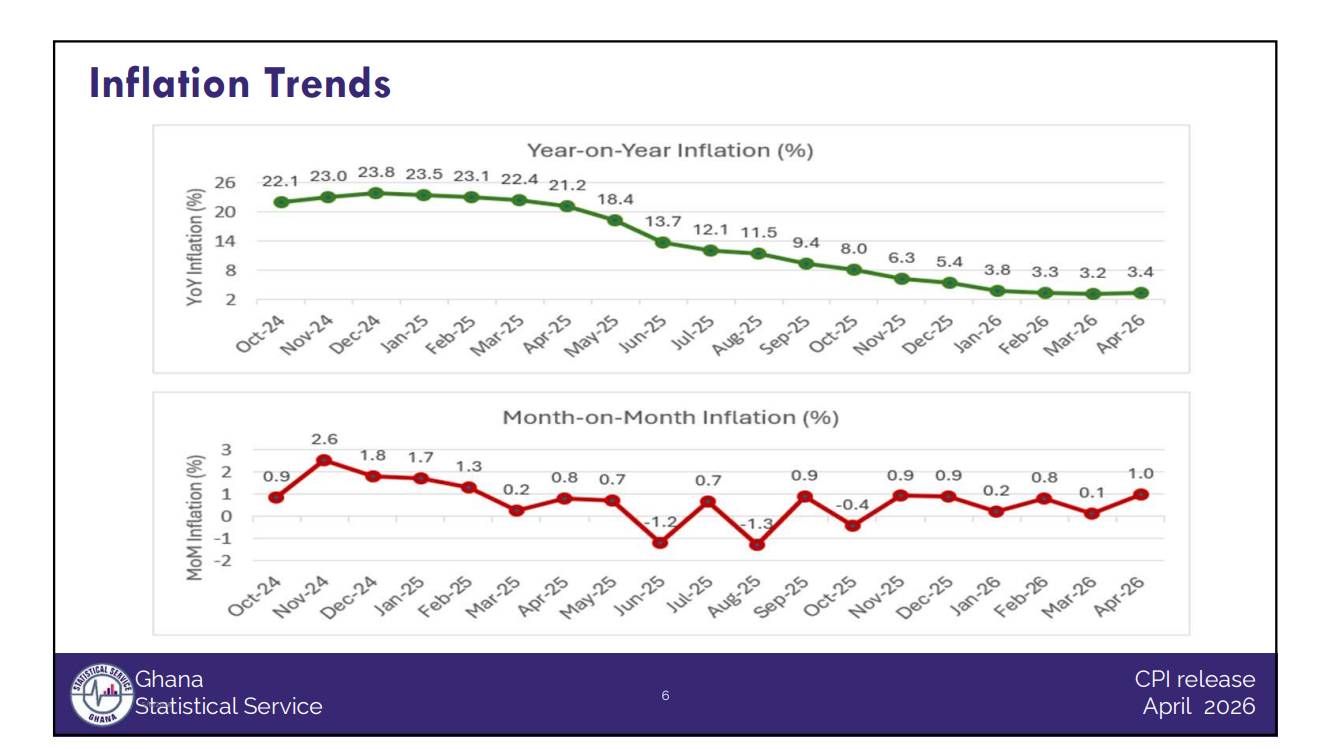
Ghana’s inflation rose slightly to 3.4 percent in April 2026, marking the first uptick since December 2024, the Ghana Statistical Service (GSS) has announced.
The increase represents a 0.2 percentage point rise from the 3.2 percent recorded in March 2026, but remains significantly lower than the 21.2 percent recorded in April 2025, reflecting a sustained disinflation trend over the past year.
According to the GSS, the Consumer Price Index (CPI) for April 2026 stood at 267.3, up from 258.6 in April 2025. On a month-on-month basis, prices increased by 1.0 percent between March and April 2026, signalling emerging short-term pressures.

Government Statistician, Dr. Alhassan Iddrisu, noted that while inflation remains relatively low, “we are beginning to see early signs of upward pressure in some components of the economy”.

A breakdown of the data shows diverging trends between food and non-food inflation. Food inflation eased marginally to 2.2 percent in April from 2.3 percent in March, although prices rose by 0.8 percent on a monthly basis. In contrast, non-food inflation increased to 4.2 percent from 3.9 percent, with a stronger month-on-month rise of 1.1 percent.
The data also shows a shift in price dynamics between locally produced and imported items. Inflation for locally produced goods declined to 4.7 percent in April 2026 from 4.9 percent in March, indicating some easing in domestic supply conditions.
However, inflation for imported items rose to 0.5 percent from -0.6 percent over the same period, reflecting renewed external price pressures.
Goods inflation slowed to 1.1 percent from 1.7 percent in March, offering some relief to consumers, as goods account for nearly three-quarters of the CPI basket. However, services inflation rose sharply to 9.6 percent from 7.2 percent, making it the fastest-rising component of inflation.
“This indicates that services such as transport, education and hospitality are increasingly driving price pressures,” the GSS noted.
At the divisional level, housing, water, electricity, gas and other fuels remained the largest contributor to inflation, accounting for about 37 percent of total inflation, with year-on-year inflation of 12.4 percent.
Food and non-alcoholic beverages followed with a 28 percent contribution and year-on-year inflation of 2.2 percent, while education services accounted for 15 percent, with inflation of 7.5 percent.
Restaurants and accommodation services also recorded rising inflation, reflecting growing cost pressures within the hospitality sector.
Regional level
At the regional level, the North East Region recorded the highest inflation rate at 9.5 percent, while Savannah Region posted the lowest at negative 3.5 percent.
Greater Accra and Ashanti regions together accounted for more than 70 percent of total inflation, underscoring the concentration of price pressures in urban and high-consumption areas. Overall, the top five regions contributed nearly 95 percent of April inflation.
Items
At the item level, charcoal, rent payments, river fish, smoked herrings, secondary school fees, green plantain and ginger collectively accounted for a significant share of inflation.
Ginger recorded the highest year-on-year price increase at 68.4 percent, followed by charcoal at 52.4 percent and shrimps at 45.9 percent.
However, some items saw sharp price declines, helping to moderate overall inflation. Prices of fried fish, pawpaw, garden eggs, cocoyam leaves and fresh okra all fell significantly compared to a year earlier.
Domestic and external drivers
Developments in both domestic and global markets also influenced price movements during the period. Supply disruptions linked to cross-border trade issues affected fresh tomato prices, which rose sharply by 34.3 percent month-on-month.
Similarly, global crude oil price increases pushed up fuel prices, with petrol rising by 17.2 percent between March and April, despite remaining lower than a year earlier.
Recommendations
The GSS emphasised that although inflation remains low and relatively stable, the latest data points to emerging pressures, particularly in services and non-food categories. It also highlighted that inflation is not broad-based but concentrated in specific regions and driven by a limited number of items.
To sustain price stability, the GSS urged government to maintain fiscal discipline, invest in food systems—particularly storage, irrigation and transport—and address regional disparities in market access.
Businesses were encouraged to improve operational efficiency, strengthen local supply chains and reduce avoidable costs, while passing on any cost savings to consumers where possible.
Households were advised to track spending more carefully, prioritise essential goods and services, avoid unnecessary expenses and build savings to cushion against potential price increases.
Post Views: 1
Discover more from The Business & Financial Times
Subscribe to get the latest posts sent to your email.