By Sharon Zoe Williams
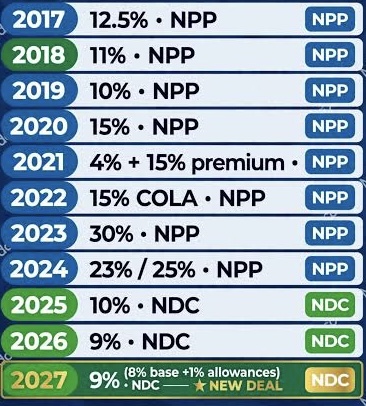
The television lights in the GBC News studio hummed with a familiar morning energy as two political strategists settled across from each other. On one side sat Prince, representing the communications machinery of the governing National Democratic Congress (NDC); directly across from him was Abdullah, bringing the sharp counter-perspective of the opposition New Patriotic Party (NPP). At stake was Remuneration issue. The debate that hits every household, market stall, and corporate office in the country; the newly agreed 9% and 10% increase in public sector wages, which comes with a deal that spread across a two-year freeze on further adjustments.
With a headline salary adjustment of 9% for 2027 and 10% for 2028, the debate quickly moved past the numbers on paper to a much more fundamental question: Will these adjustments genuinely protect the purchasing power of the Ghanaian worker?
The Government’s Perspective: Balancing Fiscal Sustainability and Relief
Opening the floor, the NDC’s Prince emphasized that wage negotiations cannot be divorced from macroeconomic realities. Government revenue generation, inflation trends, and the sustainability of public finances must be carefully weighed against worker demands.
“When it comes to salary negotiations, you must first analyze your fiscal health and revenue generation to determine whether an increment is sustainable,” Prince noted.
He acknowledged the heavy toll that past inflation spikes—particularly the soaring rates experienced in previous years—had taken on household incomes. However, he pointed to recent stabilization efforts, pointing out that inflation has moderated and utility tariff increases have seen temporary restraint during critical quarters.
Addressing the controversial topic of food and commodity prices, Prince referenced recent market monitoring reports comparing baseline costs between August and September. While acknowledging that staple items like onions, tomatoes, and cooking oil continue to test family budgets, he argued that targeted government interventions are actively working to cushion consumers from runaway market volatility.
When pressed on why the two-year deal features staggered increases rather than an even split, Prince explained that projected inflation targets for 2027 and 2028 guided the structure. With macroeconomic indicators pointing downward toward single-digit targets, the government sought a balanced path that prevents unsustainable promises while still delivering predictable year-on-year growth.
The Opposition’s Critique: A Gap Between Macroeconomic Claims and Market Realities
The NPP’s Abdullah, however, offered a sharply contrasting assessment, arguing that the 9% and 10% adjustments fall woefully short of restoring what public sector workers have lost to inflation and currency depreciation.
“I don’t think the government has been fair to the public sector workers,” Abdullah stated bluntly.
He challenged the narrative of economic recovery by comparing current cost-of-living pressures with historical wage actions during periods of severe national crisis. According to the opposition’s figures, cumulative adjustments achieved during prior challenging cycles far outpaced the single-digit offers currently on the table.
The discussion grew particularly animated when addressing the cost of fuel, transport, and construction materials. Abdullah pointed to local market indicators—citing commercial transport fare adjustments and the cost of building supplies like cement—to argue that the money supply in the system remains severely constrained.
“When you take money out of the system so there’s literally no money, lack of money is equivalent to poverty,” Abdullah argued, adding that reduced purchasing power has forced merchants to adjust prices simply because demand has dried up.
Fact-Checking the Agricultural Debate: Ghana’s Import Standing
The broadcast also touched on broader structural economic policies, sparking a spirited debate over agricultural production and food imports. Prince defended the government’s agricultural modernization initiatives, pointing to past distribution programs aimed at empowering local farmers, livestock producers, and poultry ventures.
In response to claims regarding Ghana’s standing as a major importer of frozen chicken, reference data from trade analysts and the Ministry of Food and Agriculture was brought into focus. While earlier global export figures placed Ghana among notable regional and international importers by value and volume, institutional clarifications highlighted the complexities of tracking seasonal import policies against domestic production timelines. Both sides agreed on the ultimate objective: strengthening local agricultural self-sufficiency so that domestic producers can sustainably feed the nation without over-reliance on external supply chains.
Looking Ahead: Constitutional Interpretations and National Discourse
As the studio clock ticked toward the next segment, the conversation underscored the delicate tightrope public administrators must walk. Balancing fiscal discipline with worker welfare. That balance remains one of governance’s toughest challenges. With the 2027–2028 remuneration framework now set, the true test will not be found in projected percentages, but will be in the everyday reality of the market stall, the fuel pump, and the elasticity of family budgets.