
By Nana Karikari, Senior International Affairs and Political Analyst
Kenyan President William Ruto and Democratic Republic of Congo President Felix Tshisekedi agreed on Sunday to restore full diplomatic relations. The pact signals a major thaw after years of bitter friction over rebel activity in eastern Congo.
The Oyo Summit Breakthrough
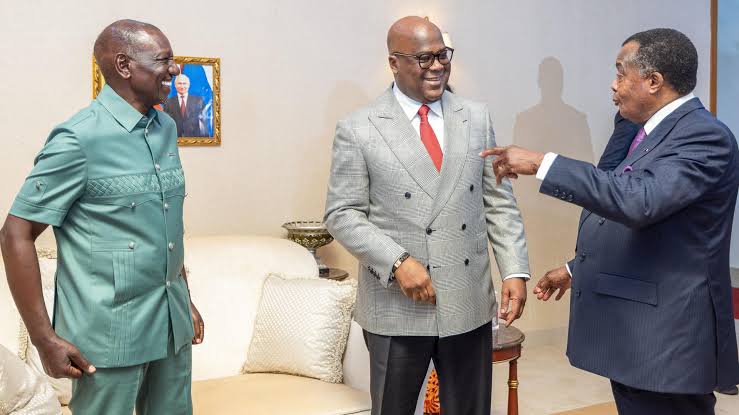
The two leaders reached the deal during a quadripartite summit in Oyo, a town in the Republic of Congo. Republic of Congo President Denis Sassou Nguesso hosted and facilitated the talks. Togolese President Faure Essozimna Gnassingbé served as mediator in his capacity as the African Union-appointed envoy for the eastern Congo crisis.
In a joint statement after the talks, Ruto and Tshisekedi pledged mutual respect for “sovereignty, territorial integrity, non-interference in the internal affairs of states.” They also committed to “good neighbourliness and peaceful settlement of disputes” and vowed to “strengthen cooperation within regional mechanisms” such as the East African Community (EAC) and the International Conference on the Great Lakes Region (ICGLR). DR Congo joined the EAC trade bloc in 2022.
Roots of the Diplomatic Rift
Relations began unraveling in 2023 when Kinshasa accused Nairobi of harboring Congolese dissidents and insurgent leaders working to destabilize the country. That year, the Congo River Alliance (AFC)—a political-military coalition incorporating the M23 rebel group—launched publicly in Nairobi. Kinshasa swiftly recalled its ambassador from Kenya in protest. Officials later refused to accredit Kenya’s newly nominated envoy.
Kinshasa’s EAC membership has faced similar strain over its persistent accusations that fellow member Rwanda arms and backs the M23 insurgency. Kigali has repeatedly denied the allegations despite mounting evidence cited by United Nations experts and Western governments.
Escalations Over Goma and Joseph Kabila
Tensions escalated sharply in March 2025 after Nairobi appointed a consul-general to Goma, the provincial capital of DR Congo’s North Kivu region. The move came shortly after M23 fighters seized Goma as part of their broader territorial control across eastern
Congo. Congolese officials condemned the appointment as a breach of national sovereignty that appeared to legitimize rebel rule.
Diplomatic standing sank even lower in October 2025. That month, Kenya hosted a gathering of Congolese opposition figures that included former President Joseph Kabila. Earlier in 2025, a Congolese court sentenced Kabila to death in absentia on charges including treason and war crimes. Kabila denied the charges and declined to appear in court. He subsequently emerged as head of the Front for the Refoundation of the Nation (FRN), a rebel coalition that succeeded the AFC.
Trade Cooperation and a Cross-Border Ebola Crisis
Beyond resolving their diplomatic standoff, Ruto and Tshisekedi used Sunday’s talks to map out deeper bilateral trade, economic development, and regional integration. Ruto announced that the two countries will revive their Joint Grand Commission for Cooperation, though officials have not yet set a firm date for ambassadors to return to their posts.
The two leaders also agreed to coordinate efforts to contain an ongoing regional Ebola outbreak. Speaking on Sunday, World Health Organization Director-General Tedros Adhanom Gheyesus warned that a surge in violent attacks across eastern Congo since late October has severely hampered medical teams. Heavy fighting near the outbreak’s original epicenter has disrupted containment operations and crippled the wider public health response.
Since authorities declared the outbreak in May, the virus has infected more than 11,000 people and killed over 5,700 across DR Congo. Driven by the Bundibugyo strain of the virus, the epidemic has spilled across national borders. Health officials have now recorded confirmed cases in Kenya, Uganda, and Nigeria.
Pan-African Stakes and Continental Integration
For the wider continent, the Oyo accord carries major significance for African-led diplomacy and cross-border commerce. Togo’s mediation alongside Congo-Brazzaville highlights growing West and Central African collaboration under the African Union’s mandate to resolve regional conflicts without external intervention.
Economically, normalized ties directly affect vital trade corridors. Kenya’s Indian Ocean port of Mombasa serves as a primary gateway for goods entering eastern DR Congo. Stability between Nairobi and Kinshasa is essential for unlocking cross-regional supply chains under the Accra-based African Continental Free Trade Area (AfCFTA) and curbing infectious disease threats across borders.
Regional Stakes Ahead
Restoring formal ambassadors removes a major diplomatic roadblock between two of East Africa’s most influential nations. However, analysts note that translating Sunday’s commitments into lasting security will test whether regional diplomacy can curb entrenched armed groups and stabilize eastern Congo’s worsening humanitarian crisis.