
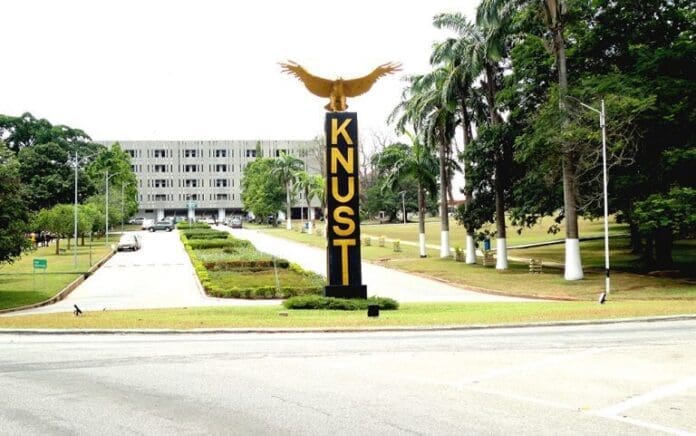

The Confucius Institute at the Kwame Nkrumah University of Science and Technology (KNUST) in collaboration with the Chinese Embassy in Ghana awarded 71 KNUST students the Chinese Ambassador’s Scholarship on Friday in Kumasi, Ghana’s second largest city. The ceremony also marked celebrations for the Chinese Lunar New Year, highlighting the deepening educational cooperation between Ghana and China.
Ke Ningli, the Chinese Director of the Confucius Institute at KNUST, said the scholarship scheme reflected the depth of educational cooperation between the two countries. He urged the scholarship recipients to continue strengthening their Chinese language proficiency and cross cultural communication skills to contribute to long term bilateral relations between Ghana and China.
Philip Antwi Agyei, Provost of the College of Science, delivered remarks on behalf of the vice chancellor of KNUST. He conveyed management’s appreciation to the Chinese Embassy, describing the scholarships as an investment in Ghana’s intellectual and human capital. The provost emphasized that the scholarships represent more than financial support, characterizing them as seeds sown into the fertile soil of Ghanaian intellect.
Nana Akua Abakoma, one of the scholarship recipients, reflected on her experience at the international Chinese Bridge competition and described cultural exchange as a powerful tool for global understanding. She said the experience deepened her appreciation of Chinese values such as respect, hospitality and wisdom, inspiring her to continue learning and sharing through cultural exchange.
Daniel Duah, the Ghanaian Director of the Confucius Institute at KNUST, said the institute had recorded steady growth since its establishment. He noted that KNUST is preparing to host the 2026 Chinese Bridge Chinese proficiency competition, which will bring together participants from across the region to demonstrate their language skills and cultural knowledge.
The Chinese Ambassador’s Scholarship forms part of broader educational cooperation initiatives between Ghana and China. In November 2024, the Chinese Embassy awarded scholarships to 300 students across multiple institutions including the University of Ghana, University of Cape Coast, and KNUST. Recipients that year also included students from Rising Sun Montessori, Nouvel Community Academy, Saint Maur Community School, Aburaman Senior High School, and University Practice Senior High School.
The 2024 ceremony also recognized security personnel from the Ghana Immigration Service and the Customs Division of the Ghana Revenue Authority (GRA) who were studying Chinese language. Chinese Ambassador to Ghana Tong Defa noted that the 2024 presentation coincided with the 20th anniversary of the establishment of Confucius Institutes globally.
Ambassador Defa stated that up to 496 Confucius Institutes and 757 Confucius Classrooms had been established across 160 countries, with three institutes operating in Ghana. He urged students to take interest in learning Chinese language, noting that 2026 has been designated as the China Africa Year of People to People Exchanges. The ambassador emphasized that language skills would create opportunities for students to become civilian ambassadors contributing to deeper bilateral relations.
Mary Afua Boateng, a level 300 Bachelor of Arts student in Health Service and Chinese at KNUST, expressed appreciation on behalf of beneficiaries during the 2024 ceremony. She said studying Chinese language had taught her a new culture and experience, particularly regarding time management and dedication required for language study.
Stanley Barning, another recipient, acknowledged that although learning Chinese was not easy, being able to speak the language was rewarding given China’s influence across the globe as one of the world’s largest economies. His comments reflect the practical motivation many students have for acquiring Chinese language skills.
The Confucius Institute Scholarship program offers various categories of support for international students wishing to study Chinese language and culture. Programs include one semester and one academic year Chinese language and culture courses, four week short programs, and specialized programs for teaching Chinese to speakers of other languages.
Scholarship coverage typically includes tuition fees, accommodation in shared dormitory rooms, basic medical insurance, and monthly allowances for personal expenses. The comprehensive support package removes financial barriers that might otherwise prevent students from pursuing Chinese language education.
The Chinese Bridge competition mentioned by scholarship recipient Nana Akua Abakoma represents a prestigious international platform for students to demonstrate Chinese language proficiency and cultural understanding. Hosting the 2026 edition at KNUST will raise the profile of Chinese language education at the university and throughout Ghana.
The steady growth of the Confucius Institute at KNUST reflects broader trends in Ghana China relations, which have expanded significantly across educational, economic, and cultural spheres. Educational cooperation through language training and scholarships creates people to people connections that strengthen bilateral ties beyond government level interactions.
The scholarship awards align with China’s broader strategy of promoting Chinese language and culture globally through the Confucius Institute network. By supporting students in developing countries like Ghana, China cultivates goodwill and creates networks of individuals familiar with Chinese language, culture, and perspectives.
For Ghanaian students, Chinese language skills open doors to educational opportunities in China, career prospects with Chinese companies operating in Ghana and across Africa, and enhanced understanding of a major global power increasingly influential in African development. The scholarships make these opportunities accessible to students who might otherwise lack resources to pursue Chinese language education.
The collaboration between KNUST and the Chinese Embassy demonstrates institutional commitment to sustaining and expanding Chinese language education in Ghana. As economic ties between Ghana and China continue to grow, demand for individuals with Chinese language skills and cultural competence is likely to increase across various sectors.