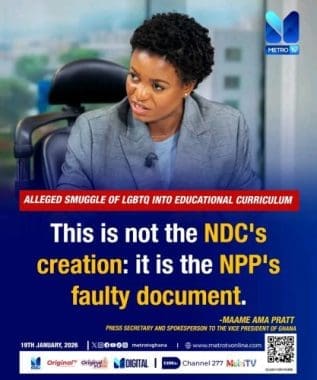
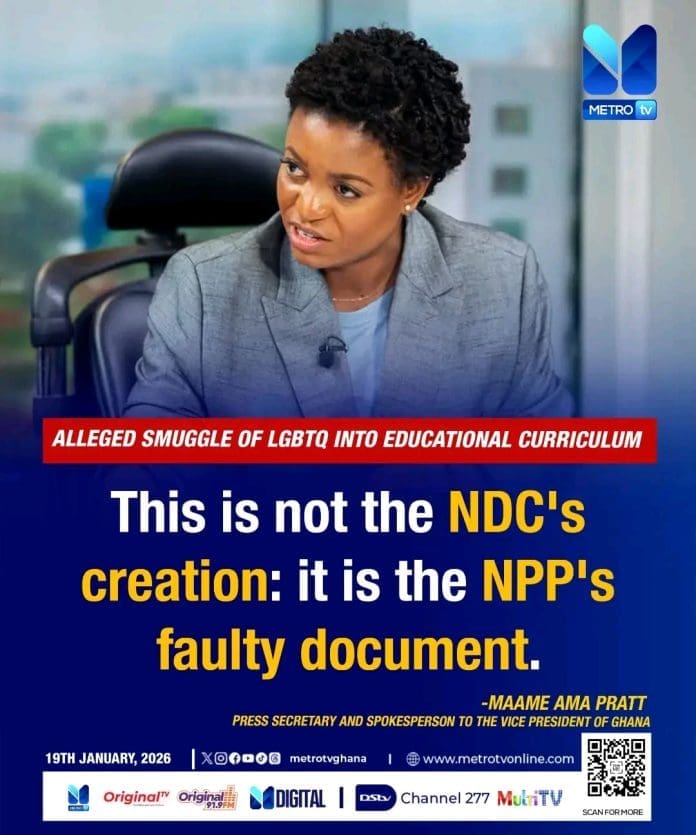

Public backlash against the Vice President’s spokesperson, Maame Ama Pratt, has escalated sharply after her comments on the alleged inclusion of LGBTQ-related content in Ghana’s educational curriculum, with many Ghanaians describing her explanation as reckless, evasive and politically dishonest.
Speaking on television, the spokesperson claimed the controversial curriculum document was not the creation of the National Democratic Congress (NDC) but rather a “faulty document” inherited from the New Patriotic Party (NPP). The statement has since ignited a storm on social media, where critics say the comments betray a disturbing lack of responsibility and seriousness on a matter involving children’s education.
Many netizens argue that the attempt to shift blame to a previous administration has only worsened the situation. They insist that regardless of who initiated the document, the NDC government oversaw its approval, printing and distribution, making it fully accountable for its contents.
Several commentators questioned why the document was not withdrawn if it was indeed flawed, noting that the same government had previously halted other programmes introduced by its predecessor. To them, the decision to proceed with printing textbooks for schoolchildren while later disowning the material exposes what they describe as hypocrisy and poor governance.
Others pointed to the role of state institutions, particularly curriculum authorities and supervising ministers, arguing that claims of ignorance or inherited mistakes amount to an admission of gross negligence. According to critics, due diligence should have identified any problematic content long before it reached classrooms.
Some reactions were particularly scathing, accusing the spokesperson of insulting the intelligence of Ghanaians and trivialising a sensitive national debate. While the tone of many comments was harsh, the underlying message was consistent: the explanation offered was seen as weak, contradictory and lacking credibility.
The controversy has further fueled demands for a full, transparent account of how the curriculum was developed, reviewed and approved, and who bears ultimate responsibility. As pressure mounts, observers say the government can no longer rely on blame-shifting rhetoric but must provide clear answers to reassure parents, educators and the wider public.
So far, no comprehensive official response has been issued to address the concerns raised, leaving the debate to rage on and confidence in the government’s handling of education policy increasingly strained.