

By: Nana Karikari, Senior Global Affairs Correspondent
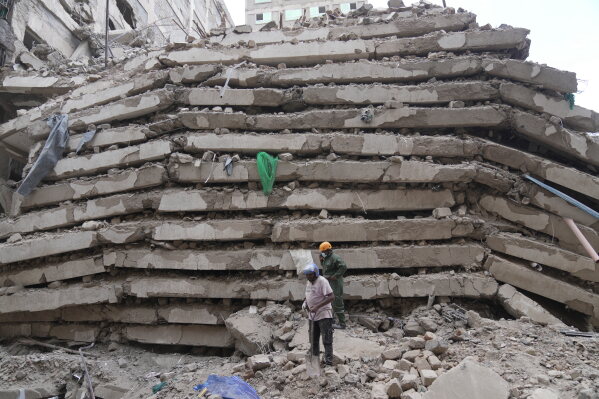
Many people are feared trapped beneath a mountain of crushed concrete in Kenya’s capital after a multi-storey building under construction collapsed on Friday afternoon, leaving rescue workers scrambling to clear twisted metal and reach survivors.
The structural disaster occurred around 1:00 p.m. local time along 9th Street in Nairobi’s Eastleigh neighborhood, a high-density commercial district crowded with thousands of daily traders and residents.
The high-rise structure pancaked as it came down, leaving more than a dozen upper floors stacked tightly on top of one another with virtually no clearance space remaining between the slabs.
Dispatched Emergency Teams Face Volatile Scene
Emergency crews and multi-agency response units rushed to the cordoned-off location to hunt for survivors amid rising plumes of dust.
Search operations encountered immediate complications as crowds swarmed the periphery and opportunists began looting nearby businesses. Law enforcement officers fired tear gas into the surrounding streets to disperse the chaotic crowds, clear traffic lanes, and grant specialized search teams access to the debris field.
Nairobi Police Chief Issa Mohamud confirmed that the structure had more than 10 upper floors actively under construction at the time of the failure. He cautioned that search operations remained precarious due to structural instability.
“One injured woman was rescued and hospitalized, and another person who was crying for help had gone silent,” Mohamud disclosed. He additionally warned of a heightened threat of a secondary collapse, pointing out that the tilted mass of the fallen building was resting heavily against an adjacent neighboring structure.
Eyewitness Accounts Detail Desperate Escape

Workers inside the high-rise described scenes of sudden panic as the physical structure gave way beneath them.
Joseph Kaula, a plasterer assigned to the fifth floor, recounted making it out just in time. He recalled hearing panicked screams before witnessing co-workers racing toward the exits shouting that the structural integrity had failed.
“I was the last person to walk out before it collapsed and the whole area was filled with dust,” Kaula said. He voiced grave fears that several of his colleagues remained trapped down in the basement level.
Trapped victims initially managed to reach out to relatives from beneath the rubble. Onlookers and family members gathered near the site reported receiving desperate telephone calls from loved ones immediately following the impact, though those mobile connections went completely silent shortly after. Officials set up a designated response tent at the perimeter to record names of the missing, as authorities conceded that the exact number of individuals trapped inside remained entirely unknown.
Resource Shortages Slow Initial Search Effort
In the immediate aftermath, heavy earth-moving machinery was severely lacking at the disaster zone.
For several hours, emergency workers in hard hats relied on crude tools, using long wooden poles stripped from nearby trees to probe deep cavities within the mountain of concrete. Heavy equipment eventually trickled onto 9th Street later in the day. An initial excavator began clearing steel-laced slabs, followed by at least two additional back shovels arriving by evening to accelerate the clearance process.
Rescuers focused their primary strategy on penetrating subterranean gaps in the basement and ground level. Ground-floor spaces were actively leased out to an electronics store, a butcher shop, and a grocery store, operating illegally while heavy construction proceeded on the upper stories directly above them.
Official Documentation and Regulatory Filings
Records released by the National Construction Authority confirmed that the site was registered on July 30, 2025, as a proposed development on land along 9th Street in Kamukunji Sub-County.
Regulatory documentation listed 9th Street Plaza Limited as the official project developer and named Stromax Holdings E.A Limited as the primary contractor. Architect Emmanuel Mwangi Maina and structural engineer Joseph Muturi Mugu were designated as the licensed professionals responsible for oversight.
Multi-agency teams—comprising the National Disaster Operations Centre, the Kenya Red Cross, the Kenya Defence Forces, and county search teams—maintained a coordinated search while specialized medical personnel remained on standby.
The National Construction Authority noted that the area remained strictly cordoned off, advising the general public to keep clear as investigations into the root cause commenced. Authorities broadcast dedicated emergency hotlines—1508 and 1199—urging citizens to submit information regarding missing relatives.

Systemic Failures and Regulatory Backlash
Building collapses represent a persistent and deadly urban crisis throughout Nairobi, where rapid commercial expansion frequently outpaces enforcement capacity. City planning officials face persistent accusations of neglecting mandatory structural inspections and failing to punish rogue developers who routinely circumvent safety mandates.
Nairobi Governor Johnson Sakaja confirmed that while the project possessed valid construction approvals, it had never been issued an official certificate of occupation. Operating active retail businesses on the lower levels without that mandatory clearance violated national building codes.
Governor Sakaja publicly criticized the weak legislative frameworks currently governing building infractions. He argued that lenient statutory penalties serve as a mere “slap on the wrist” for developers who ignore safety guidelines and approved architectural blueprints.
To tighten enforcement, Sakaja stated he petitioned the Director of Public Prosecutions to restore direct prosecutorial powers to county governments, enabling local regulators to criminally charge violators.
Law enforcement authorities emphasized that systemic failures will face rigorous legal accountability.
“Investigations will be carried out,” Mohamud declared. “We’ll make sure people face the law for any negligence.”

As night fell over Eastleigh, floodlights illuminated the tangled wreckage where rescue crews continued their search into the early hours. For grieving families waiting at the perimeter tent, the tragedy underscores an urgent national crossroad between rapid urban growth and strict safety oversight.
Whether this disaster forces long-overdue reform across Kenya’s construction industry will depend on how rigorously authorities enforce compliance once the dust settles.