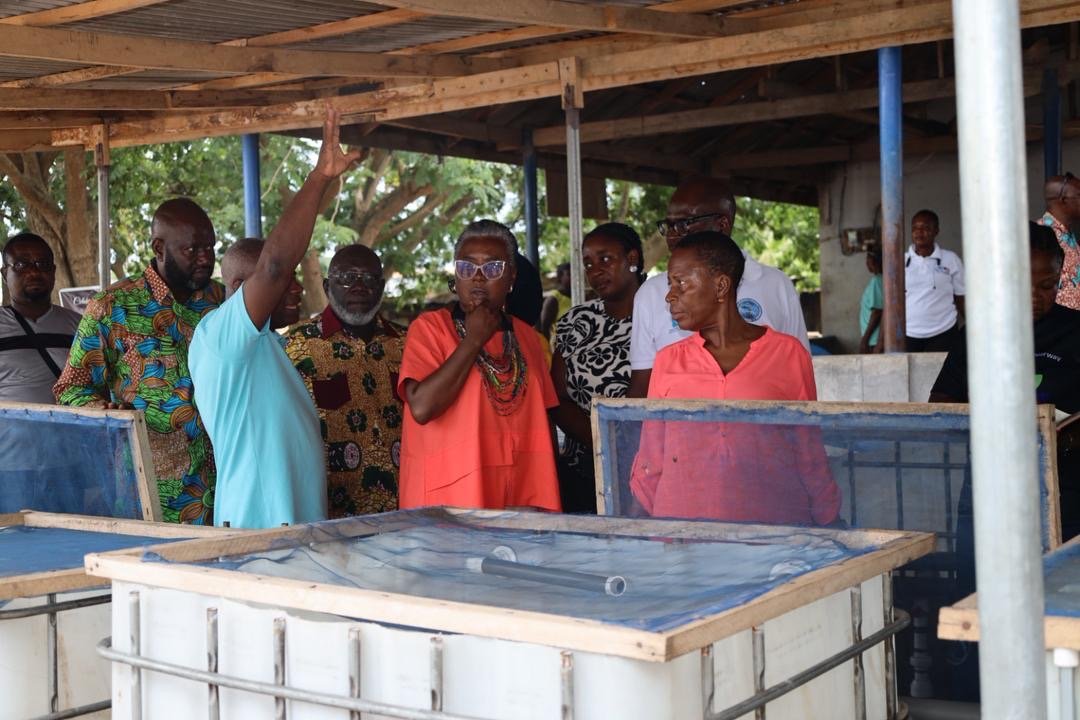


The Minister for Fisheries and Aquaculture Development, Emelia Arthur, has toured clam fishing communities along the Lower Volta ahead of the launch of Ghana’s first Inland Fisheries Management Plan.
The visit took the minister to communities including Ada Kponkpo Kpanya and Ageke-Tsatsu Kope, where clam fisheries remain a major source of livelihood and economic activity.
The forthcoming management plan is expected to introduce measures aimed at protecting and sustaining inland fishery resources, particularly clam habitats that support hundreds of families in the area.
In Ada alone, clam fishing directly employs about 500 people, while an estimated 700 others depend indirectly on the trade through transportation, processing, and marketing activities.
During the peak fishing season, around 50 canoes reportedly land clams daily, with each canoe unloading approximately 60 sacks, equivalent to about 300 margarine buckets of clams.
The clam industry in the Lower Volta operates through a structured value chain rooted in traditional ecological knowledge passed down through generations.
The process begins with the harvesting of spat, or juvenile clams, from the wild. These are sold by the paint bucket to farmers who seed them in carefully selected locations within the river system.

Depending on market demand, the clams are harvested after one to two years.
Beyond the clam meat itself, the shells have also become an important economic resource. They are used in industries such as animal feed production and paint manufacturing, with industry players indicating that investments in clam shells can yield returns of over 100 per cent within a year.
Despite its economic significance, the fishery faces growing threats.
Community members raised concerns over the expansion of aquaculture activities, which they say has led to restrictions on access to traditional clam farming areas by some private “water owners.”
Sediment mining along sections of the river was also highlighted as a major challenge affecting clam habitats. Residents explained that increased turbidity degrades water quality and threatens clam survival, as clams depend on clean water for feeding and growth.
The Ministry of Fisheries and Aquaculture Development says the Inland Fisheries Management Plan will focus on safeguarding clam habitats, ensuring fair access to water resources, and protecting traditional livelihoods tied to the industry.