
The Minority in Parliament has questioned the government’s commitment to establishing a women’s bank, alleging that the 2027 Budget failed to address a promise repeated in the previous two budgets.
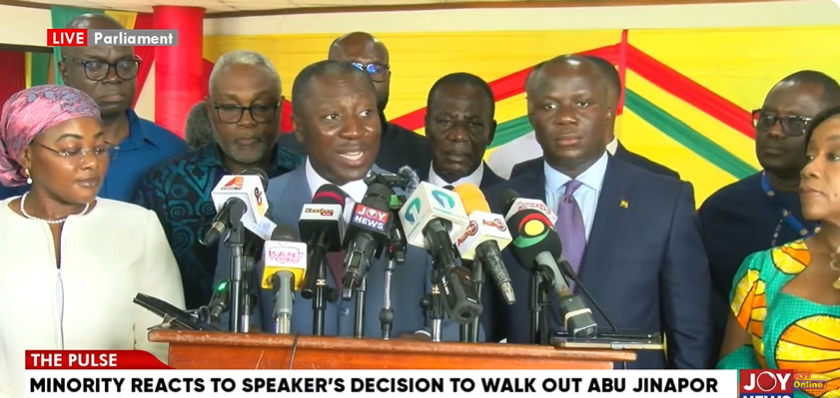
Minority Leader Alexander Afenyo-Markin raised the concern at a press conference on Thursday after Finance Minister Dr Cassiel Ato Forson presented the 2027 Budget Statement and Economic Policy to Parliament.
He accused the government of failing to honour its pledge to give women, particularly traders, access to loans through the proposed bank.
“Meanwhile, in the 2025 budget, they said they were going to establish a new women’s bank. 2026, they said the same thing. But in 2027, they were quiet. The minister was silent.”
Afenyo-Markin argued that the alleged omission raised questions about the government’s delivery on its campaign commitments.
“It is clear that the NDC could not fulfil its own promises to the women, the traders of this country,” he said.
The criticism formed part of the caucus’s preliminary response to the budget. The Minority Leader said members would examine the statement in detail and present a fuller assessment after the budget workshop.
He linked the women’s bank pledge to broader concerns about employment, business support and the cost of living.
According to him, high food prices continued to put pressure on households and traders across markets in Techiman, Tamale, Kumasi, Winneba and Accra.
He argued that the government’s economic claims had not brought sufficient relief to ordinary Ghanaians.
“Stability on paper, hardship in our pockets.”
Afenyo-Markin also challenged the government to state how many jobs it had created. He questioned the Finance Minister’s appeal for patience, saying Ghanaians expected employment opportunities after two years in office.
“Ghanaians want jobs, jobs, jobs.”
The Minority Leader further demanded clarity on the relationship between the New Economy Programme and the government’s 24-hour economy policy.
He said the budget did not provide enough detail on how much of the proposed US$10 billion for the New Economy would be available in 2027 or which projects it would finance.
The caucus also questioned the government’s support for private businesses. Afenyo-Markin criticised what he described as limited incentives for machinery imports and argued that businesses needed a stronger enabling environment to expand and employ people.
“Without the private sector, the economy cannot grow.”
While welcoming the government’s stated ability to meet deferred payments under the Domestic Debt Exchange Programme, he asked why funding remained a concern for public-sector workers and recruitment.
For the Minority, he maintained, the budget’s test would be its ability to deliver jobs, support businesses, and ease household hardship.
DISCLAIMER: The Views, Comments, Opinions, Contributions and Statements made by Readers and Contributors on this platform do not necessarily represent the views or policy of Multimedia Group Limited.
DISCLAIMER: The Views, Comments, Opinions, Contributions and Statements made by Readers and Contributors on this platform do not necessarily represent the views or policy of Multimedia Group Limited.
Source link