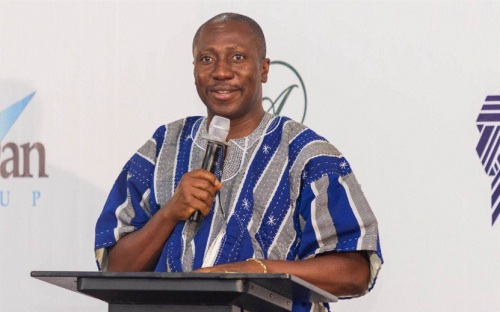


The Minority in Parliament has criticized the National Democratic Congress (NDC) government for cancelling the One District One Factory (1D1F) initiative without introducing alternative policies to drive private sector growth and job creation, as youth unemployment remains a pressing national concern.
Minority Leader Alexander Afenyo Markin spoke at a press briefing in Parliament on Monday, February 3, 2026, upon the House’s resumption from recess, expressing disappointment over what he described as zero initiatives and lack of leadership on critical economic and social policy fronts. The briefing marked the Minority’s one year assessment of the NDC government’s performance since taking office on January 7, 2025.
Afenyo Markin noted that the Ministry of Trade and Industry has not announced any major private sector initiative to create economic growth despite cancelling the 1D1F programme that was established under the previous New Patriotic Party (NPP) administration. He questioned the government’s commitment to industrialization and manufacturing sector development in the absence of a clear replacement policy.
The Minority Leader also raised concerns about stalled public sector reforms, noting that the minister responsible for public sector reform appears inactive. He stated that there have been no major announcements, even in the 2026 budget, as if that ministry is non existent. This lack of progress contradicts government promises made during the 2024 campaign to improve efficiency and accountability in the public sector.
Youth unemployment emerged as another focal point of the Minority’s criticism. Afenyo Markin highlighted a reported 34 percent youth unemployment rate, describing it as very unacceptable. He questioned where the jobs are given all the promises made by the government during the election campaign. The figure cited by the Minority Leader aligns with Ghana Statistical Service (GSS) data showing that national youth unemployment for persons aged 15 to 24 years stood at 32.8 percent, with significantly higher rates in some northern regions exceeding 39 percent.
The Minority Leader criticized several government youth employment programmes including Adwuma Wura, National Apprenticeship Programme and Nkoko Nkitinkiti, describing them as paper promises. He argued that in reality, tangible outcomes from these programmes are minimal or scanty. Afenyo Markin emphasized that 2026 marks the government’s second year in office, stating that the honeymoon is over and Ghanaians expect concrete results.
Adwuma Wura, announced by President John Dramani Mahama during his inauguration in January 2025, aims to partner with institutions including the Mastercard Foundation to provide startup capital for young entrepreneurs. The government has also promised to train one million coders over four years to create workforce capacity for business process outsourcing and software development. However, implementation details and funding mechanisms for these programmes remain unclear more than a year after their announcement.
The National Apprenticeship Programme, managed by the Council for Technical and Vocational Education and Training (COTVET), seeks to formalize apprenticeship training across Ghana. The programme connects young people with master craftspersons in various trades while providing structured training and certification. Nkoko Nkitinkiti, a colloquial Ghanaian term meaning small scale or incremental, reportedly refers to micro enterprise support initiatives, though official programme documents have not been widely published.
The Minority’s critique comes amid broader economic challenges facing Ghana. The country recorded gross domestic product growth of 6.1 percent over the first three quarters of 2025, driven mainly by services and agriculture sectors. Inflation declined to 5.4 percent in December 2025, the lowest rate since July 2022, marking 12 consecutive months of decline. The Ghana cedi appreciated 40.7 percent against the United States dollar in 2025 following significant depreciation in 2024.
However, these macroeconomic improvements have not translated into significant job creation or visible changes in living standards for many Ghanaians. The World Bank estimates that approximately 38.8 percent of Ghana’s youth are unemployed, with nearly 68 percent of employed youth engaged in vulnerable jobs characterized by low pay, instability and no long term security.
According to Afenyo Markin, the NDC strongly criticized NPP policies when it was in opposition, but almost a year into governance, there has been little evidence of a major shift. He acknowledged that the only notable intervention so far is the establishment of the Gold Board, which has helped stabilize the cedi through centralization of gold purchases. Beyond this, he argued that sectors like agriculture have seen no major improvement.
The Gold Board, established in April 2025, consolidated all gold purchasing activities under the Bank of Ghana (BOG) to reduce foreign exchange demand from gold exports and strengthen the domestic currency. The initiative contributed significantly to cedi stability in 2025, though critics note it primarily addresses symptoms of exchange rate pressure rather than underlying structural economic challenges.
The 1D1F programme was launched by the NPP government in 2017 as a flagship industrialization initiative aimed at establishing at least one factory in each of Ghana’s 261 districts. By December 2024, the programme had established 278 factories across the country, with 140 operational, 124 under construction and 14 at various stages of completion. The factories span sectors including agriculture processing, textiles, pharmaceuticals, building materials and light manufacturing.
The NDC government announced the cancellation of 1D1F shortly after taking office in January 2025, arguing that the programme was poorly implemented, lacked proper targeting and diverted resources from more strategic industrial development initiatives. However, more than a year later, no comprehensive alternative industrial policy framework has been unveiled to replace 1D1F’s objectives of decentralized industrialization and job creation.
Trade and Industry Minister Kobina Tahir Hammond has indicated that the government plans to develop a new industrial policy focused on sectors where Ghana has competitive advantages, including agribusiness value chains, pharmaceuticals, petrochemicals and digital economy services. Specific timelines, funding commitments and implementation mechanisms for this new policy have not been publicly disclosed.
Afenyo Markin stressed that without clear leadership and tangible interventions, public sector reform remains stalled and promises must now translate into concrete actions. His remarks indicate growing impatience among opposition lawmakers who expect the government to move beyond rhetoric and deliver visible results on employment, industrialization and institutional reforms.
The Minority’s criticism reflects broader frustration among Ghanaians over persistently high youth unemployment despite relatively strong macroeconomic performance. Youth unemployment remains a critical national security concern, with studies by the United Nations Development Programme (UNDP) identifying joblessness as the most common driver of vulnerability to violent extremism and radicalization in Ghana’s northern regions.
Minister for Youth Development and Empowerment George Opare Addo acknowledged in January 2026 that youth unemployment constitutes a national security risk requiring aggressive intervention. His ministry has prioritized programmes aimed at formalizing informal employment, introducing youth to agriculture, supporting entrepreneurship and developing digital economy skills.
However, experts caution that effectiveness of government initiatives hinges on execution, transparency and measurable outcomes. Professor Justice Bawole, Dean of the University of Ghana Graduate Business School, noted in December 2024 that while the NDC’s youth focused programmes are commendable, they fall short in critical areas including funding adequacy, measurable outcomes and active youth engagement in policy implementation.
The Minority urged the government to provide concrete steps to tackle the unemployment crisis, emphasizing that young Ghanaians need real opportunities, not just programmes on paper. As Parliament resumed sittings on Tuesday, February 3, 2026, the opposition indicated it would intensify scrutiny of government programmes, ministerial performance and budget allocations related to job creation and industrial development.
The debate over 1D1F’s cancellation and youth unemployment programmes is expected to feature prominently during the 2026 budget debate scheduled for March. The Minority has signaled it will demand detailed explanations of how the government plans to achieve promised job creation targets without the 1D1F framework and what alternative mechanisms exist to support private sector led industrialization across Ghana’s districts.