By: Nana Karikari, Senior Global Affairs Correspondent
More than 300 people have been killed across western Sudan and the disputed border territory of Abyei following a series of military drone strikes, local authorities and civil society monitoring groups reported.
The strikes targeted a funeral procession, local gathering spots, and a bustling commercial hub, marking one of the deadliest single bursts of aerial bombardment in the country’s ongoing civil war.
The bloodiest incident in West Kordofan occurred on Sunday evening, resulting in 150 deaths, according to sources tracking the violence.
A truck transporting roughly 200 mourners from an area north of Abyei came under direct hit upon arriving in the town of Al-Dabab. Monitors reported 145 fatalities from the vehicle impact, while five additional mourners died when a nearby funeral tent was struck.
Approximately 150 other individuals suffered injuries. On the same evening, army aircraft targeted a market in Al-Mujlad, though total casualties there remain unverified.
According to the Sudan War Observatory, military aircraft launched the wave of drone strikes from the army-controlled city of Kadugli in South Kordofan state, signaling an expanding aerial reach into strategic resource corridors.
Amiet Market Attack Sparks Border Tensions
Violence escalated further on Monday morning around 11:30 local time when an aerial strike hit Amiet Market, also known as Al-Na’am Market, situated roughly six miles from Abyei town. The death toll in Abyei surged dramatically as emergency responders sifted through the wreckage.
“It is a horrible and shocking situation,” said Yohana Akol Ngor, the region’s information minister, who confirmed that the casualties at the site had climbed to 153 dead.
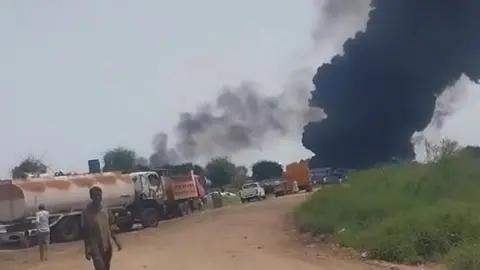
The strikes hit a key fuel trading zone, triggering massive fires that hindered rescue operations. Satellite imagery and verified videos showed extensive burn damage across the northeast quadrant of the market, with large plumes of smoke rising near fuel tankers.
“The market was completely destroyed. The bombing spread terror and fear among the local population,” market trader Fadlallah Adam Hamouda told reporters.
A second trader expressed disbelief over the breach of safety protocols given the presence of over 2,800 UN peacekeepers deployed in the region. “Our area is a weapons-free zone under United Nations protection, yet it was targeted by drones,” he noted, adding that “the attack caused extensive material damage after the fuel market was struck, sparking a massive fire that spread to nearby homes.”
A Sudanese military source confirmed the army executed the Abyei raid, alleging the market functioned as a critical fuel supply point for the rival Rapid Support Forces (RSF). The army maintained that it does not intentionally target non-combatants, even when operating in areas with suspected paramilitary personnel.
The assault has severely heightened diplomatic friction between South Sudan and Sudan. Both nations jointly administer the oil-rich Abyei territory, which has remained unresolved since South Sudan gained independence in 2011. South Sudan has officially summoned Sudan’s ambassador to lodge a formal protest amid growing concerns over cross-border spillover.
Diplomats warn that prolonged military action in Abyei risks entangling South Sudanese forces directly into the broader Sudanese civil war, threatening fragile regional stability across East Africa.
Medical Crisis and Looming Famine
Nearby healthcare facilities struggled to treat the influx of wounded civilians arriving from the burning market. Emergency teams at Ameth Bek Hospital in Abyei town worked continuously to stabilize blast victims.
“So far we received over 20 patients, including several critical cases. Patients with burns were also admitted. We are providing surgical services and wound dressing, along with other emergency care,” said Christian Lindauer, the hospital manager for Médecins Sans Frontières.
The strikes coincide with worsening humanitarian conditions across the nation, where 20 million people face acute hunger and severe famine risks threaten Darfur and Greater Kordofan.
The Greater Kordofan region serves as a strategic corridor linking RSF-controlled Darfur to the capital city of Khartoum. Meanwhile, air warfare continued in the capital on Monday, where air defense systems shot down incoming RSF drones near Khartoum airport, though one strike killed four individuals, including three children.
The United Nations issued a strong condemnation regarding the proliferation of unguided aerial attacks. “We are alarmed by the continued deadly drone strikes across the country that are killing civilians, including children, and that are disrupting essential services,” stated UN spokesperson Stéphane Dujarric.
While a partial international arms embargo remains in place, external supply chains continue to furnish both armed factions with advanced unmanned aerial systems, solidifying combat drones as the primary tactical weapon in a war that has displaced over 14 million citizens.
As remote aerial warfare increasingly replaces conventional ground combat across Sudan’s economic heartlands, the human toll continues to fall disproportionately on displaced civilians and vital commercial infrastructure.
Without enforceable international mechanisms to curb foreign drone inflows or establish verifiable ceasefires, the accelerating conflict threatens to fracture regional diplomacy while deepening one of the century’s most devastating humanitarian catastrophes.