

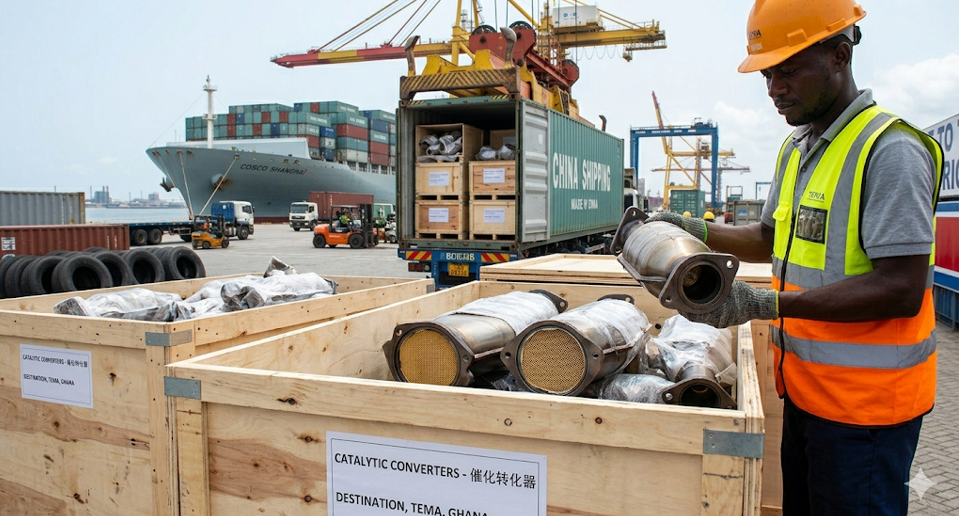
Catalytic converters have been a source of trouble for a number of vehicle owners due to their exorbitant price tag. Unethical roadside mechanics and automobile sellers, who are aware of the high prices of catalytic converters, have often had to secretly remove such devices from the vehicles of their unsuspecting clients, then sell the parts elsewhere.
However, for many drivers, the only way out of such circumstances has been foregoing such parts, since purchasing brand new parts was quite expensive. Today, yet, another development is changing the landscape of the issue. More affordable catalytic converters made in China are starting to be sold on a large scale, providing car owners with another opportunity to replace lost parts without having to pay a hefty price.

The situation might seem like a win-win deal, yet…
This change would be a welcome development because drivers would be able to acquire replacements without spending several thousand cedis on originals.
As mentioned before, this development is not without problems and challenges.
As far as one observes in the market in Tema, some of these cheap converters are of bad quality and wear out quickly while others perform adequately. It all depends on where they were made and by whom sold.
On the other hand, still, availability of cheaper converters might be one of the benefits because there will be less incentive for thefts as the converters become cheaper and more common.
Nonetheless, the problem remains serious.
According to several interviews with mechanics and spare part vendors, there is a significant number of thefts related to catalytic converters both for imported used cars and those circulating in Ghana. In general, it is difficult for car owners to identify the absence of converters until the increase in fuel consumption or engine performance becomes noticeable.
Stealing of the converter does not usually occur secretly as it lies directly beneath a car near the exhaust. Sometimes, mechanics allegedly take away converters during regular services when cars are left overnight for maintenance.
At times, many people including garage employees and even customs officials are involved in the theft. They remove converters and weld the exhaust system back before delivering a car to its owner. There are also suggestions that some dealers remove converters from imported cars and sell them as they are.
The incentive for theft is obvious: converters on local market range from GHS1,200 to GHS2,500 for various models. The models of the vehicles with catalytic converters stolen more often include Corolla, Civic, Accord, Rio, and Camry but larger cars such as Toyota Fortuner are also at high risk.
There might be a suspicion that most used cars being offered for sale nowadays are already without converters.
Nevertheless, the incentive that leads to stealing of converters is likely to result in another consequence – the importation of cheaper converters. The latter become available in Ghana, including China-made converters which cost GHS600 on average. However, as discussed previously, cheap converters have relatively short life span compared to expensive and original ones.
In this case, owners face a serious challenge because after several hands have been involved in the process of importing and selling of a car, identifying the place where the converter was stolen is virtually impossible.
Moreover, diagnosing the lack of a catalytic converter is not easy task as one cannot immediately recognise that the converter is absent by receiving the message “check engine”. Such a message may indicate various problems and to establish the exact problem may require significant amount of time.
Thus, for now, it seems like the choice is clear: spend hundreds of cedis for replacement of expensive catalytic converter, buy a cheap one or live without it.
Post Views: 24
Discover more from The Business & Financial Times
Subscribe to get the latest posts sent to your email.